

Miami Concourse D Expansion Rebuilds D60 Gates by 2030
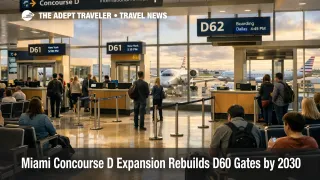
American Airlines and Miami Dade County are moving forward with a $1 billion Concourse D rebuild at Miami International Airport (MIA) that replaces the current D60 regional jet area with 17 indoor, traditional gates targeted for completion by 2030. The practical change for travelers is simple, boarding shifts from outdoor, tarmac level gates that share a single boarding door to indoor gate holdrooms built to handle larger regional jets and mainline narrowbody aircraft.
The project eliminates the current D60 setup where passengers funnel through one common door and then walk outside to aircraft stands, a design that can amplify delay stress during heat, lightning holds, and summer downpours, and it can also create uneven boarding and tight gate area crowding when multiple departures stack. Miami International also says the rebuilt gates will connect directly into the international arrivals processing area on the third floor of Concourse D, paired with new concessions and an enhanced baggage handling system.
One sentence nut graf, the Miami Concourse D expansion is a capacity and process upgrade that removes outdoor boarding at D60 and tightens the connection between gates, arrivals processing, and baggage flow at Miami International Airport.
What Changes for Miami Connections First
If you regularly connect through Miami on American, the most immediate value is operational, not cosmetic. Indoor boarding typically reduces weather driven stoppages, lowers the odds that boarding becomes a ramp level scramble, and gives the airport more flexibility to swap equipment types when the schedule needs it, because the gates are built for a broader set of aircraft than the current D60 hardstands.
The direct tie in to the international arrivals processing area matters because Miami runs a large mix of domestic departures, inbound international flights, and onward connections. When arrivals processing and gate flows are poorly matched, the pain shows up as missed connections and long terminal walks that eat into connection buffers. This project is positioned as an infrastructure fix to that system level friction, not just a gate count headline.
Who Benefits Most From the Miami Concourse D Expansion
American is Miami's leading airline, and it said it runs about 400 daily flights from Miami, with its operation centered in Concourses D and E. That concentration means the travelers most likely to notice the change are American connection passengers moving between regional flights and mainline flights, plus passengers arriving internationally and trying to make a same day onward flight.
There is also a traveler comfort segment that matters, even if it sounds small. Anyone who has been routed through D60 during irregular operations knows the constraint is not only the aircraft, it is the shared choke point at the single boarding door and the outdoor walk. Families, travelers with limited mobility, and anyone carrying tight work timing tend to benefit when the airport shifts boarding inside, because the variability is reduced even when the schedule is not perfect.
Finally, premium travelers tracking Miami will see this as part of a broader American investment stack. American has already said it plans a new Flagship Lounge in Miami and intends to convert the current Flagship Lounge into an expanded Admirals Club. Lounge builds and gate builds solve different problems, but they interact on the same day, crowding and dwell time become more manageable when both seating and boarding infrastructure catch up to demand.
What Travelers Should Do Now
For trips in 2026 and 2027, treat this as a construction era story, not an immediate benefit story. If you are booking tight Miami connections, the safer posture is to keep buffers healthy, because early phase work often shifts pedestrian paths, compresses gate seating, and moves bottlenecks rather than eliminating them on day one.
Use a simple decision threshold when you are choosing an itinerary. If your Miami connection is under 60 minutes and it includes a terminal change, an international arrival, or a late afternoon departure during peak thunderstorm season, buy the longer connection or pick a routing that avoids the D60 area entirely when possible. The tradeoff is obvious, longer connections cost time, but they protect the trip when boarding constraints and ramp holds ripple through the bank.
Over the next 24 to 72 hours before departure, watch for three signals. First, gate assignments that cluster in the D60 area, because that is where the old configuration has the most structural constraint today. Second, schedule changes that swap a regional jet for a larger narrowbody, because that is one of the scenarios the rebuilt gates are meant to handle more cleanly in the future. Third, if you rely on lounge time to make a long connection tolerable, keep an eye on American's Miami lounge construction timelines, since lounge closures and relocations can change how early you want to arrive at the airport.
Why This Project Matters Inside the MIA Plan
This D60 rebuild is a targeted fix inside a much larger modernization program. Miami International frames the work as part of the $9 billion MIA Plan, and that larger effort includes a new six gate Concourse K and central terminal redevelopment, along with baggage and terminal projects that are meant to raise capacity and resilience across the airport.
The mechanism is about removing single points of failure in passenger flow. One shared boarding door feeding 17 outdoor gates is a classic throughput bottleneck, it works on calm days, and it breaks first during disruption days. Replacing that with 17 discrete indoor gates changes the failure mode. Instead of one choke point that can stall the entire regional bank, the stress is distributed across multiple holdrooms, multiple boarding doors, and an interior environment that is less sensitive to ramp constraints.
Second order, this kind of rebuild can reduce missed connection cascades even for travelers who never board at D60. When a feeder bank runs late, it pushes misconnects into later flights, it concentrates rebooking demand at customer service, and it increases checked bag misroutes, especially at a hub where international and domestic flows intersect. Miami is trying to buy down that systemic risk by modernizing the gate environment and the baggage system at the same time, even though the payoff arrives only after years of disruption and phased construction.
Sources
- Miami-Dade County Mayor and American Airlines unveil plans for MIA's Concourse D expansion
- American carries legacy forward with $1 billion investment in MIA concourse expansion
- CIP - Terminal Projects
- MIA Concourse K
- Tranquilo y tropical: American to elevate the travel experience at MIA with new Flagship lounge and expanded Admirals Club