

Carnival Australia Deployment Shift Sends Adventure North 2028
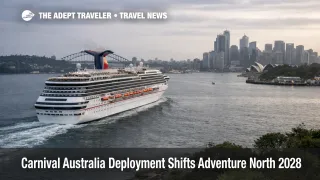
Carnival Australia ship deployment is set to change in a way that matters for availability and pricing, starting in April 2028. Carnival Cruise Line says Carnival Adventure will relocate to North America for the northern hemisphere summer, and then return to Australia seasonally, rather than staying in the region year round. In the same update, Carnival confirmed it will keep two ships sailing year round in Australia, Carnival Splendor and Carnival Encounter, while Carnival Luminosa and Carnival Adventure will split time between Australia and North America.
The practical takeaway is that Australia and New Zealand itineraries that would have relied on Carnival Adventure capacity across every month will become more seasonal, even if the brand continues to market a broad set of homeports in 2027 and 2028. Carnival frames the move as a response to stronger market conditions elsewhere and what it calls an uncertain regulatory environment in Australia and New Zealand, which is a reminder that cruise capacity follows both demand and operating predictability.
Carnival Australia Deployment: What Changes for 2028
Carnival's published plan puts the key inflection point in April 2028, when Carnival Adventure heads to North America for the northern hemisphere summer season. Carnival has not positioned this as an exit from Australia, but it is a clear reduction in year round deployment for that specific ship, and it tightens the math on how much berth capacity is continuously available in the region at any given time.
Under the announced setup, Carnival Splendor and Carnival Encounter remain year round in Australia, which preserves a baseline of continuous supply for travelers who plan far ahead or who want more date flexibility outside peak holiday windows. The swing ships, Carnival Luminosa and Carnival Adventure, become the variable, which is where travelers should expect the biggest differences in sailing calendars, itinerary repetition, and cabin inventory depth across shoulder season months.
Which Travelers Will Notice the Shift First
The travelers most exposed are those who book Australia and New Zealand cruises specifically because they want lots of date options throughout the year, or who rely on last minute inventory to find lower fares. When a ship is no longer committed year round, the calendar becomes more lumpy, which can reduce the number of comparable sailings available to price shop month to month.
Families and groups planning around school holiday periods will still see plenty of options, but they may face higher price pressure on the most popular weeks if the overall pool of sailings is more seasonal. For itinerary planners, the change also matters for port intensive routes and specialty dates, because a ship that is repositioning for another hemisphere tends to cluster itineraries that fit the repositioning logic, rather than offering a steady mix every month.
Travelers who are flexible on ship choice, cabin category, and embarkation port will have the easiest time adapting. Travelers who want a specific ship, a specific week, and a specific cabin type should assume they will need to book earlier as April 2028 approaches, because the most constrained outcome is not a total lack of cruises, it is fewer equivalent substitutes when the sailing you wanted sells out.
What Travelers Should Do Now
For 2026 and 2027 bookings, the immediate action is simple, verify the ship name on the itinerary, and then sanity check the sailing season against your assumptions about year round availability. Carnival says Carnival Adventure will complete its published voyages before the April 2028 relocation, so travelers should treat already published itineraries as the anchor, and treat farther out sailings as the ones most likely to be rebalanced into the new seasonal pattern.
The decision threshold is about flexibility. If the trip is tied to fixed dates, such as school breaks, weddings, or long haul flights already purchased, locking in a sailing earlier is usually the safer move, because alternatives may be fewer in the same month once the seasonal pattern is in place. If the trip is date flexible, waiting can be rational, but only if you are also flexible on embarkation port and ship, because the market can reprice quickly when capacity tightens for a specific window.
Over the next 24 to 72 hours, the main thing to monitor is whether Carnival, major travel sellers, and cruise trade outlets publish additional schedule detail, including which North American homeports and itineraries Carnival Adventure will take during its summer season. That detail will help travelers infer which Australia and New Zealand months are most likely to lose inventory, and which months may remain comparatively well supplied.
Why Carnival Is Making This Move, and How It Ripples
Carnival's stated mechanism is a blend of demand and operating certainty. The company says it is seeing more favorable market conditions elsewhere, and it explicitly flags regulatory uncertainty in Australia and New Zealand. In cruise operations, that combination matters because ships are mobile assets, and the highest return market is often the one with both strong demand and fewer friction costs, including port fees, compliance complexity, and schedule reliability.
The first order effect is straightforward, a ship that is no longer stationed year round removes continuous supply from the local calendar. The second order effects show up in pricing, cabin availability, and itinerary variety. When supply becomes more seasonal, peak weeks can price higher, and travelers can face fewer close substitutes when a sailing sells out. It also changes how shore side partners, ports, and tour operators plan staffing and inventory, because demand concentrates into denser periods, which can make popular shore excursions harder to secure on short notice.
For travelers, the key is not to overreact to the headline, but to plan around the new pattern. Carnival is still maintaining two year round ships in Australia, and it is not eliminating regional cruising. The real change is that certain sailings may become harder to match with alternatives if your first choice disappears, which is exactly the kind of operational detail that should influence when you book, how flexible your flights are, and whether you buy refundable components.