

Europe Border Delays: EES Rollout Still Uneven
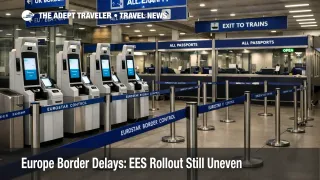
Europe EES border delays are not a future risk, they are a current planning problem because the EU Entry Exit System (EES) is still rolling out unevenly across airports, rail terminals, and ports. New since the last 48 hours of coverage is the clearer operational picture: travelers are seeing mixed procedures from one crossing to the next, with long queues where biometric enrollment is active, and more normal flows where it is not. That unevenness is the point, it creates unpredictable processing times even when nothing else is "wrong" with the trip.
EES requires most non EU travelers entering the Schengen Area to create a digital border record using biometrics, typically fingerprints and a facial image, and then to verify that record at later crossings. The European Commission's launch note described a progressive rollout over six months, with full operation expected by April 10, 2026. The UK government's guidance makes the traveler facing consequence concrete: the process can add minutes per passenger, and it can mean longer waits at the border during busy periods.
Where Delays Hit Hardest, and Who Feels It Most
First time travelers to Schengen since EES began are the most exposed because enrollment takes longer than routine verification. That is true whether arrival is by air, rail, or sea, but it is most disruptive at high throughput pinch points where space is limited and queues back up quickly, including major hub airports, international rail terminals, and ferry ports.
UK side Channel crossings deserve special mention because the checks happen before departure from the UK for travelers entering the Schengen Area via Port of Dover, Eurotunnel LeShuttle at Folkestone, and Eurostar at London St Pancras International, which pulls border time forward into the pre departure schedule. For travelers, that changes the failure mode: border delay can mean missing a timed train, a ferry sailing, or a same day onward plan in France or beyond, even if the hotel and flight pieces look fine on paper.
Travelers with tight self connections are also more exposed, especially itineraries that stack arrival, border control, baggage claim, and an onward train inside a narrow window. The queue risk is not just "longer," it is variable, and variance is what breaks plans.
What Travelers Should Do Before Departure
Build buffers based on crossing type, not based on optimism. For air arrivals into Schengen, treat EES as a variable time add on for first entry, and avoid booking anything non flexible right after landing. For rail and ferry crossings from the UK into France, shift your mindset to "airport style" processing and arrive earlier than you would have before EES, because the checks are completed before you leave the UK, not after you arrive.
Use a simple decision threshold for onward commitments. If your plan includes a fixed event, a pre paid tour, or an onward connection that cannot be rebooked easily, either buy time by taking an earlier service, or add a buffer night on the far side of the border. The tradeoff is boring but real: one extra hour up front can prevent a cascade that forces higher last minute fares, missed trains, and an unplanned hotel.
Plan for mixed day to day conditions through peak periods. Industry reporting and airport operator warnings have centered on summer volume as the stress test, and multiple sources describe member state flexibility to pause or partially suspend EES operations during congestion windows, which is good for flow in the moment but bad for predictability across crossings. In practical terms, travelers should assume the procedure can vary by location and day, and they should not treat a smooth experience on one leg as proof the return will match.
Why the Rollout Stays Uneven, and How Delays Spread
The mechanism is a classic throughput problem. EES adds new steps at the border, and at first use it adds enrollment steps, so each traveler takes longer to process, which reduces hourly capacity unless staffing, lane design, and equipment uptime rise enough to compensate. In real terminals, those compensations lag, so queues form first at the highest volume, least flexible spaces.
First order impact is straightforward: longer biometric registration and verification at the border, and unpredictable queue times at busy entry points. Second order ripple is where it becomes expensive: missed onward trains and flights, more rebooking pressure, and more travelers deciding they need earlier arrivals or extra hotel nights to protect the itinerary. When enough people do that at once, it can also raise demand for airport hotels, taxis, and flexible rail inventory around the same hubs that are already stressed.
The key is to separate "full implementation date" from "steady state performance." Even with the European Commission's target of full operation by April 10, 2026, the lived experience can remain uneven because congestion management tools, local staffing, and terminal layouts are not uniform, and because temporary suspensions can keep the system functional while still producing inconsistent traveler outcomes across locations.
Sources
- EU Entry-Exit System went live 12 October 2025
- EU Entry/Exit System, GOV.UK
- Summer travel disruption fears over new biometric checks at European borders, The Guardian
- EU member states are able to "partially suspend" EU Entry/Exit System during the summer travel peak, International Airport Review
- EU gives countries EES 'flexibilities' to ease summer queues, Business Travel News Europe