

KLM Suspends Amsterdam Tel Aviv Flights From March 2026
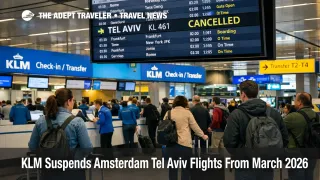
KLM will suspend flights between Amsterdam, Netherlands and Tel Aviv, Israel starting March 1, 2026, removing a key nonstop option for travelers who rely on Amsterdam Airport Schiphol (AMS) as a connector. KLM says the route is no longer commercially or operationally feasible, and it has not published a clear end date for the suspension.
For travelers, the immediate consequence is simple, trips ticketed on KLM to or via Tel Aviv will shift from a single, predictable hub connection into a higher variance itinerary. That usually means a longer total travel day, a higher chance of an involuntary reroute, and more ways for a small delay to turn into a missed onward connection, especially during peak spring travel demand.
Which Itineraries Are Most Exposed
Travelers connecting through Amsterdam are the first group to feel this, because the suspended segment often sits at the end of a long haul arrival bank into Schiphol. When that final leg disappears, the replacement routings tend to push passengers into a different hub, or onto a multi stop path that creates new connection points, new minimum connection times, and new failure modes.
North America to Israel itineraries are also exposed because Amsterdam is a common transatlantic transfer point, and a carrier cancellation on the final segment can cascade into tight same day options when long haul flights arrive late in the European afternoon. Europe based travelers face a different problem, fewer nonstop seats in the market can tighten availability and raise the odds of an overnight in a substitute hub when same day onward flights are full.
Separate ticket travelers are the most fragile case. If you independently booked a long haul into Schiphol and then a separate onward ticket to Tel Aviv, a reroute can break your plan without the same reaccommodation protections you would have on a single ticket. In that scenario, the practical risk is not just the cancellation itself, it is paying twice, once for the new flight, and again for any nonrefundable hotel, tour, or onward transport you miss.
What Travelers Should Do Now
Start by confirming what you are actually ticketed on for March 1, 2026 and later, directly in your booking, not from assumptions based on schedule displays. KLM says it will rebook affected passengers and provide refund options, but it also warns that limited availability can delay when new bookings appear in My Trip or the KLM app.
Use a decision threshold based on how much slack your itinerary has. Rebook immediately if you have a hard arrival deadline, if you are connecting onward on a separate ticket, or if you are traveling during a peak date where you cannot absorb a missed connection without an overnight. Waiting can be rational if you are on a single ticket, you have schedule flexibility, and you can tolerate an extra connection, but you should still push for routings that preserve time buffer rather than chasing the shortest published connection.
When you talk to an airline or agency, ask for protections that match your risk. The practical goal is not just "any reroute," it is a reroute that gives you later same day backup options in the new hub, and avoids tight minimum connections that are easy to miss when the first leg runs late. If the reroute forces an overnight, treat that as a cost and logistics decision, and decide whether a refund and a self reroute on another carrier produces a better outcome for your trip.
Finally, keep your entry preparation aligned with the new routing. When itineraries shift, document checks, transit rules, and airport process time can change, especially if you are routed through a country you did not originally plan to transit. For Israel specific entry planning, use the verified guide Israel Entry Requirements For Tourists In 2026.
Why This Suspension Raises Misconnect Risk
A route suspension is not just a canceled flight, it is a network change that forces the system to re solve thousands of itineraries into fewer remaining seats. The first order effect is capacity removal, fewer nonstop seats between Schiphol and Ben Gurion Airport (TLV), and fewer connection combinations that work cleanly on one ticket. The second order effect is that displaced demand concentrates into alternate hubs, which tightens inventory, and increases the share of passengers traveling on more complex routings.
This complexity matters because misconnect risk is mostly about compounding constraints. Add one more connection, and you add another boarding cutoff, another security flow, another gate change risk, and another point where a small delay can consume your buffer. Add a late arriving long haul into Europe, and the replacement flight may be the last viable departure of the day, which turns a modest delay into an overnight.
The other mechanism to watch is volatility. KLM recently had Middle East flying changes tied to feasibility and security posture, which is a reminder that schedules can tighten, loosen, and tighten again as conditions evolve. That is why the best traveler strategy is to build a short monitoring loop, confirm current ticketing, avoid fragile tight connections, and choose routings with multiple later backups when possible.