

Doha, Dubai Hub Pauses Break Connections Feb 28
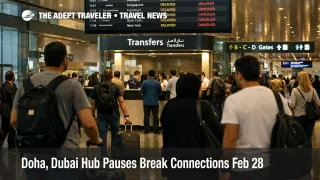
Doha, Qatar and Dubai, United Arab Emirates became high risk transfer points on February 28, 2026, after regional airspace closures and restrictions forced airlines to pause or sharply curtail operations, wiping out the short connection windows many itineraries depend on. Reporting from major outlets described widespread cancellations and reroutes across the Middle East, with Gulf hubs pulled into the disruption as carriers halted flights and airspace constraints spread.
Dubai's airports reported a full stop in flight operations at Dubai International Airport (DXB) and Al Maktoum International Airport (DWC), with passengers advised to follow official channels for restart timing. Separately, flight tracking coverage reported Qatar closing its airspace and major airlines suspending or rerouting flights across the region, which immediately degrades Doha's role as a high reliability connector.
For travelers, the core decision shift is simple. If your itinerary relies on a tight transit at Hamad International Airport (DOH) or DXB, treat it as fragile on February 28, 2026, because even small bank interruptions convert routine transfers into misconnects, involuntary reroutes, and forced overnights.
Which Travelers Are Most Likely to Get Stranded
The highest exposure group is anyone holding short scheduled connections through Doha or Dubai, especially itineraries built around bank timing, for example arriving on one long haul flight and departing within 60 to 120 minutes on a separate onward leg. When a hub pauses, the first failures are boarding cutoffs and gate closures, and the second failures are capacity problems, meaning the next available seat may not be the same day.
Separate ticket travelers are the most financially exposed. If you bought one ticket into DOH or DXB and a separate ticket onward, the onward carrier may treat you as a no show even if the first disruption was outside your control. In practice, that is where costs stack fast, new tickets at walk up prices, lost prepaid hotels, and missed cruise or tour start times.
Travelers checking bags should expect a second distinct failure mode, baggage separation. When airlines reroute or rebook on short notice, bags can remain tagged to the original plan, or they can miss the new departure if the bag system and ramp operations are not running normal flow. This is most common when you are rebooked onto a different flight number, a different carrier, or a next day departure.
What Travelers Should Do Now to Protect Onward Legs
Start with triage, confirm whether your hub is actually operating and whether your inbound aircraft is still coming. Do not rely on the schedule alone, use your operating carrier's app plus airport operations updates, because a hub pause can turn on and off in stages as airspace restrictions evolve.
If you are on one ticket and you have a tight connection, push for a proactive rebook onto an itinerary with slack, not the shortest legal connection. The practical threshold is whether a missed connection breaks the trip purpose. Rebook early if an overnight would cause you to miss a cruise embarkation, a tour start, a work shift, or a family event, because those are the situations where waiting for a perfect same day fix usually fails first during mass reaccommodation.
If you are on separate tickets, act like you are uninsured against chain failure. Ask the first carrier to rebook you to a routing that arrives earlier, or arrives at an alternate hub where you have multiple later backup options. If you cannot move the inbound, then protect the onward by moving it preemptively, even if it costs more today, because last seat pricing and sold out cabins can turn a manageable delay into a multiday delay once banks restart.
At the desk or on the phone, be specific about what you need. Ask the agent to confirm whether your bag is protected to the new routing, and if not, request a plan for baggage delivery. If an overnight is unavoidable, ask what the airline will provide, and what documentation you should keep for reimbursement or insurance, because rules vary by ticket type and by cause. For monitoring, track airline waiver postings, hub operations statements, and flight tracking indicators of staged reopening patterns, because that is often the earliest signal that banks will rebuild.
Why Hub Pauses Break Connections So Quickly
A hub connection plan works because arrival and departure banks are timed, gates are assigned for flow, and minimum connection times assume normal operations. Airspace closures and conflict driven restrictions break that timing at the system level, aircraft may divert, return to origin, or route around closed corridors, which shifts arrival times and causes departure banks to miss their feed.
The first order effect is misconnects and cancellations at the hub. The second order effect is network displacement, aircraft and crews end up in the wrong place, which then forces cancellations in entirely different regions, including Europe and Asia rotations that were supposed to be served by the same equipment later that day. This is why a few hours of hub stoppage can turn into a longer recovery tail, even after restrictions ease.
Finally, capacity compression is what makes rebooking slow. When a major connector pauses, thousands of passengers are pushed onto fewer remaining routings. Even if airports reopen in stages, the backlog competes for limited seats, and the best itineraries, meaning the ones with daylight slack and multiple backups, sell out first. The traveler facing lesson is not abstract geopolitics, it is that "tight" becomes "brittle" at hubs, and brittle itineraries fail at the first shock.
Sources
- Airlines suspend Middle East flights after US, Israel strikes on Iran
- Attack on Iran disrupts flights across the Middle East and beyond
- Israel launches "pre-emptive" strikes on Iran, airspace closures going into place
- Dubai suspends flights at DXB and Al Maktoum airports amid regional tensions
- All flight operations at DXB, DWC suspended until further notice