

Buenos Aires Downtown Closures, March 1, 2026
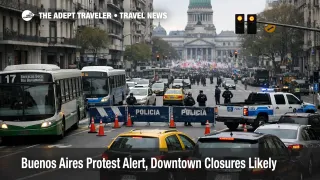
Buenos Aires downtown closures are likely on March 1, 2026, as security perimeters and street restrictions build around Argentina's Congress for the opening of ordinary sessions, with the ceremony scheduled for 9:00 p.m. local time. This is different from the February 27, 2026 demonstration day alert that some travelers may have seen earlier in the week. Today's risk is a managed access footprint around Congress that can still create the same traveler failure mode, your transfer time stops being predictable, and fixed commitments like flights and timed bookings become harder to protect.
For visitors, the key takeaway is simple. If you are staying central and need to cross downtown, assume detours and slower travel, especially late afternoon into the evening when restrictions are expected to tighten.
Which Travelers Are Most Exposed to Downtown Restrictions
Travelers based in Microcentro, Congreso, Monserrat, San Telmo, and nearby central corridors are the most exposed, because even short trips can run into barricaded blocks and forced reroutes. Anyone trying to move from a central hotel to Jorge Newbery Airfield (AEP) or Ministro Pistarini International Airport (EZE) faces elevated timing risk, because the most common routes often rely on downtown arteries that can slow sharply once a perimeter is active.
Even if your destination is not Congress, the spillover matters. When traffic is redirected onto fewer streets, congestion propagates outward, which is why travelers in Palermo and Recoleta can still see longer rides even if they never planned to go near the Congress district.
What Travelers Should Do Now
If you have a flight, treat the problem as a clock risk, not a distance problem. Leave earlier than usual from central Buenos Aires, and expect your driver to reroute more than once. The tradeoff is idle time at the airport versus a missed check in window, and on restriction days the reliable choice is usually to buy the buffer.
If you have timed tours or evening commitments that require crossing downtown, shift them earlier, or plan a route that avoids the Congress area corridors. If you cannot shift, build flexibility into the meeting point, including walking a few blocks to a pickup spot outside the restricted perimeter if your hotel frontage is impacted.
If you are moving between hotels, keep it simple. Avoid stacking check out, a cross town transfer, and a fixed time booking into one tight window. On a perimeter day, one delay often cascades into the next commitment.
Why These Closures Create Wider Travel Delays
Large security perimeters near Congress tend to create "pinch points," because closures are not just one street, they are a connected set of blocks that changes how vehicles can traverse downtown. Once a few key crossings become unavailable, traffic concentrates onto the remaining avenues, which raises travel time variance even outside the immediate zone.
This is also why protest days and security days can feel similar operationally, even when the cause is different. A February 27, 2026 security advisory about a planned demonstration outside Congress emphasized the same traveler mechanics, road closures, heavy traffic, and advice to avoid the downtown core. The actionable lesson is the same, plan for detours, protect your time critical moves, and avoid treating central cross town transfers as fixed duration.