

Cuba Jet Fuel Shortage Clouds March Travel Plans
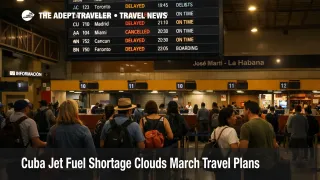
Cuba travel outlook is still workable for travelers who can absorb disruption, but the next few weeks are not a "set it and forget it" window. Jet fuel constraints in Cuba have pushed some airlines to suspend or modify service, and that matters most for travelers connecting through Havana, Cuba, or trying to keep a tightly timed itinerary. At the same time, daily power outages, and fuel shortages are creating operational friction that can show up as slower transport, weaker backup power, and more limited services. If your trip depends on specific flight days, fixed tours, or onward connections, the safest move is to build buffers, or postpone.
The Cuba travel outlook for early March 2026 is defined by transportation reliability, not a blanket closure.
Cuba Jet Fuel Shortage: What Changed for March Travel
Cuban aviation authorities have warned airlines that Jet A 1 fuel may not be available for international refueling at key airports from February 10, 2026, through March 11, 2026, which increases the risk of cancellations, schedule changes, and technical fuel stop planning. Some carriers can still operate by tanker fueling, adding intermediate stops, or adjusting aircraft utilization, but those workarounds reduce flexibility, and airlines tend to cut marginal flights first when reliability is uncertain.
For travelers, the immediate consequence is simple. Even if Cuba remains open to visitors, flights can become the weak link that breaks the trip, especially when you are traveling on a single weekly frequency, you have nonrefundable lodging, or you have a same day onward connection. The practical way to read this is that the calendar matters. Trips departing or returning before March 11, 2026, should be treated as higher risk for last minute airline changes than a typical shoulder season week.
Which Travelers Can Still Do Cuba Smoothly, and Who Should Wait
The trips most likely to go smoothly over the next few weeks are the ones with slack in the system. That includes travelers who can accept arriving a day later, who can stay longer if a return flight is disrupted, and who are not building the trip around a fixed start, such as a wedding, a cruise embarkation, or a conference check in. Travelers staying primarily in Havana, Cuba, or in a single resort area with arranged transfers are also better positioned than travelers trying to string together multiple cities on a tight timetable.
The highest exposure group is anyone trying to run Cuba like a high precision itinerary. If you are relying on a specific flight day, a specific carrier frequency, or a same day connection, the jet fuel constraint window turns normal travel friction into a real trip failure risk. The second high exposure group is travelers who are not prepared for infrastructure variability. The U.S. State Department and the U.S. Embassy in Havana have both highlighted unreliable electrical power, and fuel shortages that can affect transportation, and the ability of some businesses to sustain generator backup during longer outages. That does not mean every hotel fails, but it means you should plan as if services can degrade, especially outside the capital.
What Travelers Should Do Now, and the Thresholds That Matter
If you are already booked, start by making your flight the anchor, and everything else flexible. Avoid same day onward connections, add at least one buffer night on each end if you cannot tolerate missed flights, and consider choosing lodging that can clearly describe its backup power plan rather than assuming it is fine. If you are traveling as a family, or with medical needs, treat refrigeration, elevator uptime, and air conditioning as items you should verify, not just amenities.
The decision threshold is timing. If your trip is built around fixed dates, limited flight frequencies, or you cannot add buffer days, postponing is rational because the downside is asymmetric, you can lose multiple trip days to a single cancellation. If you can float dates, and you are comfortable adapting, you can still travel, but you should book with change flexibility, and keep your itinerary simple.
Over the next 24 to 72 hours, monitor three things. First, airline schedule changes for your exact flight numbers, not just generic headlines about Cuba. Second, any extension, or early end, of the March 11, 2026 fuel constraint window, because that is the operational hinge for near term flight reliability. Third, local power and fuel conditions, because those shape what you can reliably do once you arrive, including transfers, and day trips. This is the core of the Cuba travel outlook, and it is the difference between a trip that bends, and a trip that breaks.
Why This Is Happening, and How the Disruption Spreads Through Travel
Jet fuel constraints create disruption in layers. The first order effect is aircraft planning. Airlines either cannot refuel normally in Cuba, or they treat refueling as unreliable, which forces decisions like tanker fueling from the origin, adding a technical stop elsewhere, or reducing frequency. Any of those choices makes schedules more brittle because they increase cost, reduce operational margin, and consume aircraft, and crew time that would otherwise absorb delays.
The second order effect is that schedule changes concentrate passenger demand into fewer flights. That is where rebooking fails, because there are fewer seats, fewer frequencies, and limited alternatives on the same city pair. When that happens, travelers see knock on consequences like forced overnights, baggage delays, missed connections, and cascading changes to hotels, tours, and transfers.
Power outages and fuel shortages compound the problem on the ground. Outages can affect water supply, lighting, refrigeration, and communications, and fuel shortages can tighten transportation availability. Even in tourism corridors, the traveler experience can become more variable, and your plan has to account for it. The near term picture, through at least mid March, is that Cuba is not uniformly "untravelable," but it is also not a destination where you should expect airline normalcy, and infrastructure stability at the same time. That is the operational reality shaping the Cuba travel outlook for the next few weeks.
Sources
- U.S. Department of State, Cuba Travel Advisory (updated May 7, 2025): https://travel.state.gov/content/travel/en/traveladvisories/traveladvisories/cuba-travel-advisory.html
- U.S. Embassy Havana, Security Alert (February 3, 2026): https://cu.usembassy.gov/security-alert-u-s-embassy-havana-cuba-february-3-2026/
- Cayman Airways, notice on Cuban jet fuel NOTAM window (February 10, 2026): https://www.caymanairways.com/cal-monitoring-havana-jet-fuel-shortage
- Reuters, Cuban jet fuel warning and airline disruptions (February 9, 2026): https://www.reuters.com/business/energy/cuba-warns-airlines-it-will-run-out-jet-fuel-2026-02-09/
- Associated Press, Canada aid and Cuba fuel, energy impacts, and flight disruption context (published February 2026): https://apnews.com/article/5a85ec96af31c787b51c0f8b9720f968