

Japan Power Bank Rules Cap Two, Ban Use From Mid April
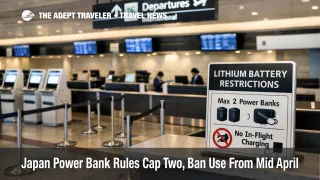
Japan is moving to tighten cabin rules for power banks, limiting passengers to two units and effectively ending in flight use starting in mid April 2026. The Ministry of Land, Infrastructure, Transport and Tourism (MLIT) opened public comments on February 27, 2026, on a planned revision that would prohibit charging a power bank onboard, and prohibit charging other devices from a power bank during flight, even when the power bank is allowed in the cabin.
For travelers, the practical change is simple: if you rely on a power bank to get through a long domestic hop, a multi segment day, or a connection buffer, you should assume you will not be allowed to use it in flight on Japan based carriers, and you should plan around seat power or pre charged devices instead. The proposal is also meant to align Japan with a fast moving international push for clearer, stricter cabin handling of lithium battery packs, with MLIT pointing to International Civil Aviation Organization (ICAO) discussions expected in late March.
Japan Power Bank Flight Rules: What Changes In Mid April
Under MLIT's proposed approach, passengers would be limited to two power banks in the cabin, and the limit would apply regardless of capacity, as long as each unit is 160 watt hours or less. Power banks above 160 watt hours would remain prohibited. The key operational shift is the onboard behavior rule: passengers would be told not to charge the power bank itself onboard, and not to use the power bank to charge phones, laptops, or other devices during flight.
MLIT's timeline points to mid April 2026 for the new standard to start. Public comments are being accepted through March 30, 2026, which is the window where details can still be adjusted before final adoption.
Which Travelers Will Feel This Most
This hits travelers who plan to "self power" through the day: long haul passengers connecting through Japan, domestic flyers on tight same day itineraries, and anyone using older devices whose batteries do not reliably last gate to gate. It also changes the calculus for travelers who pick seats, cabins, or aircraft types based on whether reliable seat power is available, because you should not assume you can fall back to a power bank once the doors close.
There is also a group that gets caught by enforcement friction rather than the rule itself: travelers carrying multiple small power banks, photographers with battery packs, and business travelers with a "tech pouch" that quietly accumulated more than two power banks over time. Under the proposed cap, those travelers will need to consolidate, leave extras at home, or move to alternatives like airline seat power, or a single larger capacity unit that stays under 160 watt hours.
What Travelers Should Do Before Departure
Start with a quick watt hour check and a consolidation pass. If your power bank is labeled in milliamp hours, convert it before you fly, because airline enforcement is typically based on watt hours. Then, assume you can carry up to two power banks, but you will not be allowed to use them in flight, even if your seat has an outlet.
Next, plan your "no power bank in flight" strategy. Fully charge devices before boarding, download content over hotel or lounge Wi Fi, and bring the right cable for seat power if your aircraft provides it. If you have a must arrive charged use case, for example medical devices that are supported by a phone app, or work requirements on arrival, build in airport charging time before boarding, and avoid landing with a near empty phone.
Finally, treat this as a packing plus monitoring problem until the rule is finalized. Because MLIT is taking comments through March 30, 2026, and tying its approach to an ICAO decision expected in late March, travelers should recheck airline guidance when check in opens, especially for April departures.
Why The Rule Is Changing, And Why It Is Focused On Cabin Use
The core risk MLIT is responding to is lithium battery thermal runaway in the cabin, especially when a battery pack is damaged, defective, or gets crushed and overheats out of sight. High profile events made the risk legible for regulators and airlines. South Korean investigators have pointed to a spare power bank as a possible source of a January 28, 2025, fire that destroyed an Air Busan Airbus A321 at Gimhae International Airport (PUS), an incident that triggered broader scrutiny of where these devices are stored and how quickly crews can detect a problem.
Japan has also had recent events involving smoke or overheating from portable batteries, reinforcing the operational point that the most important control is early detection and fast response in the cabin. That is why airlines have been pushing passengers to keep power banks within reach rather than in overhead bins, and why the new approach targets onboard use, not only carry on eligibility.
The second order effect is consistency. Airlines around the world have been moving in parallel, but not always in the same way, which creates traveler confusion and uneven compliance. MLIT is explicitly framing its update as an alignment step with an ICAO standard change that could be adopted as early as late March, which is the path toward fewer surprises for travelers who fly multiple carriers on one trip.
For travelers, the bottom line is not that power banks disappear from cabins. It is that Japan is trying to make them easier to control by limiting quantity and removing the most common ignition and escalation behaviors, charging, and active use during flight, when a failure can spread quickly if it happens in an unseen bag.