

Mayon Volcano Alert Level 3 Limits Tours, Drives
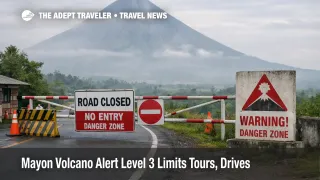
Southern Luzon travel planning has an active hazard signal because Mayon Volcano Alert Level 3 remains in effect on March 2, 2026, with continuing lava activity, rockfalls, and pyroclastic density current signals reported in recent monitoring updates. For travelers, the practical change is that close range sightseeing is not a normal "show up and decide" situation right now, and the disruption can jump from tours and road access to aviation routing cautions if ash output or wind conditions shift. The most important near term decision is whether your itinerary depends on guaranteed access to Mayon viewpoints, fixed time tours near the volcano, or same day connections that do not tolerate a detour or cancellation.
Mayon Volcano Alert Level 3: What Changed For Travelers
Mayon's activity is being reported as ongoing, including lava effusion and collapse from the summit crater, plus hazards such as rockfalls and pyroclastic density currents, with the six kilometer Permanent Danger Zone described as strictly off limits. For visitors, that translates into a higher chance of last minute operator cancellations, checkpoint driven reroutes on roads nearest the volcano, and tighter control over where vehicles and people can legally go, even if the weather in Legazpi, Philippines looks calm.
This update matters because it is the kind of situation where a trip can feel "fine" until it suddenly is not. The first order impact is that access closest to the volcano is constrained, and tours that sell proximity are the first to break. The second order ripple is that once a few tours cancel or roads slow, hotel check in times, driver schedules, and onward transfers compress, and that is where travelers start missing the next segment of a multi stop Luzon plan.
Which Itineraries In Albay And Bicol Are Most Exposed
The highest exposure sits with travelers basing in Legazpi, Philippines or Daraga, Philippines specifically to see Mayon up close, and with anyone who booked a fixed time viewing plan, a private driver with a tight loop, or an excursion that assumes unrestricted slope access. Travelers who are combining Mayon sightseeing with same day flights are also exposed, because aviation guidance for volcanoes is conservative by design, and pilots may be advised to avoid flying near the summit due to ash risk from sudden activity.
If you are flying into the region, Bicol International Airport uses the IATA code DRP, and it sits in the same provincial travel system that absorbs delays when roads or tours change at the last minute. A flight can operate normally, but the real failure mode is that your ground plan assumes a specific arrival time, and that plan breaks when a tour cancels, a road segment is controlled, or you have to reposition to a safer, permitted viewpoint.
What Travelers Should Do Now
For trips within the next 24 to 72 hours, treat Mayon viewing as optional, not guaranteed. If the purpose of your Albay stop is the volcano itself, the resilient move is to shift to refundable lodging, avoid prepaid close range tours, and keep your driver day flexible so you can substitute a farther viewpoint or a different local activity if access tightens. If your itinerary is broader, protect the harder to change segments, like flights out of the region, or timed starts for tours elsewhere in Luzon, and allow extra buffer for any day that includes Mayon area driving.
Use a simple decision threshold instead of hoping conditions hold. If official reporting continues to describe hazards like pyroclastic density currents and heavy rockfall activity, or if local enforcement expands checkpoints beyond the usual perimeter, treat that as a trigger to move the Mayon day off the calendar, rather than waiting until the morning of the tour. If you must keep dates, build slack by adding a buffer night before any flight, or by moving your flight earlier in the day so a same day road or tour disruption does not cascade into a missed departure.
Why This Hazard Disrupts Tours, Roads, And Flights
Alert Level 3 is not a tourism label, it is an operational warning that hazardous phenomena are more likely because magma is pushing up inside the volcano. That is why authorities keep a no entry zone in place, and why tour access can change quickly, even without a dramatic new eruption headline. When a volcano produces rockfalls, pyroclastic density currents, ash emissions, or lava flows, the system response is layered: first, restrict people and vehicles from areas where fast moving hazards can travel; next, adjust road access and tour operating decisions; then, apply aviation avoidance guidance if ash becomes a concern for aircraft engines, visibility, or air routes near the summit.
For travelers, the mechanism is why "I will decide when I get there" is the wrong mental model. A Mayon day trip depends on permissions, road conditions, and operator risk tolerance, and those can flip in hours. The smart play is to build an itinerary that still works if you never get close to the volcano, and to monitor official alert status before you commit money to nonrefundable tours. Mayon Volcano Alert Level 3 is, in practice, a volatility flag, and volatility is what breaks tight schedules.