

Chicago O'Hare Summer Flight Cap Planned by FAA
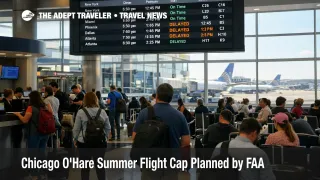
The Federal Aviation Administration is moving to rein in planned summer flying at Chicago O'Hare International Airport (ORD), warning airlines that the schedules they have filed exceed what the airport can reliably handle. In practical terms, this is the FAA signaling that "busiest summer ever" at O'Hare is not a badge, it is a delay risk, and the agency is preparing to force schedules back toward a level it says matches today's runway, terminal, and air traffic control limits.
The filing volume the FAA is reacting to is steep. Peak summer days are currently showing more than 3,080 total daily takeoffs and landings, up from about 2,680 last summer, according to reporting that cites FAA concerns. The FAA has framed roughly 2,800 daily operations as manageable under current infrastructure and staffing, and it is proposing to align the summer schedule to that reality to avoid system-wide irregular operations at one of the country's biggest hubs.
O'Hare Summer Flight Cap: What Changed for Travelers
The immediate traveler relevance is not that flights vanish overnight, it is that airlines may have to trim published schedules for the core summer season, which runs from March 29 through October 25, 2026. The FAA has publicly set up a scheduling reduction process that points toward operating limitations in a final order, rather than relying on carriers to self-police growth.
For travelers, the risk window is broad, and it is concentrated in the exact periods people care about most, morning and late afternoon departure banks, tight connections, and peak weekend demand. If the FAA forces schedule cuts, the first-order impact tends to show up as timetable changes, fewer marginal frequencies, and more aggressive reaccommodation when weather or staffing turns a normal delay day into a cancellation day. The second-order impact is that a right-sized schedule often reduces cascade risk, meaning fewer late-day meltdowns that strand connections, separate bags, and force last-minute hotel nights.
Which Trips Are Most Exposed at Chicago O'Hare
Travelers most exposed are anyone building a same-day chain that depends on O'Hare running at peak throughput with no slack. That includes short connections, especially where the inbound is a regional flight and the outbound is long-haul, and itineraries built on separate tickets, where a missed connection becomes a self-funded problem.
The other group to watch is spring break through early summer bookings, because both United and American have already been advertising growth out of Chicago, which is part of why the schedule filings surged. United has described Chicago as a major growth focus, and has promoted a record seasonal schedule from O'Hare in public announcements. Even if your specific flight is not cut, a cap that reshapes peak banks can change connection options, minimum connection comfort, and same-day rebooking availability across a carrier's network.
What Travelers Should Do Now
If you are booking summer 2026 travel through O'Hare, prioritize itineraries with slack that you control. Choose earlier departures when you can, build longer connections, and treat the last flight of the day as higher consequence, because reaccommodation options shrink fast when capacity is constrained by design.
Use a decision threshold for protection: if your trip has a fixed start, such as a cruise departure, a wedding, a conference keynote, or a paid tour with timed entry, avoid same-day tight connections through O'Hare during peak periods. Either connect with more buffer, or overnight in Chicago, Illinois, so a single rolling delay does not break the entire itinerary.
Finally, monitor for schedule changes after the FAA process dates, not just for day-of delays. Airlines typically push schedule updates into apps and emails, but you should also re-check your booking periodically, especially 30 to 45 days before departure, and again in the final two weeks, because that is when frequency trims and retimings often become obvious in seat maps, connection options, and flight numbers.
Why the FAA Is Stepping In
The mechanism is capacity realism. An airport can look fine on an average day and still fail on peak banks, because runways, gates, baggage systems, ramp staffing, and air traffic control spacing rules all interact. When carriers publish schedules beyond demonstrated throughput, the system has no recovery margin, so a routine disruption, such as thunderstorms, a runway configuration change, an equipment issue, or staffing gaps, can create long delay tails and late-day cancellation waves.
The FAA is formalizing that concern through a scheduling reduction meeting process. In the Federal Register public inspection notice, the FAA says it will host opening remarks on March 3, 2026, at 300 p.m., and hold the scheduling reduction meeting on March 4, 2026, beginning at 900 a.m., with written information requested by March 11, 2026. Separately, Reuters reported a March 3 meeting date for discussions with major carriers, which aligns with the FAA's March 3 opening remarks and the March 4 working session described in the notice.
This is not unprecedented. The FAA has used similar schedule management to curb overscheduling and protect reliability at other high-stress airports, including Newark Liberty International Airport (EWR), where caps were used to keep demand aligned with deliverable capacity during constraints.
Sources
- Operating Limitations at Chicago O'Hare International Airport, Notice of Meeting and Request for Information (Public Inspection PDF)
- FAA plans to reduce flights at Chicago O'Hare, cites boost in schedules (Reuters)
- United and American Fight at Chicago's O'Hare Draws Federal Scrutiny (The Wall Street Journal)
- United Expects Biggest Summer Yet at Chicago O'Hare (United Newsroom)