

Kilauea Forecast Window March 8 to 15, Park, Air Risk
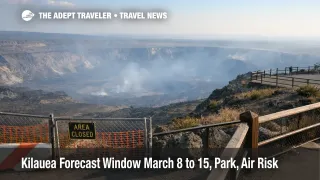
Kīlauea's summit eruption is currently paused, but the U.S. Geological Survey Hawaiian Volcano Observatory says preliminary models point to March 8, 2026 through March 15, 2026 as the most likely window for the next lava fountaining episode to begin. That forecast does not mean an eruption will start on a specific day or at a predictable hour, but it does give travelers a decision window where park access rules, viewing area management, and some tours can change with little notice.
For most airline passengers, this is not an ash cloud crisis signal, the summit activity is occurring within a closed area of Hawaiʻi Volcanoes National Park, and recent USGS updates emphasize monitoring and hazards management rather than widespread off summit activity. The more common traveler facing friction in this kind of summit episode is operational: sudden parking and traffic surges at popular overlooks, temporary area closures, and volcanic gas and vog shifting with wind, which can make outdoor plans uncomfortable or unsafe for sensitive travelers.
Kilauea Forecast Window: What Changed for Travelers
What changed versus a normal "volcano is doing volcano things" headline is that USGS HVO is publishing a time bounded forecast window for the likely onset of the next fountaining episode, March 8, 2026 to March 15, 2026, after episode 42 ended on February 15, 2026 at 11:38 p.m. HST. In plain terms, the volcano is quiet right now, but the monitoring team is seeing patterns that often precede the next short, intense burst of lava fountaining at the summit.
Travelers should treat this as a volatility window, not a guarantee of dramatic viewing. A fountaining start can bring a fast tightening of where people can stand, where vehicles can park, and what tour operators will run, even if conditions look calm earlier the same day. The practical advantage is you can plan buffers now, instead of improvising after the park changes traffic flow or closes a corridor.
Which Big Island Trips Are Most Exposed
The highest exposure is travelers whose Big Island itinerary depends on a specific, timed Kīlauea viewing plan inside Hawaiʻi Volcanoes National Park, especially if it is chained tightly to hotel check in, dinner reservations, or a next morning departure. When a summit episode begins, the first order impact is usually not "the park closes," it is that the most popular access points and viewpoints become capacity constrained, and the park may adjust closures and routing to keep people out of hazardous areas and to manage crowds.
The second exposure group is travelers booking flightseeing or air tours that market lava viewing. Even without ash, operators may alter routes, timing, or cancel if visibility drops from haze, if volcanic gas concentrations are a concern, or if airspace and safety considerations shift around the park environment. That is especially relevant during a forecast window because you can get a surge of demand and more conservative operating decisions at the same time.
A third exposure that is easy to miss is travelers arriving or departing the island on the same day they plan to chase conditions. If you are flying into Ellison Onizuka Kona International Airport at Keahole (KOA) or Hilo International Airport (ITO) and then driving straight to the park, your real risk is not the flight, it is the ground timeline. A sudden viewing opportunity can tempt travelers into late returns, while a sudden closure or air quality downgrade can strand plans in traffic and parking churn.
What Travelers Should Do Now
If your trip touches the park during March 8, 2026 through March 15, 2026, the resilient move is to build optionality into the Kīlauea day. Keep lodging refundable where you can, avoid stacking a must do volcano window on the same day as a hard departure, and assume you may need to shift the viewing attempt earlier or later by several hours based on park management and conditions.
Use a simple decision threshold for tours. If your operator cannot clearly explain what happens if the episode starts late, if the park changes access, or if vog becomes unhealthy, you should treat that booking as fragile and either choose a more flexible operator or hold off until closer in. Waiting can be the better trade if you do not need a specific day, because the forecast window is a probability band that can move as new deformation and gas data come in.
For air quality, plan a fallback loop inside the park. Hawaiʻi Volcanoes National Park explicitly warns that winter light or southerly winds can push volcanic gas and vog into visitor areas near Kīlauea summit, and the right response is to change your location in the park rather than trying to gut it out. If anyone in your party has asthma, COPD, cardiovascular concerns, or is simply sensitive to irritants, treat vog warnings as a hard constraint, not an inconvenience.
Why This Window Can Change Access and Local Air Conditions
USGS HVO describes the current summit activity as episodic, short fountaining bursts separated by pauses that can last more than two weeks. That rhythm is exactly why access can feel stable for days and then change quickly, because the hazard posture and visitor management needs are different when lava fountaining resumes inside the summit area.
The air piece is mostly about gas and wind, not ash. Vog forms when sulfur dioxide emitted from the volcano reacts in the atmosphere, creating haze that can be both a health issue and, at times, a visibility annoyance for scenic plans. Wind direction determines who gets the worst of it on a given day, which is why dashboards and real time maps matter more than generic "vog season" advice.
For aviation, the key mechanism is operational conservatism under uncertainty. Volcanic ash is the major aircraft hazard, and the national aviation system has formal ash response planning, but in this specific USGS reporting cycle the traveler relevant risk signal is localized and conditional: if conditions produce haze, if operators see deteriorating visibility, or if safety constraints tighten around the park environment, you can see tour cancellations and minor schedule shifts without any broad commercial airline shutdown.
If you want the most practical monitoring stack as the window approaches, anchor on the USGS HVO notices for the next episode forecast, the park's current conditions and air quality guidance, and the statewide air quality maps for SO2 and particulate levels. Those three sources will usually tell you what you need to know before social media does.
Sources
- USGS HVO Notice, Kīlauea summit eruption paused, forecast window March 8 to 15 (March 1, 2026)
- USGS HVO Notice, Kīlauea episodic eruption status and monitoring (March 2, 2026)
- Hawaiʻi Volcanoes National Park, March 2026 events and updates, air quality guidance
- IVHHN Vog Dashboard, current air quality maps and visitor advice
- National Volcanic Ash Operations Plan for Aviation (2024)