

Azamara 2028 World Cruise Segments Now Open
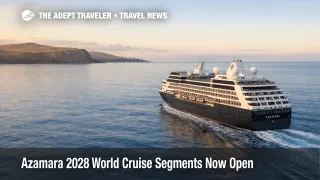
Azamara 2028 world cruise segments are now open for booking, letting travelers buy into parts of the line's full 175 night world cruise instead of committing to the entire voyage. Azamara is selling 14 segments, nine "Grand Voyages," and six combination cruises that all draw from the same global itinerary aboard Azamara Onward. The practical change is flexibility, you can target one region, or stitch multiple regions together, while still getting many of the marquee ports the full world cruise is built around, including Easter Island, Pitcairn Island, Komodo Island, Ho Chi Minh City, Bangkok, Singapore, Cape Town, and Florence.
The decision point is timing. Segment inventory tends to behave like a best of list, the most "rare port plus good weather window" combinations are usually the first to tighten, especially once advisors start packaging flights and hotels around fixed embarkation and disembarkation ports. If you are considering any long, flight intensive segment, the best move is to price flights and cabins in parallel, because the best cabin choices can disappear long before air becomes cheap or convenient.
Azamara 2028 World Cruise Segments: What Changed
Azamara has opened bookings for partial versions of its 2028 World Cruise itinerary, specifically 14 World Cruise Segments, nine Grand Voyages, and six Combination Cruises, all on Azamara Onward. This follows the earlier announcement that the full world cruise spans 175 nights and is structured to be sold in multiple pieces, not only as one continuous sailing.
In plain terms, this is Azamara turning a single, calendar consuming cruise into a menu. Travelers can treat one segment as a self contained trip, or combine segments into a longer "mini world cruise" without needing to be away for nearly six months. Azamara's own positioning is that these options are meant to preserve the "world cruise" style of travel, more unusual calls and deeper time in destinations, while lowering the commitment threshold for travelers with limited time windows.
Who These 2028 Options Fit Best
These segment and Grand Voyage options are best for travelers who want world cruise level routing but cannot, or will not, commit to the full sailing. The clearest fit is the traveler who wants one high friction region to be handled by the ship, for example remote Pacific calls such as Easter Island and Pitcairn Island, or a Southeast Asia run that bundles multiple countries without repeated hotel changes.
They also fit travelers who care about itinerary depth more than ship size, because Azamara's brand proposition leans toward longer stays and a more destination heavy pace compared with mainstream megaship patterns. If you want a resort at sea with a heavy onboard attraction stack, this product can be the wrong tool. If you want to wake up in a new place and spend real time ashore, this structure is designed for that.
For planners and advisors, the segmentation matters because it changes how you de risk the trip. Instead of insuring and logistically supporting a single 175 night commitment, you can choose one segment with clean flight endpoints, or two segments that minimize forced one way international airfare pain.
How To Book, and How To Avoid the Common Traps
Start by choosing your constraint first, time window, budget ceiling, or a must have destination, then back into the segment that matches. Because this is a world cruise derivative, embarkation and disembarkation ports may be far from major nonstop air markets, and the wrong endpoint can add a full extra travel day each way. Before you place a deposit, verify the exact port, date, and time for both embarkation and disembarkation, then sanity check flights that actually work on those days.
Next, decide whether you are buying a single chapter or building a longer arc. If you are tempted by a Grand Voyage or a combination cruise, price it both ways, as the packaged longer option, and as its component segments, because promotions and category availability can make the math non intuitive. Also treat visas and entry rules as a planning gate, not an afterthought. A segment that touches multiple countries can trigger passport validity rules, visa lead times, and proof of onward travel expectations that are easy to miss if you only look at the headline destinations.
Finally, be realistic about the tradeoff. A segment reduces the time commitment, but it does not necessarily reduce complexity. Long distance repositioning flights, jet lag, and luggage logistics still apply, and they can be more demanding when your cruise ends far from where your next flights are easiest. Build at least one buffer night at the end of the cruise if you have a hard commitment at home, because long haul air disruptions compound fast when you are departing from smaller gateways.
If you want the broader world cruise context, including the full voyage framing and why Azamara built it as 14 pieces, see 2028 World Cruise From Miami To Athens With Azamara. For a quick refresher on why this ship size category changes port access and onboard feel, see Medium-Sized Cruise Ships: The Perfect Balance of Comfort and Adventure.
Why The Segment Model Changes Traveler Outcomes
The mechanics are straightforward. When a cruise line sells one long world cruise, it concentrates demand into a tiny buyer pool that can travel for months. When it sells the same itinerary as segments, it opens the market to travelers who can do two weeks, a month, or a region at a time, and that usually increases overall demand for the most distinctive parts of the route.
First order, segment booking tends to tighten availability in the most "storybook" ports, remote islands, wildlife heavy calls, and classic cities, because those are the pieces travelers recognize and will buy as a standalone trip. Second order, air pricing and hotel inventory can become the real bottleneck, not the cruise fare, because segment endpoints can be capacity constrained gateways where the best flights sell out early, or where an extra overnight becomes expensive in peak season.
There is also a risk management upside. Travelers who only book a segment are less exposed to the cumulative fatigue, health risk, and schedule drift that can show up on very long voyages. But they can be more exposed to flight irregular operations at the endpoints, because they have fewer "spare days" built into their personal calendar. That is why endpoints, buffers, and insurance terms matter as much as the port list when you book a world cruise segment.