

Brussels Airport Halts Departures for March 12 Strike
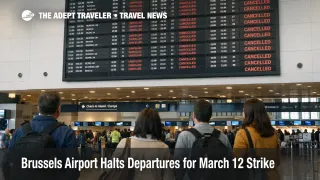
Brussels Airport (BRU) will run zero departing passenger flights on March 12, 2026, after the airport said a national strike involving parts of its security and handling staffing would make normal operations unsafe. The airport says the decision was made in consultation with airlines, and it also warned that some arriving passenger flights could be canceled.
This is a hard operational stop, not a soft risk item. For travelers, it means any itinerary that relies on a March 12 departure from BRU should be treated as non viable, and any itinerary that connects through BRU that day should be treated as highly breakable once feeder flights start canceling and rebooking queues surge.
Brussels Airport's passenger advisory is direct: airlines will contact passengers in the coming days with options, and the airport's flight overview will only show cancellations once each airline registers them.
Which Travelers Face The Most Disruption
The most exposed travelers are those scheduled to depart BRU on March 12, and anyone connecting through Brussels on separate tickets. The first group loses the entire departure bank. The second group risks cascading failures, a canceled inbound feeder, a missed long haul connection, and a reprice into last seat inventory on alternative hubs.
Inbound risk is real but uneven. Brussels Airport says cancellations of some arriving flights are possible. In practice, airlines often trim arrivals when they cannot reliably turn aircraft, staff gates, or move crews onward, especially for short haul rotations that would normally depart again the same day. Long haul arrivals may also be adjusted if the aircraft would otherwise be stuck out of position for March 13 flying.
If your trip has a fixed event on March 12 or March 13, the second order exposure is the reroute surge into nearby hubs. Expect meaningful displacement pressure into Amsterdam Airport Schiphol (AMS), Paris Charles de Gaulle Airport (CDG), and London Heathrow Airport (LHR), because those hubs can absorb rebooked passengers, but only while seats last.
For prior Belgium strike context and how waivers tend to expand as the date approaches, see Brussels March 12 Strike, Brussels Airport Waivers Grow and Brussels Airport cancels all departures October 14.
What Travelers Should Do Now
Start with the airline, not the airport. Brussels Airport says airlines will contact affected passengers with options, and cancellations will appear on the airport's flight list only after airlines register them. That means the fastest path is usually the carrier's manage booking flow, app notifications, and call back tools. If you are offered a free change window or a reroute, take it while inventory exists, waiting for the formal cancellation can leave you with worse routings and forced overnights.
If you must move on March 12, set a threshold and act early. Rebook immediately if you have a protected long haul connection, a cruise embarkation, or a same day business obligation. Wait only if your trip is flexible on arrival day, and you can accept arriving March 13 without breaking the purpose of travel. Keep receipts for reasonable extra costs, and make sure any surface leg you add is compatible with the airline's reissued itinerary rules.
For substitutes, rail is often the cleanest way to keep Western Europe itineraries intact. Eurostar publishes real time timetables for Brussels Midi to Paris Gare du Nord, and Brussels Midi to London St Pancras International, which can replace many short haul flights when airports hard stop. For trips aimed at the Netherlands, Eurostar also sells Brussels to Amsterdam service, which can be a practical bridge when AMS becomes the flight reroute target.
If you are rerouting by air, aim for one change max, and avoid tight connections on March 13. Aircraft and crew mispositioning from a full day stop at BRU can bleed into next day rotations, and that risk tends to show up as late aircraft, last minute swaps, or short notice cancellations on early waves.
Why The Disruption Spreads Beyond Brussels
The mechanism is staffing dependency. An airport departure is a chain, check in, bag acceptance, screening, gate staffing, ramp handling, and operational control. Brussels Airport says part of the security and handling provider staffing is participating in the national action, and the airport made a coordinated decision with airlines not to operate departures for safety.
First order, BRU loses all departing passenger flights on March 12. Second order, airlines protect their networks by trimming some arrivals to avoid stranding aircraft and crews, and displaced passengers flood alternative hubs where rebooking capacity is finite. Third order, the ground layer becomes fragile, because Brussels Airport also warns of expected public transport disruption starting Sunday, March 8 at 10:00 p.m., and directs travelers to rail and regional operators for service updates.
That matters because even a successful reroute can fail at the last mile. If domestic rail is running an alternative service, and airport access is slower, the effective buffer you need rises quickly. Build extra time into any rail to air self transfer, and treat March 11 evening through March 12 as a period where simple transfers can take much longer than normal.