

Brussels March 12 Strike Hits Rail, Airport, Brussels
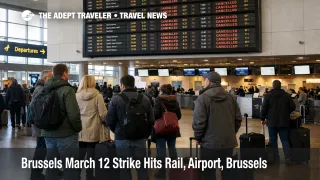
Brussels is now facing a stacked mobility disruption window that makes "just take the train instead" a weaker fallback than it normally would be. Brussels Airport will operate zero departing passenger flights on March 12, 2026, due to strike related staffing constraints, and the airport has also warned that some arrivals may be canceled or adjusted. The new, traveler relevant update is that Belgium's rail network is also heading into a multi day strike in the days immediately before March 12, and Brussels is expecting a large national demonstration that can slow city movement and disrupt local public transport on the same day. The practical consequence is that travelers should plan for both air and surface options to be constrained, and should decide earlier than usual whether to reroute to another hub or reposition overnight.
Brussels March 12 Strike: What Changed For Travelers
The March 12 situation at Brussels Airport is no longer "expect disruption," it is "no departures." The airport says it made the decision in consultation with airlines to protect passenger and staff safety, and it has warned that some arriving flights may also be canceled. What changed versus earlier planning assumptions is the compounding surface transport risk around the same window. Train availability will be limited across the Belgian rail network from 10:00 p.m. on Sunday, March 8, through the last train on Wednesday, March 11, with operators planning alternative schedules based on staffing. On March 12, Brussels public transport disruption is expected as staff participate in the national demonstration, and the movement of the procession itself can affect service.
Which Itineraries Are Most Likely To Break
The most exposed travelers are anyone scheduled to depart Brussels Airport on March 12, anyone connecting through Brussels on separate tickets, and anyone planning a same day surface transfer into Brussels to catch a flight from another airport. If you were counting on rail as your resilience layer, the multi day rail strike reduces the reliability of tight positioning plans on March 9, March 10, and March 11, and it can also thin last minute options that travelers typically use to self rescue after a cancellation.
The next most fragile set is travelers trying to do "land in Brussels, sleep, depart next morning" patterns, or "arrive by rail, stay central, then transfer to the airport" patterns. When a large demonstration is in motion, road friction and transit uncertainty tend to cluster around central corridors, which adds time variance that is hard to price into airport and hotel transfers, especially if you are trying to protect a fixed long haul departure from Paris, Amsterdam, or London. If your trip purpose is time critical, the relevant risk is not just one cancellation, it is the loss of slack across the system.
What Travelers Should Do Now
Travelers should treat March 11 and March 12 as a combined decision window, not separate events. If you are currently booked to depart Brussels Airport on March 12, push for a reroute or a date change now, while inventory still exists, rather than waiting for the formal cancellation flow to grind through call centers. If you must be in Belgium for March 12, consider positioning into Brussels by March 7 or early March 8, before the rail strike window begins at 10:00 p.m. local time on March 8.
The decision threshold is simple. If you have a fixed event on March 12 or March 13, you should assume Brussels Airport cannot be your outbound gateway on March 12, and you should proactively choose an alternate plan that does not require same day rail positioning into Brussels. If your travel is discretionary or flexible, shifting travel outside March 8 through March 12 reduces both direct disruption risk and the secondary risk of expensive recovery nights and last seat rebooking.
What to monitor over the next 24 to 72 hours is not "will there be disruption," that is already clear. Instead, monitor your airline's waiver terms, the Belgian rail operator's published alternative schedules for each strike day, and Brussels local transport updates as the demonstration plan firms up. If your plan involves switching gateways, watch seat and train load factors into Amsterdam, Paris, and London, because displacement pressure is likely to accelerate as more travelers move off Brussels.
Why The Disruption Spreads Beyond The Airport
Brussels Airport's zero departure plan removes the outbound bank that normally clears passengers and positions aircraft and crews for the next cycle. That first order effect forces rebooking into alternate flights and hubs, and it also increases the value of reliable surface access for anyone repositioning to another airport. The second order problem is that Belgium's rail strike window limits train availability just before the airport shutdown, which reduces the reliability of the most common self rescue method travelers use in Western Europe. When that happens, the fallback stack shifts toward taxis, private transfers, and earlier hotel nights, which raises trip cost and increases the odds of missed connections for anyone who waits to decide.
Finally, a national demonstration in Brussels can add uneven, hard to predict surface friction on March 12. Even when flights from alternate hubs operate normally, travelers still have to reach the airport, and demonstrations tend to turn airport access into a time variance problem rather than a pure distance problem. The net is a narrower set of "safe" itineraries, and those tend to be the ones that move earlier, have built in buffer, and avoid same day multimodal transfers.