

Port au Prince Flight Ban Extended to September 3
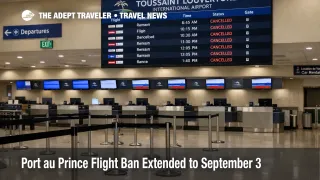
The Port au Prince flight ban will remain in effect through September 3, 2026, extending the long running prohibition on U.S. flights landing in Haiti's capital. The Federal Aviation Administration (FAA) cited ongoing safety of flight risks tied to armed groups, and said security forces have not been able to prevent attacks against aircraft in and around Port au Prince.
For travelers, this keeps normal commercial itineraries into Toussaint Louverture International Airport (PAP) off the table for at least another six months. First order, you cannot rely on a standard U.S. airline ticket to get you into Port au Prince. Second order, more trips will be forced onto alternate gateways, added connections, and separate tickets, which raises misconnect risk, baggage separation, and forced overnights if any segment slips.
This is an extension versus the prior FAA window that had been set to expire in early March, and it follows earlier FAA actions that reopened U.S. flights to several airports outside the capital while keeping Port au Prince restricted. If you have been tracking this story, the practical takeaway is simple, the runway for a near term restart into PAP just got pushed out again. For background on the earlier March 7 cutoff, see Port au Prince Flight Ban Runs to March 7.
Port Au Prince Flight Ban: What Changed
The FAA extended the prohibition on certain U.S. civil aviation operations in Haiti that effectively blocks U.S. carriers and commercial operators from operating below 10,000 feet mean sea level in specified areas, including the airspace that matters most for approaches, departures, and ground proximity around the capital. The current Haiti prohibition NOTAM is effective until September 3, 2026.
Reuters reporting on the FAA decision describes the extension as driven by risks from armed groups to civil aviation, and notes the restriction has been in place since late 2024 after multiple U.S. commercial aircraft were struck by gunfire. The FAA also continues to allow U.S. aircraft to transit over Port au Prince at or above 10,000 feet, which is a reminder that the highest exposure is at lower altitudes where small arms fire can reach an aircraft.
Which Travelers Still Have Options in Haiti
Travelers whose plans depend on arriving in Port au Prince are the most constrained. That includes family visits, NGO and humanitarian trips, business travel tied to the capital, and anyone who needs Port au Prince as the anchor for onward ground movement. In practice, this pushes many itineraries into a patchwork of alternate arrivals and overland transfers, and those transfers can become the fragile link even when you find a workable flight.
The FAA has allowed flights to resume to six other airports in northern Haiti, creating an uneven map where air access may exist outside the capital while remaining shut at PAP. That sounds like a workaround, but it only helps if your real destination is reachable from those airports with acceptable security and reliability, and if you can tolerate added travel time, uncertainty, and limited same day recovery options when flights misconnect.
If your travel decision is discretionary, the State Department's Level 4 Haiti travel advisory should be treated as a binding constraint, not just a warning label. Even if you can route into a different airport, you still need a credible plan for ground movement, lodging, and contingency exits that do not assume U.S. government assistance.
What Travelers Should Do Before Departure
Rebuild your plan around the assumption that you will not be flying commercially into PAP before September 3, 2026. If you are holding tickets that touch Port au Prince, call or message your airline and ask what your no fee change, refund, or reroute options are under the current restriction and any carrier waivers. When the restriction is risk driven rather than weather driven, airlines often keep the schedule thin or suspended, and that means fewer reaccommodation seats when something breaks.
Set a decision threshold early. Rebook now if your trip has fixed dates, critical appointments, timed connections, or any downstream segments that are not on the same protected ticket. Wait only if your trip is flexible, you can absorb date changes, and you have a safe alternative plan if the carrier cancels close in. The tradeoff is that waiting might preserve your original routing, but rebooking sooner usually improves seat availability and reduces the chance you get stuck with only expensive last minute options.
Over the next 24 to 72 hours, monitor three things. Watch the FAA NOTAM status for amendments, because that is the governing constraint. Watch your airline's travel alerts page for waiver language changes, because that determines your cost to adjust. Watch official security guidance for Haiti, because the aviation restriction is only one part of the trip, and the hardest failure modes often happen on the ground, not in the air.
Why the FAA Keeps the Restriction in Place
A NOTAM like this is designed to reduce risk to U.S. civil aviation when the threat environment makes routine operations unsafe, especially during approach, departure, and time on the ground when aircraft are low, slow, and predictable. In its background notice, the FAA explicitly points to security forces' inability to prevent attacks against aircraft in and around Port au Prince, and says small arms fire has been used to attack aircraft within the prohibited area.
The "10,000 feet" rule is the key mechanism travelers should understand. High altitude overflight is allowed because small arms fire risk drops off with altitude, while arrivals and departures necessarily spend time at lower altitudes where the aircraft is exposed. That is why the practical outcome for travelers is not just fewer flights, it is a structural block on normal commercial service into PAP until the security environment changes enough for the FAA to lift or materially narrow the restriction.
First order, the Port au Prince flight ban keeps commercial aviation options constrained at the capital's main airport. Second order, it concentrates demand into the remaining gateways, increases reliance on separate tickets and improvised routings, and raises the odds that a single delay turns into a trip failure with unplanned overnights and hard to recover connections. Until the FAA changes the NOTAM, the most reliable plan is to avoid itineraries that depend on arriving at PAP on a standard U.S. commercial flight, and to postpone discretionary travel.
Sources
- US extends flight restrictions to Haiti capital until early September
- KICZ NOTAM A0024-26 Haiti Prohibition
- FAA Background Information Regarding U.S. Civil Aviation, Specified Areas of the Territory and Airspace of Haiti
- Haiti Travel Advisory, U.S. Department of State
- US extends ban on commercial flights to Haiti's capital due to gang violence