

US Shutdown: TSA Pay Protection Campaign Presses Congress
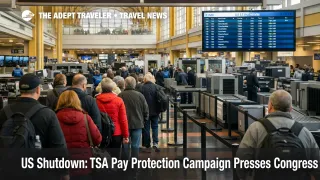
A coalition of major travel industry groups launched a new "Pay Federal Aviation Workers" campaign on March 5, 2026, as a partial Department of Homeland Security funding lapse keeps Transportation Security Administration screeners working without pay. The timing matters because U.S. airlines are projecting record spring volumes from March 1 through April 30, a period when even small staffing drops can turn into visible security line volatility at big hubs. The practical traveler takeaway is simple, until funding is restored, assume higher risk of slower screening at peak hours, build more buffer for morning departures, and avoid itineraries that only work if the checkpoint runs perfectly.
The campaign is also a signal that the industry is trying to shift this from a recurring shutdown drama into a permanent pay protection mechanism, by backing specific bills that would keep key aviation and security workers paid even when appropriations lapse. Whether Congress moves quickly is still unclear, but the operational risk rises the longer missed paychecks stack up.
TSA Pay During Shutdown: What Changed, and Why It Matters Now
The new development is coordinated pressure from U.S. Travel Association, Airlines for America, the American Association of Airport Executives, and the American Hotel and Lodging Association, framed as a campaign to push lawmakers toward legislation that protects pay for essential aviation and security personnel during future funding lapses.
This matters right now because TSA screening is a throughput system with limited slack during peak banks. When workers are missing paychecks, the immediate failure mode is not "the airport shuts down," it is uneven staffing, more unscheduled absences, and fewer open lanes at the exact hours when demand spikes. That shows up to travelers as longer, less predictable waits at security, and it can cascade into missed flights when schedules and connections are tight.
Which Trips Are Most Exposed Heading Into Spring Peaks
Trips most exposed are the ones built on thin margins, early morning departures at major hubs, tight same day connections, and any itinerary that must arrive by a fixed time with no recovery options later that day. If a traveler has a cruise embarkation, a wedding, a timed entry tour, or a same day business commitment, security line variance is the kind of small delay that becomes an expensive miss.
The record demand backdrop raises the stakes. Airlines for America has projected 171 million passengers from March 1 through April 30, 2026, about 2.8 million passengers per day on average, with roughly 26,000 daily passenger flights and about 3.5 million seats. In that environment, when passengers miss flights, rebooking options can disappear faster, and the second order costs, hotel nights, rental car repricing, and lost vacation time, climb quickly.
What Travelers Should Do Now
Treat buffer time as the main hedge until DHS funding is restored. For departures, plan to arrive earlier than you normally would at large airports during morning peaks and late afternoon pushes, because staffing risk tends to show up as fewer open lanes, not as a clearly announced "shutdown."
Use a decision threshold for when to change flights proactively. Rebook early if your itinerary has a short connection, if you are on separate tickets, or if you only have one viable flight that day that meets a hard arrival requirement. Waiting is only rational if you have multiple later flights that still work, and you are willing to accept the risk of longer lines plus slower reaccommodation under peak loads.
If you are planning an international return, assume extra time at arrivals even if your outbound screening is smooth, because DHS disruptions can spill into other traveler facing processes. For ongoing context on how the lapse is already changing airport operations, see US Shutdown Hits Airports, TSA Pay Cut, Global Entry Paused. For a deeper structural explainer on why staffing and governance issues propagate into national delays, see U.S. Air Traffic Control Privatization: Reality Check.
Why This Is Happening, and How the Disruption Spreads
The immediate driver is a DHS funding lapse that has left many frontline employees working without pay, while political negotiations over DHS funding and immigration enforcement standards remain unresolved. Reporting has described concerns across DHS components, including TSA, with warnings that prolonged missed pay can worsen absenteeism and strain airport operations as demand rises.
The mechanism is predictable. First order, staffing stress reduces throughput at security checkpoints, which increases queue length nonlinearly during peaks. Second order, missed departures increase load on airline rebooking, customer service, and hotel inventory, and they push more passengers into later flights that are already full in spring travel season, which further reduces recovery capacity for everyone else.
The industry coalition is trying to convert that operational vulnerability into a legislative fix by advocating for bills that would keep air traffic controllers and TSA officers paid during future funding lapses, instead of relying on back pay after the fact. Whether that effort succeeds will matter beyond this week because the same failure mode repeats every time funding becomes leverage, and it repeats most painfully when passenger volumes are highest.
Sources
- Airlines, Hotels, and Airports Demand Pay Protections for TSA Amid Government Shutdown
- Travel Leaders Unite: Fund TSA, Protect Travelers, Keep America Moving
- U.S. Airlines Prepare for Record Number of Passengers this Spring Amid Government Shutdown
- Airlines, travel groups warn of risks to air traffic as partial shutdown persists
- Republicans take another crack at Homeland Security funding, citing Iran war
- Congress searches for shutdown off ramp as DHS employees start missing pay