

Nepal Election Disruption Hits Kathmandu Transfers
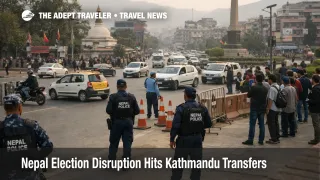
Nepal election travel disruption remains a live risk in Kathmandu after the March 5, 2026 vote, even though formal movement restrictions have been lifted. The U.K. Foreign, Commonwealth & Development Office, or FCDO, updated its advice on March 6 to warn that protests, political violence, police surges, curfews, and broader travel disruption can still follow the count, the results, and the formation of a new government. For travelers, that means the legal restriction window may be over while the practical movement risk window is still open.
That matters most in Kathmandu, where the FCDO specifically tells travelers to stay away from vote counts, political rallies, demonstrations, political party offices, and the Maitighar Mandala area. Counting began after polling closed, and final results were still being worked through on March 7, with ballots from remote areas continuing to come in. Travelers should treat the next phase as a volatility period, not a return to normal city movement.
Nepal election travel disruption is now a ground movement problem first, and a broader itinerary problem second. The immediate risk is getting caught in a protest zone, a sudden traffic freeze, or a police control point. The next risk is missing an airport transfer, an intercity bus, a tour departure, or a same day hotel move because a route that looked open an hour earlier stops moving.
Nepal Election Travel Disruption: What Changed
The actual change is narrower, and more important, than a simple "restrictions lifted" headline suggests. The FCDO says the post election movement restrictions have been lifted, but it kept a live warning that protests can start at short notice, clashes remain possible, police presence may increase, and curfews could be imposed with little notice in different locations. In other words, the formal rule eased, but the operating environment did not fully stabilize.
That distinction matters because election stress often moves in phases. Polling day can pass relatively calmly, then pressure shifts to counting centers, party offices, symbolic protest points, and government formation bargaining. Associated Press reported that counting started after a broadly peaceful vote, while Reuters and AP both described a fluid political picture as results continued to come in on March 7. That is exactly the kind of period where transport friction can spike even without a blanket citywide shutdown.
Which Kathmandu Travelers Face the Most Risk
The most exposed travelers are the ones relying on timed urban movements in Kathmandu, especially hotel to airport runs, airport to city transfers, same day intercity bus connections, and sightseeing plans that pass near central protest corridors. On first mention, Tribhuvan International Airport (KTM) is the main international air gateway, and access can become harder if demonstrations or police operations build along major roads rather than at the terminal itself. Earlier this year, authorities also imposed protest related restrictions around the airport zone itself, which is a reminder that aviation access in Kathmandu can tighten quickly when security concerns rise.
The FCDO names Maitighar Mandala and political party offices as places to avoid, and that is useful because Maitighar is not a random landmark. It is a long used protest node in Kathmandu, with recent demonstrations there on unrelated causes as well. Travelers do not need to be attending a protest to be affected. It is enough to have a car route, hotel location, bus departure, or day plan that overlaps with a gathering point, a police corridor, or a diversion pattern.
What Travelers Should Do Now
For the next 24 to 72 hours, travelers in Kathmandu should build extra buffer into every fixed movement. For airport runs, that means leaving earlier than usual, confirming the route with the hotel before departure, and avoiding any plan that depends on a last minute ride hail or a tight check in margin. For tours and bus departures, it means checking again on the morning of travel, not just the night before, because the FCDO is explicit that protests and control measures can emerge at short notice.
The practical decision threshold is simple. If your itinerary depends on crossing central Kathmandu at a specific hour, especially near known protest zones, assume added friction and pad the schedule. If your movement is optional, such as nonessential sightseeing across the city, postpone it during active counting and major result announcements. If your departure is high value, such as an international flight or a long intercity leg, move closer to the departure point earlier rather than betting on normal traffic.
Travelers should also monitor the right signals. Watch local media, check with your hotel, airline, or tour operator, and ask specifically whether routes are moving normally, whether police diversions are in place, and whether any neighborhood level curfew chatter is emerging. "Restrictions lifted" is not the signal that matters now. The useful signal is whether your exact corridor, at your exact time, is still functioning.
Why Nepal Can Stay Disrupted After Restrictions Lift
The mechanism is straightforward. Elections create concentrated movement around counts, results, and political negotiations, and those pressure points tend to cluster in capitals first. When crowds gather, police numbers rise, or small clashes start, the first order effect is slowed or blocked movement on specific roads. The second order effect is wider travel unreliability, missed check ins, disrupted tours, bus timing slippage, and hotel transfer planning that suddenly stops working on the original timeline.
Kathmandu is especially sensitive to this kind of disruption because the city's traveler flows are concentrated. A protest node does not need to sit inside the airport to affect airport access. It only has to interfere with one of the main approach corridors, trigger diversions, or force a security operation that slows traffic beyond the protest area itself. Recent reporting on demonstrations near the airport road, plus earlier airport area gathering restrictions, shows how quickly a political event can spill into transport operations.
The main takeaway is that Nepal election travel disruption should now be treated as a dynamic urban operations story, not a rule change story. Travelers in Kathmandu do not need to panic, but they do need margin, route awareness, and a bias toward avoiding central protest nodes until counting, results, and the first stage of government formation settle down.
Sources
- Nepal travel advice, GOV.UK
- Vote counting begins in Nepal after a peaceful parliamentary election, AP News
- Ex-rapper's political party leads early results in Nepal's first election since 2025 youth revolt, AP News
- Inside the Nepal campaign that could vault Balendra Shah to power, Reuters
- Vote counting set to begin tonight in all 10 Kathmandu constituencies, The Kathmandu Post
- Prohibitory order imposed in and around Tribhuvan International Airport, The Kathmandu Post
- River conservation activist on hunger strike, The Kathmandu Post
- Rabi Lamichhane's supporters stage protest in Kathmandu, The Kathmandu Post