

Hawaii Tourism Can't Carry the Economy Alone
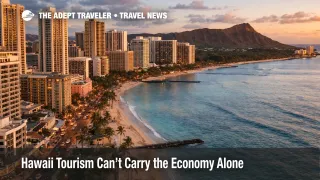
Hawaii's travel economy still matters enormously, but the state's deeper problem is no longer just the cost of living. The bigger issue is that tourism, while essential, has not generated enough long term productivity growth or enough high wage work to keep pace with housing, food, energy, and other living costs. That gap matters to residents first, because it feeds outmigration and weakens household stability, but it also matters to travelers because it shapes the kind of visitor economy Hawaii can sustain, the service levels they can expect, and the pressure points likely to define future trips.
Hawaii economic diversification matters to travelers because the state is trying to protect a tourism backbone that still pays the bills while building industries that can deliver better wages, more resilience, and less dependence on visitor volume alone. UHERO says inflation adjusted visitor spending per arrival really peaked in 1988, and its latest forecast argues that recent revenue gains have come more from higher prices and mix shifts than from a return to a stronger, more productive visitor model.
Hawaii Economic Diversification, Why Travelers Should Care
For travelers, this is not an abstract state policy debate. It affects what Hawaii sells, how it staffs hotels and tours, how much pricing power resorts retain, and whether the Islands continue chasing volume or move toward higher value travel. UHERO's recent work argues that after adjusting for local prices, Hawaii looks less like a rich but expensive outlier and more like a place with decades of lagging per person growth and productivity. That is a warning sign for any destination that depends heavily on hospitality labor while trying to remain livable for residents.
The travel relevance is immediate. DBEDT's preliminary January 2026 release showed visitor arrivals and spending rose year over year, but the broader pattern across 2025 was uneven, with several months showing fewer visitors even when spending held up because daily outlays were higher. That means Hawaii is not simply returning to an older, stronger model. It is often earning more nominal dollars from a narrower or more price sensitive demand base.
Which Hawaii Trips and Businesses Feel It Most
The biggest exposure is in the broad middle of the market. Luxury properties can still capture affluent travelers and push room rates higher, while lower tier operators often compete on discounts, bundles, or shorter stays. The part under the most strain is the mass market middle where travelers want Hawaii, but increasingly resist the full cost once airfare, lodging, dining, car rental, and activity prices are combined. UHERO's forecast says the industry entered 2026 with revenue gains driven more by stronger spending than by expanding visitor volumes, which is a less stable foundation than it looks at first glance.
Different islands also feel this differently. Maui is still working through post fire recovery distortions, Oahu remains the main gateway and convention anchor, and the neighbor islands can show stronger spending in some periods while still facing the same structural dependence on outside demand. DBEDT's 2025 visitor reports repeatedly showed a pattern where arrivals lagged or softened even when nominal spending improved, which is useful for travelers because it signals that headline revenue can hide softer demand underneath. For a recent demand snapshot, see Hawaii tourism decline raises summer travel concerns.
What Travelers Should Do Before Booking Hawaii
Travelers should not read this as a reason to avoid Hawaii. They should read it as a reason to book more selectively. If the goal is value, shoulder season timing and island choice matter more than ever, because some suppliers still need demand while others, especially at the high end, remain able to hold pricing. A soft statewide demand story does not automatically mean a cheap Hawaii trip. It often means a more uneven market where one property discounts while another raises rates because its customer base is different.
Travelers should also pay attention to where their money goes. In a destination wrestling with outmigration, labor pressure, and weak wage growth, locally rooted operators, restaurants, guides, and activity providers matter more than the brochure suggests. Spending decisions do not fix the state's economy, but they do affect which parts of the visitor sector remain viable and which kinds of jobs are supported.
Over the next 12 to 24 months, the practical watch items are air demand, room pricing outside the luxury tier, convention related softness on Oahu, and whether Hawaii can grow sectors such as technology, ocean related industries, defense adjacent software, and other exportable services without treating tourism as the only engine in the room. For broader destination context, see Hawaii - Travel News and Guides from The Adept Traveler.
Why Hawaii's Tourism Model Is Under Strain
The mechanism is simple, even if the fix is not. Tourism brings outside money into Hawaii, but if visitor growth comes with lower inflation adjusted spending per trip, or if more of the gain is absorbed by higher costs rather than real productivity, the industry supports the economy less effectively than raw arrival totals imply. UHERO's forecast makes that plain, showing inflation adjusted visitor expenditure per arrival peaked in 1988 and arguing that Hawaii has too often maintained aggregate visitor spending by adding more bodies, each bringing in less real spending to support the local economy.
That weakens the state in two ways. First, it leaves Hawaii more exposed when shocks hit, whether from volcanic events, pandemics, wildfire disruption, or shifts in long haul demand. Second, it makes it harder for tourism centered growth to fund the kinds of wages that keep younger workers and families from leaving. The U.S. Census Bureau said Hawaii was one of only five states to lose population between July 2024 and July 2025, which fits the broader pattern of a state still struggling to convert visitor demand into broad based resident prosperity.
Tourism will remain the backbone. That part is not in serious dispute. The real question is whether Hawaii can make tourism more productive while finally expanding industries that are less shock prone and more wage supportive. Until that happens, the state will keep selling one of the world's most desirable trips while fighting an economy that does not reliably create enough opportunity for the people who live there.
Sources
- Beyond the price of paradise: Is Hawai'i being left behind?
- 26Q1 UHERO State Forecast Update
- Population Growth Slows Due to Decline in Net International Migration
- Visitor Spending and Visitor Arrivals Increased in January 2026
- Visitor Spending and Visitor Arrivals Declined in July 2025
- Hawaii's Targeted and Emerging Industries - 2025 Update Report