

Philippines Protest Warning Hits Manila Trip Timing
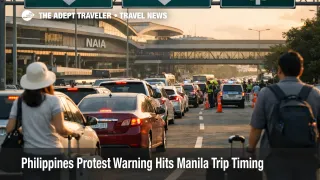
The Philippines protest travel timing picture has become more operational, not just more political. On March 6, the U.K. Foreign, Commonwealth & Development Office, or FCDO, updated its Philippines advice to warn that large scale demonstrations are expected over the coming weeks in Metro Manila and elsewhere, that they may cause travel disruption, and that travelers should allow extra time for journeys. For anyone using Manila as a gateway, that shifts the risk from abstract civil unrest language to real transfer friction that can break airport runs, domestic flight connections, and tightly timed city itineraries.
The practical change since earlier Philippines coverage is that official advice now tells travelers to build in slack before the disruption is visible on the street. That matters most for trips touching Ninoy Aquino International Airport (MNL), bayfront hotels, downtown Manila sightseeing, intercity bus movements, and same day domestic onward flights, because all of those rely on surface travel through a metro area where even peaceful demonstrations can trigger rolling congestion, route changes, and heavier police presence.
Philippines Protest Travel Timing: What Changed
What changed is the wording and the traveler consequence. The FCDO now says large scale demonstrations are expected over the coming weeks in Metro Manila and elsewhere in the Philippines, and it explicitly links those demonstrations to travel disruption and longer journeys. That is a different traveler signal than a generic caution about unrest, because it tells people to plan for movement delays before they set out.
There is also fresh local evidence that protest related traffic friction in Metro Manila is not theoretical. A Quezon City government traffic advisory issued ahead of a February 25 rally warned of slower traffic around Epifanio Delos Santos Avenue, or EDSA, Katipunan Avenue, Ortigas Avenue, White Plains Avenue, and Temple Drive, and said alternate routes would be needed. That does not prove every coming demonstration will hit the same corridors, but it does show how quickly a rally can turn a normal Metro Manila journey into a detour problem.
Which Travelers Face the Most Disruption
The most exposed travelers are those with airport dependent schedules in Manila. A delayed ride to NAIA can do more damage than a delayed sightseeing stop, because Manila is both the main long haul gateway and a domestic connection hub. If a protest or security cordon slows the road network, the first order effect is a longer airport run. The second order effect is a missed domestic flight, a reissued ticket, or an extra hotel night before the trip can continue.
Travelers staying around Manila Bay, Rizal Park, Intramuros, Ermita, Malate, Makati, Ortigas, and Quezon City should think about route reliability, not just distance. Adept's earlier Manila protest reporting showed how bayfront corridors and central protest zones can snarl trips between NAIA, waterfront hotels, and downtown districts, while the Quezon City advisory shows that major arteries in the eastern part of the metro can also slow during rally activity. The point is not that every district will fail at once, but that trips crossing central choke points become less predictable.
"Elsewhere in the Philippines" also matters, but with a limit. The FCDO warning does not name specific cities outside Metro Manila in the updated advisory text, so travelers should not assume a nationwide shutdown. What they should assume is that domestic itineraries with narrow timing, especially ones that depend on reaching a port, a bus terminal, or a domestic airport from an urban center, now need more slack than usual until the protest pattern becomes clearer.
What Travelers Should Do Now
For Manila airport runs, the sensible move is to treat normal timing as outdated. On days with visible demonstrations, announced rallies, or heavier security around government and protest prone areas, travelers should leave far earlier than they normally would for NAIA, avoid same day domestic connections on thin buffers, and ask hotels or drivers which route they plan to use before getting in the car. Routes that rely on a single protest exposed corridor are weaker than ones that can shift between expressways and inner city alternatives.
For city stays, the threshold is simple. If your day depends on crossing Metro Manila at a fixed hour, build slack or move the plan. That includes cruise or ferry check in, guided tours with timed pickups, embassy or visa appointments, business meetings with no flexibility, and same day airport transfers after a morning sightseeing block. Travelers who only have one night in Manila should lean toward staying closer to the airport or using a hotel with a route plan that does not depend on protest exposed waterfront or government corridors.
Over the next 24 to 72 hours, the main things to watch are local traffic advisories, police or city government route notices, and any carrier or airport alerts that acknowledge access delays. The FCDO's new language means travelers should not wait for a full transport breakdown before adjusting. In practice, Philippines protest travel timing now rewards early movement, wider connection margins, and fewer same day dependencies in Metro Manila.
Why Metro Manila Delays Spread So Easily
The mechanism is straightforward. Demonstrations do not need to close an airport to disrupt a trip. In a dense capital region, they only need to slow or reroute the roads that feed hotels, business districts, terminals, and transfer points. Once police create security perimeters, close a few turns, or meter traffic around a crowd, travel time becomes unreliable long before transport fully stops.
Metro Manila is especially vulnerable because so many traveler movements stack on the same urban network. A passenger can land at NAIA, head into Makati for one meeting, continue to a hotel, then fly domestic the next morning. When demonstrations or related security measures hit even one leg of that chain, the whole itinerary loses resilience. That is why the new FCDO wording matters. It tells travelers to solve the timing problem in advance, not after traffic is already broken.
This is also why non political trips still need more slack. You do not need to attend or even approach a demonstration to be affected by it. Airport pickups, intercity coach departures, domestic flight check in windows, and ferry links tied to Manila timing can all fail because the city's transport system absorbs crowd management badly when pressure rises. The Philippines protest travel timing issue is therefore not only about safety near rallies, it is about degraded trip reliability across the capital region.