

Princess 2028 World Cruise Opens on Coral Princess
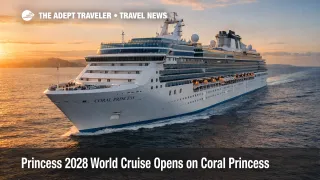
Princess 2028 World Cruise is now on sale, with Coral Princess scheduled to depart January 3, 2028, on a 115 day roundtrip voyage from Fort Lauderdale, Florida, or Los Angeles, California. Princess says the sailing will cover 49 destinations in 24 countries across five continents, include 39 UNESCO World Heritage Sites, and offer shorter segments for travelers who do not want to commit to the full voyage. For cruise buyers, this matters now because world cruise inventory, longer segments, and high value cabin categories can tighten early, especially when the line is also dangling up to $3,000 in onboard credit for qualifying bookings.
The bigger story is not just that Princess opened another world cruise. It is that this itinerary is being sold as a longer, more ashore focused alternative to traditional around the world sailings, with overnight stays in Cape Town, South Africa, and Auckland, New Zealand, plus multiple late night calls including Barcelona, Spain, Casablanca, Morocco, Dubrovnik, Croatia, Honolulu, Hawaii, Melbourne, Australia, and Sydney, Australia. That fit makes the voyage more attractive for retirees, extended leisure travelers, and remote workers who want a world cruise experience without giving up every day to port churn.
What Is New in the Princess 2028 World Cruise
The core product is a 115 day Coral Princess sailing that Princess says spans about 36,000 nautical miles, crosses both the Equator and the International Date Line, transits the Panama Canal, and runs through Hawaii, the South Pacific, Australia, New Zealand, the Indian Ocean, South Africa, western Africa, the Mediterranean, and the Atlantic return to North America. A maiden call at Mossel Bay, South Africa, is one of the headline additions, and Princess is also leaning hard on the ship's smaller 2,000 guest scale as part of the sales pitch.
What changed for travelers versus a more standard grand voyage is the amount of flexibility. Princess is selling the full sailing as a roundtrip from either Fort Lauderdale or Los Angeles, a 100 day Los Angeles to Fort Lauderdale option, and shorter segments that currently range from 20 to 95 days on the booking page. That matters because it widens the market beyond classic full world cruisers. Travelers who want South Pacific, Australia and New Zealand, South Africa, or Mediterranean portions can buy into the experience without absorbing the cost and time burden of the full 115 days.
Who Benefits Most From Coral Princess World Cruise Segments
The best fit is travelers who value duration and destination depth more than flashy new ship hardware. Coral Princess is an older, smaller vessel, not a next generation mega ship, so the appeal here is itinerary design, longer port time, and a more manageable onboard environment rather than headline grabbing attractions. Buyers looking for a floating resort may find the ship less compelling. Buyers who care more about a long, structured global itinerary with fewer hotel changes may find that tradeoff entirely reasonable.
This itinerary also fits travelers who want more control over commitment and spend. Princess is using bonus onboard credit to sharpen the offer, with higher credits tied to longer sailings and higher cabin categories. Inside and oceanview cabins on sailings of 96 days or more currently show $1,000 in onboard credit per stateroom, balconies show $2,000, and minisuites and full suites show $3,000. That does not automatically make the cruise cheap, but it does improve the math for travelers already considering a long segment or full voyage. Readers comparing big cruise purchases should also keep an eye on how perks stack during Wave Season, because cruise value often hinges on onboard credit, fare structure, and flexibility, not headline pricing alone.
How To Book or Plan Around It
The practical move is to decide first whether you are shopping for the full world cruise or a region specific segment. Full voyage buyers should act earlier, because the most desirable cabin categories on long cruises can compress fast once loyalty members, repeat world cruisers, and advisor groups start locking in inventory. Segment buyers have a different threshold. They should compare the Princess option against land plus cruise alternatives in the same region, especially in Australia, New Zealand, South Africa, and the Mediterranean, where partial voyage demand can be stronger than the line's marketing language suggests.
Travelers should also look past the romance of "unpack once" and pressure test the operational realities of a trip this long. Princess itself flags the obvious issues, work leave, remote connectivity, insurance, medical care, and prescription planning, and those are not minor details on a 115 day sailing. A world cruise is closer to temporary relocation than to a normal vacation. That means insurance coverage, refill strategy, cancellation terms, and pre and post cruise hotel buffers deserve the same attention as cabin selection.
There is also a broader planning angle. Recent world cruise design across the industry has been shaped by geopolitical and routing constraints, especially around former Suez and Red Sea patterns. Princess's 2028 route is being sold as a Pacific, Indian Ocean, Africa, and Mediterranean arc rather than a traditional Red Sea heavy world loop, which reduces one set of chokepoint risks but does not remove the need for itinerary vigilance over the next two years. Travelers interested in how these patterns have been shifting should read Red Sea Security Reroutes 2026 World Cruises, because the same structural pressures are part of why long cruise routings now look different from older world cruise playbooks.
Why This Launch Matters
Princess is trying to sell more than a bucket list cruise. It is selling time ashore, modular booking, and a smaller ship format at a moment when travelers are increasingly split between two cruise preferences, short high energy sailings on hardware heavy ships, or longer, more immersive voyages that reduce travel friction. The overnight calls in Cape Town and Auckland, the late departures in multiple headline cities, and the new safari framing all push this product toward the second camp.
The mechanism is straightforward. More overnights and late departures increase the practical value of each port, because guests can book longer excursions, dine ashore without ship time anxiety, and treat marquee calls more like short city stays than checklist stops. Segment options widen the addressable market, because Princess does not need every buyer to say yes to 115 days. And the smaller Coral Princess footprint helps the line position the trip as more intimate, even if the ship itself is not the newest product in the fleet.
That combination should give Princess a cleaner sales story for 2028. The tradeoff is that buyers need to be honest about fit. This is a commitment heavy cruise aimed at travelers who want depth, time, and geographic sweep, not a quick luxury splash. For the right traveler, that is the whole point. For everyone else, the segment structure is what makes the launch meaningful, because it turns a once in a lifetime purchase into something more flexible and easier to justify.