

Houston Storm Delays Raise Spring Break Air Risk
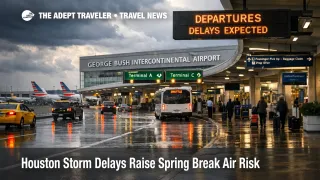
Thunderstorms turned Houston into a weaker spring break gateway just as passenger volumes were already running high. On Wednesday, March 11, the Federal Aviation Administration imposed ground stops at George Bush Intercontinental Airport (IAH) and William P. Hobby Airport (HOU), with both stops lasting through 330 p.m., average departure delays around 45 minutes, and a longer ground delay at Bush that the FAA said would run through 9 p.m. Houston Airports had already projected about 185,000 passengers for Thursday, March 12, inside a March 5 through 16 spring break period expected to bring about 2.2 million travelers through the system. For travelers, the practical takeaway is simple a short weather stop can still break same day cruise, connection, and pickup plans when Houston is this full.
Houston airport delays matter more this week because they are colliding with a second bottleneck. Houston Airports says the federal shutdown has reduced TSA staffing, recommends arriving three hours early for domestic flights and four hours early for international flights, and notes that spring break runs through March 16. That means even when the worst weather has passed, recovery can still be uneven because checkpoint flow, baggage timing, and rebooking queues stay under pressure.
Houston Airport Delays: What Changed
The immediate disruption was temporary, but it did not end cleanly at the same time everywhere. Both Houston airports saw weather driven ground stops on March 11, and both were lifted before 4 p.m. The more important detail for travelers was the longer tail at Bush, where a ground delay remained in place through 9 p.m. after the stop itself ended. That is the difference between a brief operational hit and an evening of rolling missed connections, late arrivals, and tighter overnight recovery.
There is also a reason not to treat this as a one off blip. The FAA's current operations planning for March 12 still shows thunderstorm related constraints in the broader Texas and Gulf system, and the National Airspace System status feed separately flagged IAH and HOU for possible ground stop or delay programs after 2100Z. That does not mean a new stop is guaranteed, but it does mean Houston remains weather sensitive even after the first round of disruption.
Which Travelers Face the Most Disruption
The most exposed travelers are the ones trying to use Houston on a tight clock. That includes same day domestic connectors, inbound international passengers clearing into onward flights, and anyone landing in Houston and continuing straight to Galveston for a cruise. Houston Airports has said the spring break period overlaps with the Houston Livestock Show and Rodeo, the World Baseball Classic, and expanded cruise departures from Galveston, which raises the odds that a short air delay cascades into a ground side failure.
Cruise passengers have a specific risk window this weekend. The Port of Galveston's March schedule shows multiple sailings clustered on Saturday, March 14, and Sunday, March 15, including Carnival, Norwegian, Disney, MSC, and Royal Caribbean operations. When Houston flights slip by even an hour or two during a peak period, the problem is not only the arrival delay. It is the combined effect of baggage delivery, rideshare or shuttle demand, road time to Galveston, and a much harder recovery if a traveler misses embarkation check in.
What Travelers Should Do Now
For flights on Thursday, March 12, through Sunday, March 15, travelers should plan Houston as a higher buffer airport, not a tight turn airport. At minimum, that means padding connections, checking airline apps before leaving for the airport, and building around Houston Airports' current recommendation of three hours for domestic departures and four hours for international departures. If your trip depends on one fixed event, such as a cruise check in, a wedding, or a paid tour, the safer move is to protect the ground segment first and the airfare second.
For cruise travelers, the smarter call shifts fast once weather and peak volume overlap. If you are flying in for a Galveston departure on March 14 or March 15, a pre cruise overnight becomes the safer default, not the cautious extra. The cost of one hotel night is usually lower than the downside of a missed sailing, especially when both airport flow and highway transfers can tighten at the same time.
For everyone else, the decision threshold is simple. Wait out a short delay if your itinerary ends in Houston or you still have wide connection margins. Rebook earlier, or shift to a later same day departure, if you are connecting onward on the last workable flight bank, heading to Galveston, or depending on pickup, rental car, or hotel timing that breaks once the evening push slips. Over the next 24 to 72 hours, watch three things together, airline app updates, airport security wait times, and FAA airport status, because Houston's problem this week is not one single failure point. It is stacked fragility.
Why the Disruption Spreads Through Travel
A ground stop is an FAA traffic management tool that keeps aircraft at their origin airports when the arrival airport cannot safely absorb more flights. In plain language, it pauses the inbound pipeline. That matters because the damage does not stay at the airport where the storm hits. Aircraft arrive late, crews time out, gates stay occupied longer, baggage comes off later, and downstream departures inherit the disruption even after the worst weather has moved on.
Houston is especially vulnerable to this kind of spillover during spring break because it is carrying both local demand and connecting demand. First order, departures and arrivals at Bush and Hobby become less reliable. Second order, cruise embarkation from Galveston, domestic onward flights, airport pickups, and hotel check in plans all become more failure prone when weather disruption lands inside already elevated passenger volume. Add in ongoing TSA staffing strain, and even a temporary thunderstorm stop can linger as a traveler problem long after the radar clears.
Sources
- Ground stops lifted at Bush and Hobby airports after thunderstorms, FAA says
- Houston Airports ready for 2.2 million Spring Break travelers
- Government shutdown impacts TSA, passengers
- Current Operations Plan Advisory, March 12, 2026
- National Airspace System Status
- Port of Galveston Cruise Schedule
- Galveston Cruise Ship Schedule for March 2026