

Travel Costs Rise as Iran War Pushes Up Oil Prices
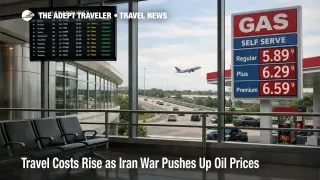
Americans are paying more to travel this spring, and the pressure is showing up first in airfares, fuel, dining, and entertainment. NerdWallet's March 2026 Travel Inflation Report says U.S. airfare was up 7.1 percent year over year in February, the sharpest annual increase in its travel index in more than a year, while Reuters reported on March 11 that the national average gasoline price had already climbed to $3.58 a gallon as the U.S. and Israel's war with Iran disrupted oil flows and raised supply fears. For travelers, that means summer budgets are getting less forgiving, especially for flights, road trips, and trips built around restaurant spending. The near term play is simple: price out trips earlier, assume fuel could stay volatile, and use softer hotel pricing where it still exists.
The new piece of information here is not just that travel is more expensive, it is that the biggest current pressure point is energy. NerdWallet explicitly says the "biggest storyline" in airfares right now is the Iran war and warns that prolonged conflict could lift airline costs further and add pressure on already weak low cost carriers. That matters because higher fuel does not just nudge ticket prices upward, it also increases the odds of capacity cuts, weaker competition on some routes, and higher fares where travelers have the fewest alternatives.
Travel Costs: What Changed for Travelers
NerdWallet's report, based on Bureau of Labor Statistics consumer price data, says overall travel prices were 3 percent higher than a year earlier in February. Within that basket, airfare rose 7.1 percent year over year, food away from home rose 3.9 percent, rental cars rose 2.7 percent, and movies, theaters, and concerts rose 5.5 percent. Hotels and motels were the one major travel category that fell, down 2.2 percent from a year earlier.
There is one important timing catch. NerdWallet says its March 2026 analysis uses February 2026 data, so the travel inflation snapshot lags current conditions by about a month. That means the sharp jump in U.S. gasoline prices reported this week is not yet fully reflected in the CPI based travel index, even though it is already hitting real world road trip and airline cost structures.
Which Travelers Are Most Exposed
Flyers are the most exposed group right now, especially anyone booking peak spring or summer domestic trips with limited competition. NerdWallet notes that a prolonged conflict could feed further airline consolidation or retrenchment among weaker carriers, which usually leaves fewer seats and more pricing power on affected routes. That is a direct consumer problem, not an abstract airline finance story.
Road trippers are the next group to watch. Reuters reported on March 11 that U.S. gasoline prices had jumped nearly 60 cents in 11 days to $3.58 a gallon, the highest since May 2024, because disruptions tied to the war with Iran hit Middle East oil flows and raised wholesale fuel prices. Families driving long distances, travelers heading to national parks, and anyone combining a road trip with a rental car are now more exposed to cost creep than the February inflation tables alone suggest.
Dining is the quieter budget killer. BLS says food away from home was up 3.9 percent over the 12 months ending in February, and NerdWallet says restaurant prices are now 50.5 percent higher than they were 10 years ago, faster than overall inflation over that span. The evidence supports saying restaurant spending is eating a larger share of trip budgets. It does not support blaming that increase largely on tariffs alone. BLS shows broad food and service inflation, and NerdWallet frames the pressure as part of wider travel cost inflation rather than a single policy driver.
What Travelers Should Do Now
Travelers booking flights for late spring or summer should treat earlier pricing as the safer move if the trip is firm. NerdWallet's own advice is to book sooner rather than later on airfare, and to remember that the cheapest basic economy fare can become expensive fast if plans change and flexibility matters.
For road trips, the smarter budget is no longer last month's gas estimate. Build in a fuel cushion, especially for longer drives, and compare flying versus driving again before locking in. In some markets, softer hotel pricing may partially offset higher transport costs, so the best savings move may be to optimize the whole trip rather than chase the cheapest ticket alone.
Over the next 24 to 72 hours, travelers should watch oil and gasoline moves more closely than generic inflation headlines. February CPI still showed gasoline down 5.6 percent year over year, but that backward looking number is already being overtaken by March's conflict driven price spike. In plain terms, the official inflation data and what travelers are paying at the pump are temporarily telling different time stamped stories.
Why Higher Oil Prices Spread Through Travel
The mechanism is straightforward. Airlines burn jet fuel, road trips depend on gasoline, and both markets react quickly when conflict threatens Middle East supply routes. Reuters reported that oil had surged toward $100 a barrel as attacks and shipping disruptions intensified, while NerdWallet tied that energy shock directly to current airfare pressure. Once fuel rises, airlines can pass some of the pain through fares, trim weaker routes, or reduce discounting. Drivers feel the squeeze almost immediately at the pump.
The second order effects matter just as much. If fuel stays expensive, low cost carriers face more strain, which can mean fewer seats in price sensitive markets. If flying gets more expensive, some travelers shift to driving, which increases rental car and fuel demand. If transport takes a bigger bite out of the trip budget, restaurants, attractions, and discretionary spending start competing harder for the remaining dollars. That is why a war driven oil shock can show up as a broader travel cost story, not just an airline headline.
Sources
- Travel Inflation Report: March 2026, NerdWallet
- Consumer Price Index News Release, February 2026, U.S. Bureau of Labor Statistics
- Consumer Price Index Table 2, U.S. Bureau of Labor Statistics
- US gasoline prices surpass $3.50 a gallon at the pumps, Reuters, March 11, 2026
- Oil unlikely to hit $200 a barrel, US energy chief says, Reuters, March 12, 2026
- Oil jumps to 2022 high on Iran war, Reuters, March 9, 2026