

Vienna Rail Disruption Extends Railjet, Night Trains
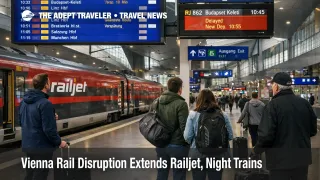
The Vienna rail disruption is now a real weeklong planning problem, not a minor timetable footnote. From March 15 to March 22, 2026, engineering works between Linz and Vienna are diverting Railjet and night train services, extending journey times by about 10 minutes, and forcing amended timetables into and out of Vienna. Some Railjet services also skip Wien Meidling, which matters because Vienna is not just a destination stop, it is the handoff point many travelers use for Vienna International Airport, Bratislava, Budapest, and same day hotel or tour check ins.
In practical terms, this is a buffer problem. The trains are still running, but the margin inside many normal looking itineraries is smaller for the whole March 15 to 22 window, especially for cross border trips and airport sequences built around one clean connection. Travelers should recheck the exact train number before departure, assume that station patterns or timings may not match their original booking, and stop treating a tight Vienna transfer as routine this week.
Vienna Rail Disruption: What Changed
What changed is straightforward. SBB says Railjet and night train services are being diverted between Linz and Vienna from March 15 to March 22, 2026, which adds about 10 minutes and brings amended timetables for trains to and from Vienna. ÖBB gives the operational reason more clearly, modernization work on the busy Weststrecke between Linz Hauptbahnhof and St. Valentin, with all long distance trains diverted via Enns during the works.
The new traveler value is not the headline delay by itself. Ten minutes is manageable when a trip ends in Vienna and nothing else depends on it. It becomes more serious when Vienna is the pivot, because ÖBB says timetable changes also reach long distance services between Wien Hauptbahnhof and Vienna International Airport, plus routes onward to Budapest and Bratislava. That means the disruption is not confined to one Austria corridor, it spreads into onward rail and air planning across Central Europe.
A second operational wrinkle is station access. Some Railjet Xpress services do not stop at Wien Meidling, specifically on certain trains in the direction of Linz. For travelers who normally use Meidling as the cleaner handoff for U Bahn, south side hotels, or station-to-station transfers, that skip can matter more than the extra 10 minutes. A missed planned stop forces a reroute through Wien Hauptbahnhof or local transport, and that is exactly how a small timetable change turns into a missed check in or a rushed airport run.
Which Trips Are Most Exposed This Week
The most exposed trips are not necessarily the longest ones. They are the trips with a second commitment attached to them. Same day airport departures from Vienna, cross border runs that continue to Bratislava or Budapest, and overnight rail itineraries with fixed morning plans are the weak spots, because each one relies on Vienna working as a clean interchange rather than a slightly slower and less predictable one.
Travelers staying near Wien Meidling are another exposed group. If your booked Railjet is one of the services that skips Meidling, the disruption is no longer just a timetable issue, it is a station mismatch. That can add local transfer time, extra luggage handling, and more dependence on Vienna local transport at the exact moment your long distance arrival has already shifted.
Night train passengers also have more to lose than a daytime city break traveler. SBB and ÖBB both say night trains are diverted and run with amended timings during the works. On an overnight trip, a modest delay can compress breakfast, hotel drop, meeting time, or onward daytime rail more quickly because the traveler has fewer easy recovery options after arrival. That is the same tradeoff Adept Traveler recently flagged in Paris Berlin Night Train Returns March 26, where overnight rail works best when the overnight itself is part of the value, not when every minute after arrival is already spoken for.
What Travelers Should Do Now
The first move is simple, recheck the exact train in ÖBB SCOTTY or your operator app shortly before travel, even if you booked days ago. ÖBB says a special timetable applies during the works and explicitly tells passengers to verify their connection before departure. That matters because the problem is not only whether the train runs, but whether its departure time, arrival time, or station stop pattern changed enough to break your plan.
For buffer, travelers should think in layers. Based on the official 10 minute extension, the Meidling stop issue, and ÖBB's warning that connections change at St. Valentin, Amstetten, and St. Pölten, a simple Vienna station transfer that would normally feel safe with a small margin should probably get at least 20 to 30 extra minutes this week. For Vienna Airport, Bratislava, Budapest, or any nonrefundable same day handoff, 45 to 60 extra minutes is the safer working buffer. That is an inference from the published changes, not an official minimum, but it matches the way small timetable shifts compound once one missed stop or one late arrival hits a second reservation.
The threshold for replanning is straightforward. If your trip depends on arriving in Vienna and immediately catching a flight, boarding a cruise or tour coach, or making one cross border train on a tight connection, rebuild the itinerary now instead of trusting a best case day. If your trip ends in Vienna and your hotel check in is flexible, you can probably absorb this with a lighter margin and a final same day timetable check. The main thing to monitor through March 22 is whether your specific train keeps its planned Vienna stop pattern, especially if you intended to use Wien Meidling rather than Wien Hauptbahnhof.
Why the Disruption Spreads Beyond 10 Minutes
The mechanism here is classic corridor disruption. ÖBB is modernizing infrastructure on one of Austria's busiest rail lines, and the temporary workaround is to divert all long distance trains via Enns. That protects service continuity better than a broad cancellation wave, but it also bakes delay and retiming into the network for a full week.
First order, the visible effect is longer travel time and adjusted departures or arrivals on Railjet and night trains between Linz and Vienna. Second order, Vienna stops behaving like a perfectly timed hinge. Airport rail links lose slack, Budapest and Bratislava connections become less forgiving, and travelers who built their day around Wien Meidling may find that their usable arrival point has changed. That is why a modest published delay can still create a bigger real world planning problem than the headline suggests.
This also matters because Vienna is a network pivot, not just a city endpoint. When long distance timing shifts at the pivot, the stress moves outward into hotel arrivals, local transport, and cross border sequencing. Travelers do not need to panic, but they do need to stop assuming that an itinerary which looked comfortably connected before March 15 will still feel comfortable all week. For the final days of the Vienna rail disruption, the smartest approach is simple, verify the exact train, avoid tight Vienna handoffs, and keep the extra buffer through March 22.