

U.S. Shutdown Pressure Grows on TSA as Airlines Warn
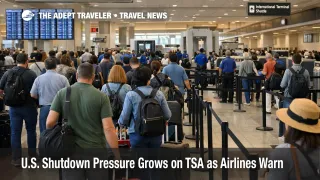
Aviation leaders are trying to turn the partial U.S. government shutdown from a Washington funding fight into a traveler facing operations story. In a March 15 open letter, CEOs from major passenger and cargo airlines urged Congress to restore Department of Homeland Security funding and back legislation that would keep essential aviation workers paid during shutdowns, after TSA officers received zero dollar paychecks and airports began reporting longer lines during the spring break rush. For travelers, the practical issue is simple, airport screening has become less predictable at the same moment U.S. airlines expect about 171 million passengers to fly between March 1 and April 30, 2026. That makes earlier airport arrival, looser connections, and more conservative same day planning the right move until staffing stabilizes.
The new angle is not just political pressure. It is that the industry is now openly warning Congress that unpaid federal aviation workers are already affecting the traveler experience. Airlines for America said TSA employees received empty paychecks on March 13, while Reuters and the AP reported that more than 300 TSA officers have quit since the shutdown began on February 14 and that some airports have seen wait times stretch into the multi hour range. The airline letter also cites upcoming demand pressure from spring travel, the 2026 FIFA World Cup build toward, and America's 250th anniversary events, arguing that the system is entering a high volume period with less staffing resilience than usual.
U.S. Shutdown TSA Delays: What Changed for Travelers
What changed over the weekend is that airline chiefs moved from general concern to a public demand for action, while the pay problem became concrete for TSA workers after zero dollar paychecks landed. That matters because the first order effect of a shutdown at DHS is not a neat nationwide ground stop. It is a slower, less reliable checkpoint system, uneven staffing by airport and shift, and a higher chance that travelers who normally clear security comfortably will lose that margin. Some airports have already responded with unusually blunt guidance, telling passengers to arrive far earlier than normal, and several airports have even organized donation drives for unpaid federal workers.
Travelers should read this as a process disruption, not just a political headline. Flights may still operate, but the airport journey before the gate is getting less dependable. That is especially relevant for families traveling during school breaks, passengers checking bags, people needing extra screening time, and anyone departing during early morning and late afternoon peaks when security lines compound quickly. Reuters reported that unpaid TSA staffing has already disrupted travel at some major airports, and AP reporting tied the issue directly to rising checkpoint delays as spring demand accelerates.
Which Travelers Face the Most Disruption
The most exposed travelers are not necessarily the ones on the longest flights. They are the ones with the least buffer in the airport portion of the trip. Domestic travelers who would usually arrive 90 minutes before departure are now the clearest risk group, especially at busy leisure airports and hubs where TSA absenteeism or resignations can remove screening capacity quickly. International passengers, travelers without TSA PreCheck, and anyone connecting from road traffic into a crowded terminal also face a sharper miss risk because one slow checkpoint can break the entire itinerary.
There is also a second order effect beyond screening itself. When passengers hit longer than expected security lines, airlines end up holding some flights, rebooking others, and absorbing more missed departures at the same time weather, spring break volume, and normal network constraints are already pressuring operations. The CEOs said airlines are trying to mitigate the damage by holding flights for delayed passengers and assisting with rebooking, but that is a patch, not a system fix. Travelers with cruise embarkations, paid tours, or nonrefundable first night hotel bookings should assume that a shutdown related airport delay can now be expensive even if the flight itself is not canceled.
What Travelers Should Do Now
The immediate move is to build more airport time, not less. For most domestic itineraries during this shutdown, arriving at least two to three hours before departure is the safer baseline, and at the most stressed airports local guidance may justify even more. Travelers who can check in online, avoid checked baggage, and complete document prep before leaving for the airport should do it, because the goal is to reduce every avoidable step before security. If you are traveling with children, mobility needs, special screening requirements, or a same day connection to a cruise or international departure, add extra buffer again.
The key decision threshold is whether missing the flight would damage the rest of the trip. If the answer is yes, protect the itinerary first. That can mean switching to an earlier departure, sleeping near the airport, or avoiding the tightest connection on the outbound leg. Waiting for Congress to resolve the shutdown may save hassle later, but it does nothing for a traveler flying this week. The more time sensitive the trip, the less sense it makes to plan around best case assumptions.
Over the next 24 to 72 hours, watch for three signals. First, airport specific advisories about checkpoint wait times or arrival windows. Second, any new reports of TSA absenteeism or resignations climbing further. Third, congressional movement on DHS funding or the aviation worker pay bills cited by the airline group, the Aviation Funding Solvency Act, the Aviation Funding Stability Act, and the Keep America Flying Act. Until one of those signals changes materially, the operating assumption for travelers should be that screening unpredictability remains part of the trip.
Why the Disruption Spreads Beyond the Checkpoint
The mechanism here is straightforward. TSA sits at the entrance to the rest of the airport system. When officers are unpaid, attrition rises, callouts increase, morale drops, and screening throughput becomes harder to sustain at peak periods. That does not automatically make the system unsafe, Transportation Secretary Sean Duffy said safety and security remain intact, but it does make it slower and less forgiving. The result is a travel system that can still function while producing more missed flights, longer queues, and more uneven recovery from normal daily disruptions.
There is an important distinction inside the airline letter as well. The immediate traveler problem is unpaid TSA and other DHS related airport personnel. The broader legislative push goes further, seeking durable pay protections for essential aviation workers, including air traffic controllers, during future shutdowns. In other words, the current pain point is checkpoint reliability, but the industry is using this shutdown to argue that aviation should not be exposed to repeated budget standoffs at all. That is why this story matters beyond one bad travel week, it is now a structural fight over whether federal aviation operations can keep absorbing shutdown politics without degrading the passenger experience.