

Valencia Fallas Metro Closures Hit Core City Moves
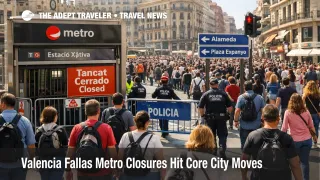
Valencia's biggest Fallas transport risk is no longer just crowding around Plaza del Ayuntamiento. The Valencia Fallas Metro closures now remove two of the network's most useful central stations, Xàtiva and Colón, plus the Alacant pedestrian passage, during the daily mascletà crowd window from March 14 through March 19, 2026, while Metrovalencia is also warning that union stoppages can alter timetables even with minimum service levels set at 75 percent. The practical result is that the city center remains reachable, but the easiest access points narrow right when visitor demand peaks and road restrictions tighten around the festival core. Travelers moving between Valencia Airport (VLC), central hotels, Valencia Nord, and València Joaquín Sorolla should add buffer, shift away from the 1230 p.m. to 230 p.m. window when possible, and treat same day transfers as lower confidence during the busiest Fallas days. This matters now because Metrovalencia is simultaneously running its longest Fallas service program, including continuous operations across the peak period, which means the network is still the best tool for many trips, but only if travelers enter and exit through the right stations.
Valencia Fallas Metro closures are changing how visitors should move through the city center from March 14 through March 19, 2026, especially around midday and into the evening festival rush.
Valencia Fallas Metro Closures: What Changed
Metrovalencia says Xàtiva and Colón stations, along with the Alacant pedestrian passage, are closed from 1230 p.m. to 230 p.m. during the mascletà period from March 14 through March 19 to avoid dangerous crowding. The operator is explicitly steering passengers toward Alameda, Bailén, Plaça Espanya, and Àngel Guimerà instead, and it has also announced extra trains between Bailén and Torrent on closure days to help replace some of the lost central access. At the same time, the Generalitat says Metrovalencia is running 168 hours of near continuous Fallas service from March 13 through March 19, but with the caveat that labor stoppages can still alter schedules under a 75 percent minimum service order.
That is the key change versus a normal festival crowd advisory. The network is not shutting down, but its central geometry is being reshaped during the exact hours when many visitors try to move between lunch plans, hotel breaks, rail arrivals, and the afternoon mascletà. This means a station that looks closest on the map may be unusable at the time you need it, and the "best" route shifts by neighborhood and time of day rather than by simple distance.
The street layer is tightening too. Valencia's Fallas traffic order closes vehicle circulation around the central festival perimeter from noon on many event days, with police retaining authority to widen or extend closures as conditions require, and then imposes broader overnight restrictions inside the inner central zone from 300 p.m. on March 16 until 400 a.m. on March 20. As a result, when Metro access narrows, surface alternatives do not necessarily stay fast or predictable.
Which Valencia Trips Face the Most Pressure
The most exposed travelers are not only festival attendees. They are also passengers landing at Valencia Airport and heading to central hotels, people arriving by rail who expect a short onward Metro hop, and anyone trying to connect hotel, lunch, mascletà, and evening fireworks on a tight urban schedule. Xàtiva sits next to the city's main rail core, and Colón is one of the most useful central interchange points for visitors staying in Ciutat Vella, Eixample, and shopping districts, so midday closures there push demand onto adjacent stations and onto walking routes that can already be saturated.
For most visitors, the better fallback stations depend on which side of the center they are approaching from. Alameda works well for east side access and for travelers comfortable with a longer walk into the central core. Bailén is the more useful pressure valve for rail related and south side movements, especially because Metrovalencia is adding Bailén to Torrent reinforcement during the closure window. Plaça Espanya and Àngel Guimerà are stronger west side alternatives and often give more resilient access when the Estación del Norte and Ayuntamiento area becomes too dense.
Airport and rail transfers are where small mistakes become bigger itinerary problems. Valencia Airport remains connected by Metro, and Adept's prior reporting on Valencia Taxi Strike Disrupts Airport And City Access notes that Metrovalencia Line 3 is a practical airport fallback when road based options tighten. But during Fallas week, the risk is less about airport line availability than about where you exit and what happens after you leave the platform. A central arrival timed into the noon closure window can easily turn into a longer walk, a slower final taxi or VTC leg, or a missed long distance rail connection if you assumed normal city center circulation.
How To Protect Airport and Rail Transfers
The simplest move is to separate essential transfers from the 1230 p.m. to 230 p.m. mascletà closure window whenever you can. If you are flying into VLC and need to reach a central hotel, a midday arrival is manageable, but it is not the right time to plan a tight lunch reservation, quick hotel drop, and immediate return to the center. Build extra margin instead, and consider stopping one station earlier or later than your instinctive city center stop if Alameda, Bailén, Plaça Espanya, or Àngel Guimerà gives you a cleaner walk.
For rail passengers, the smart threshold is simple. Do not rely on a sub 45 minute transfer between long distance rail and any onward Metro or hotel move that crosses the central Fallas zone during the noon crowd window. If your train into València Joaquín Sorolla or Valencia Nord is time sensitive, arrive earlier in the day, delay your onward city movement until after 2:30 p.m., or book lodging that can be reached from one of the fallback stations without needing a final short vehicle ride through restricted streets. This is the same logic Adept has applied in broader Spain rail disruption coverage, including Spain Rail Strike Feb 9 to 11 Hits Trains Nationwide, where the real damage often comes from missed secondary connections rather than from the first disruption itself.
Over the next 24 to 72 hours, monitor Metrovalencia notices rather than assuming expanded Fallas service means normal service. The operator has made clear that strike related timetable changes remain possible even with 75 percent minimum service. For airport focused planning, Valencia Airport (VLC) remains the most useful Adept internal reference point, because the real question is not whether the airport is open, but whether your last mile into the center is still robust once central stations and streets hit their daily pressure peak.
Why the Disruption Spreads Beyond Two Closed Stations
The mechanism here is straightforward. Xàtiva and Colón are not just two stops on a map, they are two of the network's best pressure release points for the historic center and business core. Once they close, passenger flow redistributes outward to Alameda, Bailén, Plaça Espanya, and Àngel Guimerà. That is the first order effect. The second order effect is that walking volumes, bus demand, taxi demand, and curbside pickup pressure all rise in the surrounding streets and station approaches, just as vehicle restrictions around central Valencia are also tightening.
This is why the story is bigger than "expect crowds." A visitor can still reach most of central Valencia, but the network loses some of its easiest, most intuitive transfer logic for two hours each day, and that distortion lands during one of Europe's biggest urban festivals. When a traveler misses the right fallback station, the system compounds the mistake, first with a longer walk, then with a slower surface move, then with less slack for airport check in, rail boarding, or timed event entry. Metrovalencia's expanded 24 hour Fallas operations help absorb demand overall, but they do not remove the midday choke point created by station closures and flexible police traffic controls.
For travelers, the practical takeaway is clear. Use the network, but stop treating the city center as if all central access points are interchangeable during Fallas week. On March 17, 18, and 19 especially, plan the station you will use before you leave the airport, your hotel, or the rail station, and protect any same day connection that matters.