

MSC Musica, Orchestra Yacht Club Bookings Open
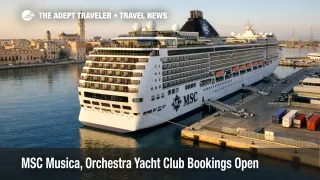
MSC Cruises has opened sales for the new MSC Yacht Club on MSC Musica and MSC Orchestra, turning what was a future upgrade announcement into a live booking decision for 2026 and 2027 sailings. The practical change is simple: travelers can now lock premium suite inventory on two older ships that are being repositioned higher in the line's onboard hierarchy through dry-dock work, new dining, and refreshed wellness spaces. What changed since MSC announced the expansion in February is that the product is no longer theoretical. It is on sale now, with MSC Musica tied to South America departures from November 2026, and MSC Orchestra tied to Eastern Mediterranean sailings from Bari, Italy, from March 2027.
The MSC Yacht Club bookings opening matters because it changes how travelers should compare these sailings against both newer MSC ships and lower priced standard cabins on the same vessels. MSC says both ships will add a 63 suite Yacht Club enclave, Butcher's Cut, Kaito Sushi Bar, a refreshed MSC Aurea Spa, and an upgraded MSC Gym Powered by Technogym(R). In plain language, this is not just a few cosmetic tweaks. It is a product tier shift that makes these ships more viable for travelers who want private spaces, bundled service, and a more controlled onboard experience on longer itineraries.
MSC Yacht Club Bookings Open on Two Older Ships
The new booking window is tied to specific deployment calendars, and that is where the traveler value sits. MSC Musica is scheduled to sail in South America from November 2026 through April 2027, with shorter Brazilian mini cruises, longer holiday runs to Buenos Aires, Argentina, Montevideo, Uruguay, and Punta del Este, Uruguay, plus a 16 night transatlantic crossing from Santos, Brazil, to Genoa, Italy, departing on April 1, 2027. After that, the ship shifts into seven night Mediterranean sailings for summer 2027. MSC Orchestra, meanwhile, is set to start sailing with the new Yacht Club from Bari, Italy, in March 2027 on Eastern Mediterranean itineraries that include ports in Türkiye and Greece.
That means the immediate decision is not whether MSC Yacht Club exists on these ships someday. It is whether your sailing date lines up with the post-refit product, and whether the premium for Yacht Club is worth paying on the itinerary you actually want. MSC says the broader program will leave all four Musica class vessels, MSC Poesia, MSC Magnifica, MSC Musica, and MSC Orchestra, with Yacht Club by mid-2027, expanding the concept across 19 ships fleetwide.
Which Travelers Get the Most Value
The best fit is not every cruiser. It is travelers who expect to use the ship heavily, care about private deck space, or want a more insulated onboard routine on sailings where the standard experience can feel busier. That makes the Yacht Club add-on more compelling on sea day heavy voyages, holiday departures, and longer repositioning or transatlantic runs than on port intensive itineraries where you are off the ship most of the day.
Repeat MSC guests who previously skipped these two ships because they lacked Yacht Club are also the clearest target. So are travelers comparing older MSC hardware with newer premium enclaves elsewhere in the market. The tradeoff is that a better top end product on an older ship can improve your personal experience while also making the rest of the ship feel more segmented, because some prime space, service attention, and higher yield inventory move behind a keyed access layer. For earlier context on the rollout, see MSC Yacht Club Added To Musica, Orchestra 2027, and for the same modernization push on a sister ship, see MSC Poesia Refit Adds Yacht Club Before Alaska 2026.
How To Book Around the Refit Window
Treat these sailings like version control. If Yacht Club is the reason you are booking, only book sailings where the new product is explicitly attached to the departure you want, not where the ship level marketing simply says the upgrade is coming. That matters most around transition periods, because cruise refurbishments are planned to tight windows and traveler assumptions often run ahead of what is actually loaded into the booking engine.
Then do the fare math honestly. Compare the Yacht Club rate against the standard balcony or suite you would otherwise buy, and ask whether the private restaurant, sundeck, butler service, lounge access, and reduced crowd friction are worth the premium for that specific sailing. On shorter South America runs, or on itinerary first trips where port time matters more than ship time, the answer may be no. On longer crossings, holiday weeks, or sailings where you want a calmer onboard day, the value case gets stronger.
The next monitoring point is inventory behavior. Once a premium enclave goes live on an older ship, suite categories can tighten faster, and standard categories do not always stay cheap just because the ship itself is older. Travelers who want Yacht Club should book confirmed post-refit dates early. Travelers who care more about itinerary than private access may find better value by staying outside the enclave and booking before awareness of the upgrade fully spreads through the market.
Why MSC Keeps Expanding Yacht Club on Older Ships
The mechanism here is straightforward. MSC is not just refreshing decor. It is using refurbishment cycles to push older ships higher up the revenue ladder by adding a more defensible premium product. That helps the line sell privacy, service, and controlled space on vessels that would otherwise compete mostly on price, itinerary, and availability. The same pattern is visible in MSC Poesia's ongoing refit and in MSC's earlier Musica and Orchestra expansion announcement.
First order, travelers get new private suites, a dedicated restaurant, and upgraded spa and gym space. Second order, the whole ship's booking mix can change. Better premium inventory can pull demand upward from standard cabins, support firmer pricing, and make older ships more appealing to guests who previously would have traded up to newer hardware or another line. That is why today's sales opening matters more than the original announcement did. It moves the story from future promise to real booking pressure.