

Rome Colosseum Restoration Opens Ancient Approach
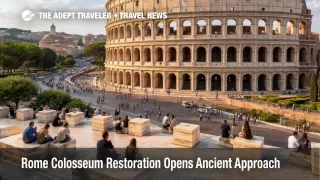
Rome's Colosseum now gives visitors a clearer sense of how the monument once worked before they even step inside. A newly restored semicircular forecourt outside the arena reopened on March 17, 2026, using fresh travertine from the same Tivoli area quarries that supplied ancient Rome, with new stone slabs marking where soaring entrance arcades once stood. For travelers, this is not just cosmetic. It changes the arrival experience at Italy's busiest monument, and it lands only months after the Colosseo, Fori Imperiali Metro C station opened beneath the site, making the approach more legible and easier to navigate in one of Rome's most crowded visitor zones.
The Rome Colosseum restoration matters most for first time visitors, shoulder season city breakers, and anyone trying to combine the Colosseum with the Roman Forum and Palatine Hill on a tight schedule. The Colosseum drew 9 million visitors in 2025, according to the Associated Press, so even an improvement that mainly changes how the perimeter is read and used still has real traveler value because it affects how people orient themselves, queue, and understand where they are before entry.
Rome Colosseum Restoration: What Changed
The newly reopened area is the southern forecourt, where Roman spectators once waited beneath two arcades supported by marble columns before entering the amphitheater. Those columns and arches collapsed over centuries, but the restoration places large travertine slabs exactly where the original pillar bases stood and restores the paving to the monument's ancient level, making the perimeter easier to read in physical space instead of only on a museum panel.
Architect Stefano Boeri said the design goal was to return a sense of the arcades' original proportions to the public. Archaeological work tied to the project also uncovered coins, statues, animal bones, and a gold ring under the forecourt area. This is the main reason the site looks brighter and more structured now. Rome did not rebuild the missing arches themselves, but it did recreate their footprint in a way that helps travelers understand how the arena originally processed huge crowds.
For visitors, the practical change is simple. The outside space is now part of the experience rather than dead ground between the street and the monument. You are getting a more interpretive arrival, clearer seating section references through reproduced Roman numerals, and a better visual bridge between the surviving Colosseum and the ruined perimeter that once organized entry flow.
Who Benefits Most From the New Piazza
This is best for travelers who care about the Colosseum as a site, not just as a checklist stop. If your plan is to take a quick exterior photo and move on, the restoration is a modest improvement. If you are booking a timed entry, pairing the Colosseum with Forum and Palatine visits, or paying for a premium route such as the underground and arena experience, the new forecourt adds context before you ever hit the turnstiles.
It also helps travelers arriving by transit. The Colosseo, Fori Imperiali station on Metro Line C opened to the public on December 16, 2025, directly beneath the area between the Colosseum and the Basilica of Maxentius. That means the traveler benefit is now layered. First order, the forecourt is easier to interpret on arrival. Second order, Rome has made one of its most congested heritage zones easier to reach and easier to read at the same time.
The biggest beneficiaries are independent travelers, families, and guided tour clients trying to make sense of a historically dense area without losing time to confusion. The tradeoff is that a better arrival experience does not mean a quieter one. With March opening hours currently running from 830 a.m. to 530 p.m., last entry 4:30 p.m., and longer hours starting March 29, 2026, the site is still a heavy volume attraction where timing matters more than aesthetics.
What Travelers Should Do Now
Book the Colosseum as a timed visit, not as a vague same day idea. The official site says standard March hours run from 830 a.m. to 530 p.m. through March 28, 2026, with last admission at 430 p.m. From March 29 to September 30, 2026, last admission shifts to 615 p.m. That makes late afternoon visits easier in the next phase of the season, but it will not eliminate crowd pressure.
Choose your ticket based on what you actually want to see. The standard visit covers the main monument, while the Full Experience Underground and Arena ticket adds the arena and underground levels and is priced from €24.00 (EUR), about $26.00 (USD), with a stated 90 minute Colosseum permanence window for that ticket type. If the underground matters to you, decide that before you buy, because this is not the kind of site where the best add on is reliably available at the gate.
For access, use the improved transit logic rather than defaulting to a taxi drop and a scramble. The new Colosseo, Fori Imperiali Metro C station now gives travelers another direct rail approach into the archaeological core. Watch for later spring crowding as longer opening hours start on March 29, 2026, and assume that the brighter, newly reopened forecourt will attract extra linger time from visitors taking photos and orienting themselves outside before entry.
Why This Is Happening, and Why Access Matters
This project is about reconstruction through legibility, not fantasy rebuilding. Rome did not try to recreate the vanished arcades in full. Instead, it used compatible travertine paving to mark the original geometry and restore the ancient walking level, which gives visitors a more accurate sense of the monument's scale without pretending the lost structures still exist. That is why the restoration feels more architectural than decorative.
The funding mechanism also matters. Project officials told the AP the Colosseum perimeter restoration used compensatory funds tied to the metro project, and reporting in Italy says CIPE Resolution No. 67 of 2019 directed Metro C compensation funding to the Archaeological Park of the Colosseum for this work. That explains why the story is really about two systems meeting each other, archaeology and mobility. Rome improved the monument's perimeter while also improving how travelers reach it.
For travelers, the result is a better threshold experience at the Colosseum rather than a new attraction detached from the old one. The Rome Colosseum restoration gives the site a more intelligible approach, while the recent metro expansion makes that approach easier to use. If you are visiting Rome in spring or summer 2026, the smart move is to treat the Colosseum as a timed, transit friendly visit that now starts outside the walls, not only once your ticket is scanned.
Sources
- Rome's Colosseum gets a fresh look that recreates the footprints of long-gone columns
- Opening Times and Tickets, Parco archeologico del Colosseo
- Full Experience Underground and Arena, Parco archeologico del Colosseo
- Online Tickets, Parco archeologico del Colosseo
- The Colosseo / Fori Imperiali Station, Metro C
- Colosseo, inaugurato il nuovo allestimento degli ambulacri meridionali