

AmaSofia Rhine Engine Failure Hits Inaugural Cruise
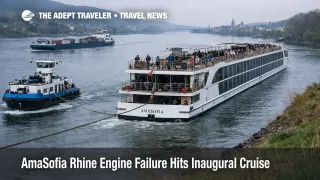
AmaSofia Rhine engine failure disrupted AmaWaterways' newest ship on March 18, 2026, after the vessel lost power on two of its three engines and had to be towed to Koblenz, Germany. The problem hit during the ship's inaugural Rhine sailing, just days after its christening in Amsterdam, and it forced a same day itinerary change as the vessel paused before entering the Rhine Gorge. For travelers, the main takeaway is that this appears to be a contained mechanical issue rather than a broader Rhine navigation shutdown, but it still shows how quickly a river itinerary can shift when a ship loses propulsion on a tightly scheduled corridor.
The immediate next step for anyone booked on near term AmaSofia departures is simple. Watch for direct communication from AmaWaterways or your advisor, and do not assume that a published port sequence will hold exactly as booked until the line confirms repairs and normal sailing. AmaWaterways' onboard sales chief said the crew aimed to resume daylight cruising through the Rhine Gorge on March 19, 2026, after repairs in Koblenz, but that timeline was presented as conditional, not guaranteed.
AmaSofia Rhine Engine Failure: What Changed
What changed is straightforward. Around 4:00 a.m. local time on March 18, 2026, AmaSofia lost power on its port side engine, then its starboard engine, leaving only the bow engine still operating. The ship anchored west of Urmitz Bahnhof, Germany, for several hours, then was towed by a cargo vessel to Koblenz rather than risk losing propulsion entirely while approaching the Rhine Gorge, one of the river's busiest and most operationally sensitive stretches.
That decision matters because river cruising does not have much slack once propulsion problems appear in a narrow, traffic heavy corridor. Unlike an ocean ship that can often drift wider or reroute around a weather band, a river ship has to manage lock timing, opposing traffic, shore excursion buses, berth availability, and daylight scenic windows in a much tighter chain. Once the vessel stopped short of the gorge, AmaWaterways shifted the day's plan away from a scheduled Rudesheim call and toward shore excursions in Koblenz instead.
AmaSofia itself is a brand new asset for the line. AmaWaterways had positioned it as a Spring 2026 debut ship for the Rhine before a June move to the Danube, and trade coverage of the March 14 christening in Amsterdam described it as the first vessel fully unveiled under the company's refreshed branding. That is why this issue drew extra attention beyond a normal mid season mechanical stop.
Which Travelers Face the Most Disruption
The travelers facing the most immediate disruption were the guests already onboard, most of whom Travel Weekly reported were U.S. travel advisors sailing on a familiarization trip after ASTA's River Cruise Expo. For that group, the practical impact was a missed or modified port call, more uncertainty around timing, and a day that shifted from scenic river progress to a repair stop and replacement touring in Koblenz.
For retail travelers booked on later March or April AmaSofia departures, the exposure is different. The main risk is not that the entire Rhine program collapses, but that a one ship technical issue can create rolling itinerary adjustments if repairs take longer than expected, require additional testing, or force an equipment workaround before the vessel enters another constrained stretch. River cruise schedules are efficient by design, which is good when operations are normal, but it leaves less buffer for propulsion or hotel system problems than many first time cruisers assume. Travelers with prebooked private transfers, independent hotel nights, or nonrefundable timed excursions at embarkation or disembarkation cities should treat those edges of the trip as the most fragile parts.
This also lands at a moment when AmaWaterways is pushing a fresh brand identity and new ship messaging into the market. That makes communication quality more important, because travelers and advisors need to know whether a service change is a one off equipment problem or a wider operational pattern. Readers who want that brand context can review AmaWaterways Rebrand: New Logo and Website for 2026, which explains how the company has been repositioning its public facing materials this year.
What Travelers Should Do Now
If you are on an affected sailing, or departing soon on AmaSofia, the right move is to prioritize operator communication over static itinerary documents. River cruise disruptions usually show up first as changed docking points, bus substitutions, late scenic segments, or port swaps, not as an outright cancellation. That means the practical question is less "Is my cruise still happening?" and more "Which parts of the original day by day plan are still intact?"
Rebook only if the trip depends on a specific scenic sequence, mobility support, or tightly chained independent plans that cannot absorb another adjustment. Wait if your main goal is still the overall Rhine cruise experience and the line confirms propulsion is restored. In most river cruise mechanical events, operators try to preserve the core vacation through bus touring, alternative berths, shipboard programming, or revised call timing before they move to more severe measures. That tradeoff matters because an early panic rebook can create extra airfare, hotel, and insurance friction that may be worse than the onboard delay itself. This is also a good moment to revisit broader river disruption planning through The 2025 European Heatwave's Impact on River Cruises, which lays out how river itineraries can unravel when a single operational constraint hits a tightly managed corridor.
Over the next 24 to 72 hours, monitor three things, whether AmaWaterways confirms repairs were completed in Koblenz, whether daylight Rhine Gorge cruising resumed as planned, and whether later departures on AmaSofia still show the same published routing. Those are the real decision points. A one day port swap is manageable. A lingering engineering issue that compresses subsequent departures would be a different story.
Why This Happening Matters on the Rhine
The confirmed cause so far is mechanical failure affecting two stern engines. What has not been publicly detailed yet is the deeper technical root cause, whether it was a propulsion control fault, engine specific malfunction, electrical distribution problem, or another systems issue. That distinction matters for engineers, but for travelers the operational mechanism is already clear, once a river ship loses redundant propulsion on the Rhine, especially before a busy scenic bottleneck like the Rhine Gorge, the safe choice is often to stop, stabilize, and bring in shoreside technical support instead of pressing ahead.
That is why this kind of disruption spreads beyond "the engine broke." First order, the ship cannot keep its original timing or call sequence. Second order, shore excursions have to be rebuilt, berth plans change, and any downstream daylight scenic promises become harder to keep. On river cruises, those second order effects can matter almost as much as the underlying fault because the product is built around sequence and place, not just transport from one city to the next.
There is no indication from current reporting that this was caused by a river wide navigation problem such as low water, closure, or a regional safety restriction. That is an important distinction. Travelers should read this as a ship specific operational interruption on a newly launched vessel, not as a sign that Rhine cruising broadly is in trouble this week.