

FAA Helicopter Safety Rule Expands At U.S. Airports
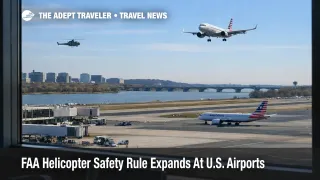
The FAA helicopter safety rule changed nationwide on March 18, 2026, when the Federal Aviation Administration ordered controllers to stop using visual separation where helicopters or powered lift aircraft cross arrival or departure paths in Class B, Class C, and Terminal Radar Service Area airspace. For travelers, this is mainly a safety and resilience story, not an immediate mass delay story. The practical takeaway is that the agency is hardening procedures at busy airports after a year long review found too much reliance on pilots to see and avoid each other in complex mixed traffic environments.
The move follows the January 2025 midair collision near Ronald Reagan Washington National Airport (DCA), plus more recent close calls at San Antonio International Airport (SAT) on February 27 and Hollywood Burbank Airport (BUR) on March 2. FAA officials said controllers will now use radar to maintain specific lateral or vertical separation instead of depending on pilot visual avoidance in those crossing situations. That matters because the traveler benefit is not faster service, but a lower chance that mixed helicopter and airline traffic will be managed with last second judgment calls near final approach paths.
FAA Helicopter Safety Rule: What Changed
What changed is procedural but important. The FAA's general notice revises air traffic control handling where helicopters or powered lift aircraft cross the flight paths of arriving and departing airplanes. Visual separation in those crossing situations must cease, and controllers must use radar based spacing instead. The rule applies across Class B and Class C airspace, plus Terminal Radar Service Areas, which means the reach is national and focused on the busier parts of the system where airline traffic and helicopter traffic mix most often.
For passengers, the immediate impact is subtle. You should not expect this to show up like a ground stop or a runway closure. What it may change is how tightly certain operations can be threaded when a helicopter wants to cross an airport's arrival or departure stream. The FAA itself said some helicopter operators may need to reroute or accept delays, and that urgent medical or law enforcement missions can still receive priority, which in some cases could disrupt airline operations to let those flights through safely.
That distinction matters. This is not a broad airline capacity cut. It is a safety margin increase that may occasionally trade a small amount of operational flexibility for more deterministic separation in places where mixed traffic geometry has proven risky.
Which Travelers Are Most Likely To Notice
Most travelers will never know this rule was applied to a particular flight. The people most likely to feel any visible effect are those flying through airports with frequent helicopter crossings near final approach or departure paths, especially when traffic is heavy or when a priority helicopter mission needs access through constrained airspace. In those cases, the rule can translate into slightly longer sequencing, small departure holds, or short arrival spacing adjustments rather than headline level disruption.
Travelers near Washington, D.C. have already seen the FAA move in this direction. After the DCA crash, the agency restricted helicopter traffic around Reagan National, later eliminated visual separation within five miles of the airport, updated route charts around DCA, Washington Dulles International Airport (IAD), and Baltimore Washington International Thurgood Marshall Airport (BWI), and then expanded permanent restrictions again in January 2026. This new notice takes the same logic and applies it much more broadly across the national system.
The traveler segment with the highest practical exposure is not leisure passengers on ordinary off peak itineraries. It is travelers on short domestic hops, tight hub connections, and late day itineraries at busier airports where a small sequencing slowdown can cascade into missed onward flights, later bag delivery, or reduced rebooking options. That is a second order effect, not a same day certainty, but it is the real operations angle to watch.
What Travelers Should Do Now
For most trips, there is nothing special to rebook around today. This is not the kind of FAA notice that should make travelers cancel plans or avoid a specific airport on its own. The better move is to treat it as a background safety change that may slightly reduce operational flexibility at some busy airports while improving separation standards overall.
Where this matters more is itinerary design. If you are booking a same day domestic connection through a helicopter heavy metro area, especially on the last viable flight of the evening, a little more buffer is smarter than before. Waiting for the minimum legal connection may still work, but the tradeoff is tighter recovery options if sequencing slows around a priority helicopter movement or other mixed traffic constraint. A nonstop remains the cleaner choice where the schedule difference is small. That is not because the system is broken, but because the FAA is intentionally removing one tool controllers used to use for speed and flexibility.
Over the next 24 to 72 hours, what matters most is whether this remains a pure safety story or turns into a measurable operations story at specific airports. Travelers should watch airline apps, airport status pages, and FAA delay tools for any location specific impacts. As of now, the FAA has framed this as a protective procedural change, and it has not announced a national schedule reduction tied to the notice.
Why The Rule Is Changing
Visual separation is a procedure in which controllers alert pilots to nearby traffic and the pilots remain clear visually instead of relying on standard separation. The FAA said its review found that approach was not enough in high traffic areas where helicopters cross airline arrival and departure paths. In plain language, the agency decided that see and avoid works too unevenly when aircraft are converging in dense, fast moving terminal airspace.
The two recent close calls help explain the mechanism. At San Antonio on February 27, an American Airlines flight and a police helicopter were on converging courses before the helicopter turned away. At Burbank on March 2, a helicopter turned to avoid a Beechcraft 99 after conflicting with its final approach path. Those events were not catastrophic, but they reinforced the same pattern the FAA says it found after the DCA collision, too much dependence on pilot visual acquisition in places where there is little room for ambiguity.
That is why this rule matters even if passengers do not feel it immediately. First order, it changes how controllers separate helicopters and airplanes at busy airports. Second order, it can reshape how priority helicopter flights are threaded through terminal airspace and how much slack airlines have in banked arrival and departure periods. The likely outcome is safer, more rule based handling, with small operational tradeoffs surfacing only when traffic, timing, and mission priority collide.
Sources
- FAA announcement on new airplane and helicopter separation measure
- FAA GENOT JO 7110.801, Interim Helicopter Separation Procedures
- FAA statements and DCA helicopter restriction updates
- Reuters, U.S. FAA tightens helicopter safety rules near major airports
- AP News, FAA expands radar separation mandate for helicopters and planes