

United Elevated 787-9 Bookings Open for April Debut
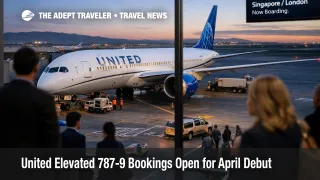
United Elevated 787-9 bookings are now open, which gives long haul travelers their first real shot at choosing United's new premium heavy Boeing 787-9 on two flagship routes out of San Francisco International Airport (SFO). The first scheduled international flight is San Francisco to Singapore on April 22, 2026, followed by San Francisco to London Heathrow Airport (LHR) on April 30, 2026. For travelers, the immediate decision is not just whether to pay for the new cabin, but whether to lock in a seat now before aircraft-specific demand pushes premium pricing higher. United is positioning this as its most premium international aircraft, with 99 premium seats and a new top tier called Polaris Studio.
In practical terms, this is a product launch with real booking consequences. United's new 787-9 layout includes eight Polaris Studio suites, 56 standard Polaris seats, 35 Premium Plus seats, 39 Economy Plus seats, and 84 Economy seats. That means the cabin is tilted much harder toward higher yielding travelers than a typical long haul jet, which should matter for mileage users, corporate buyers, and anyone trying to secure a specific seat map instead of merely a business class fare bucket. United has also said it expects as many as 30 of these aircraft to be flying globally by the end of 2027, but for now the practical entry point is still San Francisco.
United Elevated 787-9 Bookings: What Changed
What changed on March 19, 2026, is that this cabin moved from announcement mode to saleable inventory. That matters because premium airline launches are often interesting in theory but messy in practice until passengers can actually select flights, compare seat maps, and price the product against competing carriers. In this case, United has opened sales for the first two planned international routes using the new interior, San Francisco to Singapore from April 22 and San Francisco to London from April 30.
The headline feature is Polaris Studio, a front row business class suite that United says is 25 percent larger than a standard Polaris seat. Studio passengers get a lie flat, all aisle access seat, a privacy door, an ottoman that can serve as a companion seat, a 27 inch 4K OLED screen, wireless charging, Bluetooth connectivity, upgraded amenity kits, and an Ossetra caviar amuse bouche service. Standard Polaris also gets privacy doors and larger screens, which means this is not just a tweak to soft product, it is a hard product reset on a key slice of United's long haul fleet.
Who Benefits Most From the New United Premium Cabin
The travelers who benefit most are not all buying the same thing. Corporate travelers on San Francisco to Singapore are the most obvious fit because that route is long enough for sleep quality, privacy, and direct aisle access to materially change how usable the arrival day feels. Premium leisure travelers on milestone trips to Singapore or London also have a clearer reason to book early, because the new cabin is part of the trip value, not just a transport detail. Travelers willing to buy Premium Plus rather than Polaris also gain from the aircraft's premium heavy layout, because more premium seating often changes upgrade dynamics and seat selection pressure across the rest of the plane.
There is a tradeoff, though. Booking a route that is scheduled for the Elevated 787-9 is not the same thing as a lifetime guarantee that the exact aircraft will operate your flight. Equipment swaps can still happen, and premium launches often attract outsized demand from frequent fliers, reviewers, and mileage users chasing the newest hard product. That means travelers who care specifically about Polaris Studio should think like aircraft shoppers, not just fare shoppers. United itself has been framing these new San Francisco flights as the first place this product will appear, which makes them the most exposed to that early demand surge.
What Travelers Should Do Before Booking
Travelers who want the new hard product should book the specific San Francisco departures now, then keep monitoring the seat map and aircraft assignment as departure approaches. The main threshold is simple. If the cabin itself is the reason for the trip purchase, or if you are booking a very long sector like San Francisco to Singapore, locking in earlier makes more sense than waiting for a theoretical fare dip. If your priority is just reaching London or Singapore in a flat bed at the lowest possible price, waiting may still be rational, because older Polaris equipped aircraft can still offer decent value without the launch premium.
Mileage travelers should also assume competition will be intense. A premium heavy cabin can create more premium inventory overall, but the eight Polaris Studio suites are few enough that they will be scarce by definition. Travelers booking with cash or miles should compare the new United offer against rivals on the same city pairs, especially if schedule, lounge access, or alliance benefits matter more than being first onto a new seat. That is where this stops being a product story and becomes a trip planning decision.
For travelers who want more context before committing, United Polaris SFO 787 9 Suites With Doors Launch 2026 laid out the earlier rollout plan, and American Airlines Flagship Suite Expands to Three Continents is a useful comparison point for how U.S. carriers are now competing for premium long haul buyers.
Why United Is Betting So Hard on Premium Heavy 787-9s
The mechanism here is straightforward. United is concentrating premium seats on long haul aircraft where corporate demand, ultra long sectors, and hub strength give the airline the best chance to earn more revenue per departure. San Francisco is the logical starting point because it already supports both high yield transpacific traffic and premium leisure demand, and because Singapore and London are strong showcase routes for a new business class product. In other words, this is not just a cabin refresh, it is network strategy expressed through seat density and product hierarchy.
The first order effect is obvious, travelers on these flights get a more competitive premium experience. The second order effect is where it gets more interesting. When one large U.S. carrier puts more premium inventory and more visible luxury cues onto major international routes, competitors face pressure to answer, whether through better suites, more lounge investment, or sharper upgrade and fare strategy. Travelers may benefit from that arms race, but they should also expect premium cabins on marquee routes to become even more segmented, with a top shelf product inside business class itself rather than a simple business versus premium economy split.