

Whittier Shore Power Project Gains Carnival Backing
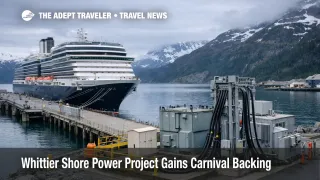
The Whittier shore power project moved further into public view on March 19, 2026, as Carnival Corporation said work remains on track for completion in 2027. The project matters mainly for Holland America Line and Princess Cruises sailings that use Whittier, Alaska, as a cruise gateway, because ships would be able to shut down their engines at berth and draw electricity from the local grid instead. This is a structural port upgrade, not an immediate booking disruption. Travelers planning Alaska cruises do not need to change plans now, but they should expect Whittier to become a cleaner and quieter turn port once the system goes live.
Whittier Shore Power Project: What Changed
Carnival Corporation said it is supporting the Whittier Cruise Ship Terminal Electrification Project in partnership with the state of Alaska and Chugach Electric Association. The company said the work began in 2023 and remains on track for completion in 2027. Once finished, the project is designed to let Holland America Line and Princess Cruises ships connect to shore power in port rather than continue running onboard engines for hotel load and ship systems while docked.
The project scope goes beyond a simple plug at the pier. State planning documents and project materials describe electrical system upgrades, voltage step down equipment near the cruise dock, and shore power connections that also support electric vehicle charging. That makes this more than a sustainability talking point. It is a port utility build that depends on grid, dockside, and vessel side compatibility all coming together on the same timeline.
Who Benefits Most From the Upgrade
The clearest beneficiaries are cruise passengers embarking or disembarking in Whittier, along with residents and businesses near the terminal. For travelers, the direct change is not faster boarding or a new itinerary. The benefit is a cleaner port environment with less engine noise and lower at berth emissions once compatible ships can plug in. For the local community, the project aims to reduce greenhouse gas and other emissions in a small port that sits close to both tourism activity and daily life.
This matters most for Princess Cruises and Holland America Line because Carnival tied the project specifically to those Alaska operations. The project also fits the profile of Whittier as a gateway port tied to cruise transfers, rail connections, and overland moves to and from Anchorage, Alaska. First order, ships at berth can shift power demand off their engines. Second order, the port becomes better positioned for stricter environmental expectations, future infrastructure investment, and a more resilient operating model for cruise calls in Alaska.
What Travelers Should Do Now
Most travelers should treat this as a medium term planning signal, not a reason to change a 2026 booking. The system is not scheduled to be complete until 2027, so current sailings will continue under existing port conditions unless operators announce a separate operational change. The practical move now is simply to understand that Whittier is being upgraded as part of a broader shift in Alaska cruise infrastructure.
For travelers choosing between Alaska cruise gateways in 2026 and 2027, the decision threshold is timing. If environmental performance in port matters to you, later sailings after the project enters service may offer a more attractive Whittier experience. If your priority is itinerary, ship, or rail transfer convenience, there is no evidence yet that the electrification project by itself should outweigh those factors.
Over the next 12 to 18 months, watch for three signals. The first is confirmation that the 2027 completion date still holds. The second is whether Princess and Holland America identify specific ships and call schedules that will use the new shore power system. The third is whether Whittier's electrification becomes part of broader Alaska booking language, as cruise lines increasingly market port side emissions reductions alongside itinerary and destination appeal.
Why This Is Happening, and What Comes Next
Carnival framed shore power as part of its path toward net zero greenhouse gas emissions from ship operations by 2050. The underlying mechanism is straightforward. Cruise ships still need substantial power while in port for lighting, food service, climate control, and other onboard systems. Without shore power, that energy usually comes from the ship itself. With shore power, a compatible vessel can connect to landside electricity and stop running engines for those needs while docked.
Whittier also fits a wider regional and industry pattern. Shore power has moved from an early demonstration concept to a more serious infrastructure standard in major cruise markets. Carnival pointed back to Juneau, Alaska, where Princess helped pioneer an early shore power project in 2001. The next step in Whittier is execution, not concept. If construction and utility work stay on schedule through 2027, the port should be able to join the growing list of cruise locations where environmental performance is shaped as much by dockside power capacity as by the ship itself.
Sources
- Carnival Corporation Expands Shore Power Commitment
- Port Electrification Advances at Whittier, Alaska
- Cruise Ship Terminal Port Electrification FY2027 Request, State of Alaska
- Whittier Cruise Ship Terminal Port Electrification FY2026 Project Summary, State of Alaska
- Grant Application for the Whittier-Chugach Cruise Terminal Electrification Project
- Chugach Electric Association Portage to Whittier Shore Power Line Rebuild, U.S. Forest Service