

Morocco Passport Help Tightens During Eid Closure
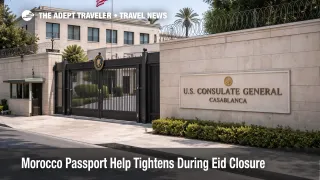
Morocco passport replacement help is tighter from March 20 to March 23, 2026, because U.S. Mission Morocco says its facilities are closed for Eid al-Fitr and the State Department's Morocco guidance says travelers departing on a replacement passport may be asked by airport police for the local loss report. The immediate exposure is narrow but real: travelers who lose a passport, have one stolen, or discover a document problem during the closure window have fewer routine recovery options and more exit friction. For anyone already in that situation, the safest move is to treat paperwork order as the priority, secure the police report first, keep proof of citizenship handy, and build extra airport time into any departure plan.
Morocco Passport Replacement: What Changed
The operational change is not a new border rule, but a temporary access squeeze. U.S. Mission Morocco said all facilities would be closed from Friday, March 20, 2026, through Monday, March 23, 2026, in observance of Eid al-Fitr, while the State Department's Morocco page continues to direct U.S. citizens needing consular help to the U.S. Consulate General in Casablanca, not Embassy Rabat. That matters because Rabat does not offer public consular services, so a traveler who assumes the embassy is a fallback is already working from the wrong playbook.
The second operational point is more important for departures than many travelers realize. The State Department says U.S. citizens who lose a passport in Morocco may apply for a temporary emergency passport in Casablanca, should obtain a police report where the loss or theft occurred, and may be asked by airport police for that report when leaving Morocco on the replacement document. That means document recovery is not finished when a new passport is issued. Departure can still slow down if the traveler cannot show the police paperwork that matches the replacement case.
Which Travelers Face the Most Friction
This hits a specific group, not the average visitor with intact documents. The most exposed travelers are those who lose a passport during the holiday closure, discover too late that a passport is missing before an onward flight, or need urgent consular help while already on a tight itinerary through Casablanca, Rabat, Marrakech, or Tangier. It also matters more for travelers at the end of a trip than at the beginning, because the pressure point is often not sightseeing or hotel check in, but getting cleared to board and depart.
Families and dual nationality cases can face even more friction. The Morocco country page warns that some children holding U.S. passports who were born to a Moroccan father may have difficulty leaving Morocco without the father's permission under Moroccan law, even when parents are divorced and the mother has legal custody. That is not new, but it changes the risk calculation for any family already dealing with a lost document during a closure period, because a routine passport problem can overlap with a separate exit-control issue.
The first order effect of the closure is delayed routine help. The second order effect is trip compression: extra hotel nights, changed air tickets, and missed onward flights when travelers cannot sequence police reporting, emergency passport issuance, and airport clearance smoothly. In Morocco, where local police handle the loss report and airport police may want to see it on departure, the process is not a single counter interaction. It is a chain, and every break in that chain costs time.
What Travelers Should Do Before Departure
Travelers already in Morocco with intact documents should lower their odds of needing help. Carry a copy of the passport, keep a digital copy stored securely, and separate backup ID from the original document. The State Department specifically advises carrying a copy of the U.S. passport as proof of identity and citizenship if needed. That will not replace a passport for travel, but it can help when reporting the loss to police, especially because the guidance notes that police have recently required evidence of U.S. citizenship before issuing a loss report.
Travelers who have already lost a passport should sequence the case carefully. First, report the loss or theft to local police in the area where it happened and obtain the report. Then contact the U.S. Consulate General in Casablanca using the emergency channels listed on the State Department page if the situation cannot wait for routine reopening. Finally, once a replacement passport is issued, do not assume the airport step will be automatic. Bring the police report, the replacement passport, booking records, and any other identity evidence to the airport, and arrive earlier than usual.
The decision threshold is simple. If you are flying during or just after the March 20 to 23 closure window and your passport situation is unresolved, do not plan on a normal arrival-to-departure timeline. Protect the flight only if you already have the police report and a workable path to the replacement document. If not, the safer move is usually to shift the flight before no show penalties or same day airport stress make the problem more expensive.
Why the Paperwork Chain Matters Next
What happens next is straightforward. Routine services should resume after the holiday closure ends, but travelers caught inside the window still face a short period where time matters more than policy novelty. This is a process story, not a security scare. The main risk is that travelers underestimate how many handoffs are involved, local police, consular documentation, and airport departure control, and build an itinerary with no slack.
The broader mechanism is worth understanding. In many countries, a replacement passport solves only the identity side of the problem. Exit authorities may still want proof that the original loss was formally recorded, especially when the traveler is leaving on a newly issued emergency document. Morocco's own U.S. travel guidance makes that explicit by warning that airport police may request the report, and by noting that passports cannot legally be sent through the mail across international borders in Morocco. That removes an easy workaround and pushes travelers back toward in person recovery.
For now, the practical signal to watch is not whether Morocco changes its entry rules, but whether your paperwork chain is complete before you head to the airport. Travelers with upcoming departures from Mohammed V International Airport (CMN) or other Moroccan gateways should assume longer margins are prudent if a passport case is involved. Emergency help still exists, but this closure narrows the room for error.