

Venezuela Level 3 Advisory Still Leaves Border Risk
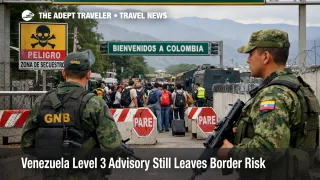
The Venezuela travel advisory changed in a way that some travelers could misread. On March 19, 2026, the U.S. Department of State lowered Venezuela from Level 4 to Level 3, removed several earlier risk indicators, and updated the advisory to reflect a phased approach to resuming embassy operations. But the same advisory still warns against travel to the Venezuela, Colombia border region and several states because of crime, kidnapping, and terrorism, while routine consular services remain suspended in Venezuela. For travelers, that means the downgrade is not a clean reopening signal, it is a narrower reassessment inside a country where help on the ground remains limited if something goes wrong.
Venezuela Travel Advisory: What Changed
The formal change is real. The State Department now rates Venezuela at Level 3, "Reconsider Travel," instead of Level 4, "Do Not Travel." It also says the "Wrongful Detention," "Unrest," and "Other" risk indicators were removed, and that the advisory summary was updated to reflect changes to U.S. embassy operations. That is a meaningful shift in official language, and it will likely alter how some travelers, corporate security teams, and trip planners read the destination.
What did not change is just as important. The advisory still warns of crime, kidnapping, terrorism, and poor health infrastructure. It also carves out multiple Level 4 zones where the U.S. government says travelers should not go at all, including the Venezuela, Colombia border region within 20 miles of the border, Amazonas state, Apure state, Aragua state outside Maracay, rural areas of Bolivar state, Guarico state, and Tachira state. That means the headline level is lower, but the map inside the country still contains several no go areas with very sharp language.
The embassy language also improved only in a limited sense. State says it began a phased approach to resuming embassy operations in January 2026, but routine consular services remain suspended in Venezuela, most consular services are still handled through U.S. Embassy Bogotá, and the Venezuela Affairs Unit cannot provide emergency services to U.S. citizens outside Caracas.
Which Travelers Face The Most Exposure
The biggest misread would be to treat Level 3 as a practical green light for independent leisure travel. It is not. Travelers most exposed are people planning overland movement near border departments, business travelers moving outside Caracas, dual nationals or visitors with document complexity, and anyone relying on the idea that U.S. consular help will work the way it does in a normal destination. The advisory is clear that the U.S. government is extremely limited in its ability to offer emergency services, especially outside Caracas.
The border piece is the operational pressure point. The Venezuela, Colombia border region remains a Level 4 area because of crime, kidnapping, and terrorism, and State says terrorist groups and criminal groups operate there. That matters even for travelers who are not trying to "visit the border" in any obvious way, because trips involving overland transfers, family visits, business stops, or rerouted ground movement can drift into higher risk corridors faster than travelers expect. The first order effect is personal safety risk. The second order effect is that a transport problem, lost document problem, or medical problem becomes harder to solve when emergency support is thin and border areas are already flagged as high threat.
Airport and urban movement also carry caveats. State warns that unregulated taxis from Maiquetía Simón Bolívar International Airport serving Caracas raise security risk, that ATMs near the airport carry risk, and that nighttime travel between cities, or between the airport and Caracas, is risky. Those are not abstract background notes. They affect when travelers should arrive, how they should book transfers, and whether they should accept a same day road move after a delayed flight.
What Travelers Should Do Before Departure
Travelers considering Venezuela should plan around support limits first, not around the headline advisory number. That starts with documents, transport, and exit options. State says visas are required, they are not available on arrival, and travelers risk detention for entering without a valid Venezuelan visa. It also says the U.S. government cannot help U.S. citizens replace lost or expired Venezuelan travel documents or obtain Venezuelan entry or exit stamps. A traveler entering with fuzzy paperwork is taking a much larger operational risk than the Level 3 label suggests.
For most readers, the right threshold is simple. Do not build an itinerary that depends on overland border movement, ad hoc ground transport, or fast government help if documents, health, or security issues arise. If the trip is optional and includes border state exposure, nighttime intercity road travel, or weak medical backup, waiting remains the safer choice. If the trip is essential, travelers should prearrange airport transfers, avoid unregulated taxis, carry extra medication, confirm medical evacuation coverage, and maintain a departure plan that does not depend on U.S. government assistance.
The next monitoring window is not just the advisory level itself. Travelers should watch for any expansion of actual embassy services in Caracas, any change to the list of Level 4 areas, and any transport or security alert affecting corridors near the Colombia frontier. A lower headline level without broader consular restoration still leaves a thin margin for error.
Why The Downgrade Does Not Equal Normalization
The best way to interpret this move is as a narrower policy recalibration, not a return to normal travel conditions. State's own explanation says the level decreased to 3, some prior risk indicators were removed, areas of increased risk were added, and the advisory summary was updated to reflect changes to embassy operations. In plain terms, Washington is saying the countrywide label now fits "reconsider travel" better than "do not travel," while still drawing very hard lines around the most dangerous regions and acknowledging that routine support on the ground remains suspended.
That distinction matters for booking behavior. Level 3 can make a destination look newly viable in search results, insurance decisions, and internal company approvals. But the mechanism travelers need to understand is that advisory downgrades and functional travel support are not the same thing. A country can become less restricted on paper while still being hard to recover from operationally if a trip goes sideways. In an earlier Adept Traveler article, U.S.-Venezuela Tensions, Colombia's Role, And Travel, the central issue was regional tension and border spillover. The March 19 downgrade changes the official framing, but it does not remove the core lesson that border exposure and limited U.S. support still shape the real traveler risk.