

Viking Libra Float Out Marks 2026 Hydrogen Debut
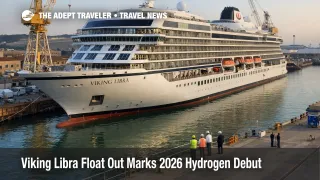
Viking Libra hydrogen cruise plans just became more concrete for travelers considering a late 2026 or 2027 sailing. On March 19, 2026, Viking said the 998-guest Viking Libra was floated out at Fincantieri's Ancona yard in Italy, moving the ship into its final construction phase ahead of a scheduled November 2026 delivery and an inaugural season in the Mediterranean and Northern Europe. The immediate effect is not a route change or a new booking rule, but a stronger signal that Viking's first hydrogen-capable ocean ship is progressing toward service. Travelers interested in lower-emission cruising now have a more credible timeline, while risk-averse buyers still need to remember that float out is a milestone, not a delivery.
Viking Libra Hydrogen Cruise: What Changed
The float out matters because it is the point where the ship first touches water and shifts from hull construction toward outfitting, systems installation, and interior completion. Viking said the ceremony at Fincantieri's Ancona Shipyard began with a cord cut to flood the building dock, and that the ship will now move to a nearby outfitting dock for final construction and interior build-out. The company still says delivery is due in November 2026, with inaugural itineraries planned in the Mediterranean and Northern Europe.
For travelers, that changes the story from a concept announcement into a live delivery watch. Viking first detailed Libra in April 2025, but the March 2026 float out is a more meaningful operational checkpoint because delays become easier to judge once a ship has reached outfitting. That does not remove schedule risk, especially for a first-of-its-kind propulsion package, but it does narrow the gap between announcement language and a ship that is visibly moving toward service.
Who Benefits Most From Viking's New Ship
The best fit is the traveler who already likes Viking's small-ship ocean product and wants a newer vessel with a lower-emission story, not someone choosing purely on novelty. Viking says Libra will be a 54,300 gross ton ship with 499 staterooms for 998 guests, keeping the same broad size and positioning as the line's other ocean ships. That means the onboard experience should look familiar to existing Viking guests, with the differentiator centered on propulsion rather than a radically different onboard layout or mass-market resort style.
This will likely appeal most to two groups. One is repeat Viking cruisers who want the newest ship in the fleet and are comfortable with inaugural-season variables. The other is sustainability-minded buyers who want a cruise option tied to hydrogen and fuel-cell technology, especially for regions where ports and regulators are tightening environmental standards. In an earlier Adept Traveler article, Viking Vesta Debuts With Sustainable Ambitions described how Viking has been positioning newer ships around incremental efficiency gains and future lower-emission operations. In another Adept Traveler article, Havila plans 12-day climate-neutral cruise in Norway we noted that Northern Europe is becoming a test bed for cleaner cruise technologies.
What Travelers Should Do Before Booking
Travelers interested in Viking Libra should treat this as an early confidence signal, not a guarantee that every inaugural-season detail is locked. Booking early may make sense for buyers who prioritize cabin choice, opening-season sailings, or Viking's newer hardware. Waiting may be smarter for travelers who dislike first-season uncertainty, because delivery schedules, early-service adjustments, and even exact deployment details can still shift during outfitting and sea trials.
The next decision threshold is simple. Book once Viking publishes the specific Libra departures you want and the cancellation terms match your risk tolerance. Hold off if you would be significantly disrupted by a ship swap, a delayed inaugural sailing, or itinerary adjustments tied to final delivery timing. That tradeoff is sharper on a first-in-class vessel because new propulsion systems can add complexity even when the ship is otherwise based on an established platform.
Travelers should also watch what Viking says about where Libra's zero-emission capability will matter operationally. The company's wording is careful. It describes a hybrid propulsion system based partially on liquefied hydrogen and fuel cells, capable of navigating and operating with zero emissions, especially in environmentally sensitive areas. That is more specific than saying the ship runs only on hydrogen all the time, and buyers should not overread the claim beyond what Viking has confirmed.
Why The Technology Matters, and What Happens Next
The bigger significance is that Viking and Fincantieri are trying to move hydrogen from a maritime talking point into a commercially operating cruise product. Viking says Libra's propulsion system is based partially on liquefied hydrogen and fuel cells, with fuel-cell output of up to six megawatts supplied through Fincantieri subsidiary Isotta Fraschini Motori. Fincantieri and Viking have framed that as a way to let the ship operate with zero emissions in at least some situations, which could matter more as sensitive cruise regions and ports impose tougher environmental limits.
What happens next is straightforward. Libra moves through outfitting, then testing, then delivery if the schedule holds. Viking's next ocean ship, Viking Astrea, is also under construction and due in 2027 with similar hydrogen-powered capability, so Libra is not a one-off publicity exercise inside the fleet plan. The seriousness for travelers is moderate, not urgent. No one needs to rebook a current trip because of this announcement. But for 2026 and 2027 cruise shoppers, especially in the Mediterranean and Northern Europe, the float out makes Viking's hydrogen strategy more real, and it gives travelers a clearer point to start comparing environmental claims against actual deployment, pricing, and inaugural-season risk.
Sources
- Viking Announces Float Out of the World's First Hydrogen-Powered Cruise Ship, Viking
- Viking and Fincantieri Announce World's First Hydrogen-Powered Cruise Ship and Two New Ship Orders, Viking IR
- Viking Libra ship page, Viking
- Fincantieri Floats for Viking "First Hydrogen-Powered Cruise Ship", The Maritime Executive