

Women Adventure Travel Demand Rises, Lindblad Says
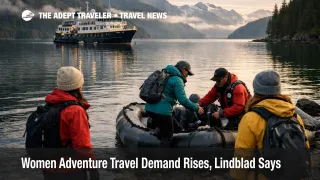
Women adventure travel is gaining momentum in the United States, at least by one major expedition operator's latest measure. National Geographic-Lindblad Expeditions said on March 20, 2026, that a survey of 2,000 American women found 66% were interested in adventure travel and 73% were eager to experience new ways to travel. For travelers, advisors, and expedition brands, the signal is less about a single marketing statistic and more about the kind of trip women appear to be prioritizing, active, expert-led, immersive travel with room for solo participation, learning, and connection. The practical takeaway is that operators selling expedition cruises, guided active trips, and small-group nature travel have a clearer demand story, while travelers may see more products, pricing experiments, and solo-friendly inventory built around that demand.
Women Adventure Travel Is Moving Further Mainstream
The immediate change here is not a new route, a new ship, or a new rule. It is a demand signal from a supplier with a direct view into one of travel's higher-value segments. Lindblad said its survey found that curiosity is a key driver, with 40% of respondents saying their interest in adventure travel was fueled by curiosity without fear or hesitation. The company also said more than a third of women reported becoming more curious later in life. CEO Natalya Leahy framed the shift as a move away from passive sightseeing and toward trips built around engagement, learning, and deeper understanding of place.
That matters because adventure travel is operationally different from generic leisure travel. It usually involves smaller group sizes, tighter inventory, more specialized staffing, more complex logistics, and higher per-trip pricing. When demand grows in that part of the market, the effects show up in limited berth availability, earlier booking curves, and more suppliers trying to differentiate with guides, scientists, photographers, and purpose-driven itinerary design. The 2025 Adventure Travel Trade Association trends report points in the same direction, describing growing demand for expert-led, women-focused, family-oriented, and low-impact itineraries.
There is one important limit. This is a company-linked survey, not a neutral census of the entire U.S. travel market. It is useful as a directional signal, especially because Lindblad operates in expedition travel and can compare what it hears in research with what it sees in bookings and onboard behavior, but it should still be read as operator-backed evidence rather than a full market measurement.
Which Travelers and Suppliers Benefit Most
The biggest winners are likely to be expedition cruise lines, active tour operators, and small-group brands that can reduce friction for women traveling alone or across generations. Lindblad explicitly said it is seeing more women traveling solo and choosing journeys that create connection to nature, other people, and themselves. That fits a broader industry picture in which women are increasingly shaping travel demand, not only by traveling more, but by steering product design toward smaller groups, stronger safety signaling, and more meaningful itinerary substance.
The fit is strongest for women who want structure without a rigid mass-market feel. Expedition cruises, wildlife trips, guided hiking programs, polar voyages, and science-led sailings all lower the planning burden while keeping the trip active. That is especially relevant for solo travelers, who often want independence without having to solve every safety, transfer, and logistics problem alone. It also helps multi-generational travelers who want a shared trip with more purpose than a standard beach holiday.
Suppliers that can translate this demand into practical booking improvements should gain first. That means fair solo pricing, transparent activity levels, strong pre-trip information, experienced guides, and itineraries that feel intentional rather than performative. National Geographic reported in August 2025 that women-only tours are rising, that the Adventure Travel Trade Association has seen a large increase in companies catering specifically to women, and that solo travel demand remains disproportionately female.
What Travelers Should Do Next
Travelers interested in this part of the market should book with a sharper eye on fit than on brand glamour. The main decision point is not whether a trip is labeled adventurous, but whether its actual operating model matches your comfort level. Look closely at group size, activity grading, medical and evacuation support, solo pricing, cabin or room supplement policies, guide credentials, and how much of the itinerary is expert-led versus merely escorted.
For solo travelers, the cost structure matters almost as much as the route. A trip can look empowering in the marketing and still become poor value once single supplements, internal flights, hotel nights, and gear requirements are added. If you are comparing expedition products, prioritize operators that are explicit about solo inventory and cancellation terms. In an earlier Adept Traveler article, Ponant waives single supplement for solo voyages showed how fast pricing friction can change the math for solo expedition buyers.
The next 24 to 12 months will likely bring more women-specific or women-forward product design, but travelers should not assume that more choice automatically means better access. In adventure travel, inventory is often small by design. If demand keeps shifting toward immersive, small-group, learning-led trips, the likely next step is earlier booking pressure on the best departures, especially for polar, wildlife, and expedition-cruise itineraries.
Why the Shift Is Happening, and What Comes Next
The mechanism is straightforward. Women with more financial independence, more willingness to travel solo, and stronger interest in purposeful travel are pushing suppliers toward products that trade passive consumption for active participation. That means more guided exploration, more specialist-led departures, and more itineraries built around nature, science, culture, and personal challenge rather than simple destination collecting. National Geographic's 2025 reporting on women-only tours described a similar pattern, with operators expanding women-focused offerings as demand rises.
There is also a second-order effect for the wider travel industry. When demand shifts toward smaller, more curated trips, mainstream brands often borrow the format. Expect more expedition-style shore programs, more active land extensions, more solo-friendly promotions, and more messaging around learning, community, and conservation. ATTA's 2022 research adds weight to that commercial logic, noting that women comprise 57% of respondents' clients on average in the adventure segment.
What happens next depends on whether suppliers follow the demand with operational substance. The market does not need more vague empowerment branding. It needs better solo pricing, safer and clearer trip design, honest activity descriptions, and itineraries that respect why women are choosing adventure travel in the first place. If brands get that right, women adventure travel will keep expanding from a trend line into a structural force inside premium and experience-led travel.