

Prague Protest Travel Risk After Letná Rally
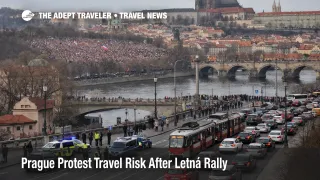
Prague protest travel risk rose on March 21, 2026, after a massive, peaceful anti government rally drew roughly 200,000 to 250,000 people to Letná in Prague, Czech Republic. For travelers, the immediate issue is not a citywide shutdown. It is concentrated disruption around one of Prague's most symbolic gathering sites, with slower road movement, heavier policing, and more fragile timing for airport transfers, station runs, tours, and timed entries as crowds arrive and disperse. The next traveler decision is simple, avoid the protest zone on demonstration days, add buffer time in central Prague, and expect more rallies because organizers have already signaled that this was not the last one.
Prague Protest Travel Risk: What Changed
What changed on March 21 was scale. Prague has seen protests before, but Reuters and AP both described this as the biggest anti government demonstration in years, centered on Letná, the hilltop plain north of the historic core that has long served as a national political gathering space. The rally was reported as peaceful, which matters for travelers because peaceful demonstrations usually create delay and access problems more than direct safety threats. That still affects itineraries in practical ways when a crowd this large compresses road space, transit access, and taxi availability near a major visitor corridor.
The deeper change is that the protest appears to mark the start of a renewed demonstration cycle, not a one day outburst. The organizing group, Million Moments for Democracy, had been building toward the Letná rally for weeks, publicly calling supporters from around the country to gather at 3:00 p.m. on March 21. AP reported that more protests are expected. For travelers, that shifts the planning problem from a single Saturday crowd event to a continuing need to watch for central Prague demonstration windows, especially on weekends and politically sensitive dates.
Which Travelers Will Feel the Most Friction
Travelers staying in or moving through central Prague are the most exposed, especially those relying on surface transfers between hotels, Praha hlavní nádraží [Prague Main Railway Station], Praha Holešovice, coach pickup points, and the historic center. Letná sits close enough to key visitor districts that large demonstrations can spill into surrounding roads and reshape how quickly cars, rideshares, and buses move across the city. The first order effect is delay. The second order effect is tighter margins for everything connected to a fixed time, including walking tours, restaurant reservations, river cruise departures, and onward rail or airport connections.
Short stay visitors are more vulnerable than longer stay visitors because they usually have less slack in the schedule. Conference travelers, cruise extension passengers, and airport hotel guests crossing the city on a clock are more likely to feel the impact than travelers with flexible sightseeing plans. Most visitors outside Prague, or those making point to point trips elsewhere in the Czech Republic, are unlikely to see the same level of disruption unless organizers expand the protest footprint or parallel rallies affect local centers. AP reported that earlier related demonstrations had already spread to hundreds of municipalities, but Prague remains the main traveler pinch point because it concentrates both the political symbolism and the visitor traffic.
What Travelers Should Do Now
Travelers with Prague arrivals, departures, or timed bookings over the next several days should treat central city movement as less predictable than usual. On any future demonstration day, the safest assumption is that road travel around Letná and adjacent districts will take longer than map apps suggest. Metro and tram combinations usually offer more resilience than cars when crowds are concentrated in one part of the city, but even then, the last segment on foot can slow as police cordons and pedestrian density build.
The threshold for changing plans is not the existence of a protest by itself. It is the combination of crowd size, route dependence, and your margin for error. If your day depends on a hard deadline, such as an airport departure, a rail connection, a guided tour with forfeitable tickets, or a business meeting, leave earlier than usual and avoid threading through Letná unless official updates show no restrictions. If your plans are discretionary, the better move is to shift sightseeing toward neighborhoods away from the demonstration zone until the crowd clears.
Over the next 24 to 72 hours, travelers should watch for three signals, whether organizers announce a date and place for the next rally, whether Prague police or transport operators publish route changes, and whether demonstrations stay peaceful and localized. If those conditions hold, the likely outcome is recurring inconvenience rather than a broad tourism shutdown. If demonstrations spread, run later into the evening, or draw counter protests, the disruption profile changes fast.
Why The Protests Happened, and What Comes Next
The confirmed reason for the March 21 protest is political opposition to the new government of Prime Minister Andrej Babiš and concern about specific policies that critics say could weaken democratic checks, public media independence, civil society, and support for Ukraine. Reuters highlighted fears around defense spending cuts, pressure on public media, and new transparency rules for NGOs. AP reported that protesters also object to the government's coalition makeup, its direction on migration and environmental policy, and parliament's refusal to lift Babiš's immunity in a fraud case. Those are political drivers, but for travelers the operational point is simpler, the issue behind the demonstrations is structural and unresolved, which makes repeat mobilization more likely than a quick fade.
What happens next is likely a pattern of episodic central Prague disruption rather than an immediate national travel crisis. Organizers have framed the Letná rally as part of a continuing campaign, and Prague's role as the country's political and visitor hub means future demonstrations will keep colliding with tourism flows, especially in the warmer months when more travelers move on foot between the Old Town, the castle district, and transport nodes. That is why Prague protest travel risk now belongs in trip planning, even though the March 21 rally itself was peaceful. Travelers do not need to avoid Prague. They do need to plan for the possibility that another large demonstration can turn a normal cross city transfer into a missed connection or a compressed sightseeing day with little warning.