

Prague Protest Risk Hits Letná, Airport Transfers
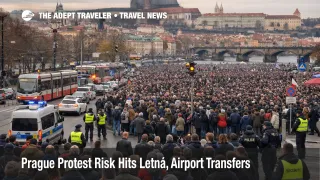
Prague protest travel risk increased on March 21, 2026, when one of the largest demonstrations in the Czech Republic since 2019 drew massive crowds to Letná Plain above the city center. For travelers, the immediate issue is not an airport shutdown or a broad transport halt. It is concentrated pressure on central movement, especially around Letná access points, nearby metro and tram links, and the road corridors that connect hotels, rail stations, and Václav Havel Airport Prague (PRG). Anyone with a same day airport run, a timed Old Town booking, or a rail handoff should now build extra transfer time into Prague plans on any renewed protest day.
Prague Protest Travel Risk: What Changed
The March 21 rally took place at Letná Plain in Prague and was organized by Milion Chvilek, also known in English as Million Moments for Democracy. Reuters reported the crowd at about 250,000, while Associated Press described attendance in the hundreds of thousands, making it the largest anti government protest in the country since 2019. The protest targeted Prime Minister Andrej Babiš and his coalition over issues including defense spending, public media, democratic checks, and the government's wider direction.
For travelers, that changes the story from a political headline into a movement planning problem. Letná is not an isolated field far from the visitor core. It sits above central Prague and pulls pressure toward the Hradčanská, Vltavská, and Nádraží Holešovice approaches that many visitors use directly or indirectly when moving between Prague Castle, Old Town, rail stations, and airport links. Local reporting before and during the rally said those access points were the expected bottlenecks, and public transport was reinforced to absorb the load.
The seriousness is real, but it is still narrower than a citywide shutdown. Flights were not reported as suspended, and Prague Airport's official guidance for city access still points travelers to normal public transport and Airport Express links. The risk sits on the land side, where crowd surges, police management, and rolling diversions can stretch journeys that normally look comfortable on paper.
Which Prague Trips Face the Most Friction
The most exposed travelers are the ones trying to thread a tight schedule through central Prague on a protest day. That includes visitors staying in Old Town, Malá Strana, Hradčany, or Holešovice, passengers connecting between Prague Main Railway Station and the airport, and anyone booked on timed walking tours, castle visits, or cross town transfers in the afternoon and early evening. The practical problem is not that every street closes. It is that one major gathering can overload a handful of key nodes at the same time.
The main repeat zones to watch are Letná itself and the surrounding access corridors, especially Hradčanská, Vltavská, and Nádraží Holešovice. Those names matter because they are the feeder points local outlets identified ahead of the rally, and they sit on the natural approaches used by demonstrators arriving from across Prague. If protests return to Letná, those same corridors are the most likely places for crowding, station controls, and slower tram or road movement before the event begins and after it breaks up.
Airport exposure is mostly indirect. Prague Airport says the fastest public transport route to the city is the 59 trolleybus to Nádraží Veleslavín for Metro Line A, while Airport Express buses run between the terminals and Prague Main Railway Station in about 40 minutes under normal conditions. A Letná protest does not automatically block either route, but city center congestion can still hit the last leg of a rail to air transfer, a taxi pickup, or any itinerary that depends on crossing central Prague without delay.
What Travelers Should Do Now
Travelers in Prague should treat renewed demonstrations as a buffer time story. On any announced protest day, leave earlier for the airport, for Prague Main Railway Station, or for timed tours in the core. A sensible working rule is to avoid building a connection that only works if street traffic and metro interchanges run perfectly through central Prague. That is the wrong assumption when a rally can push hundreds of thousands toward the same district.
For airport planning, the strongest move is to protect the surface segment, not to panic about the flight itself. If you are flying out of Prague on a protest day, use a larger transfer buffer than usual, and avoid adding a last minute lunch, museum stop, or shopping detour on the way to the terminal. If you are arriving the same afternoon, expect a slower handoff from airport to hotel if your route enters the center near the river, Letná, or the main rail area. Travelers with flexible schedules should put Old Town and castle area sightseeing on the morning side of the day, then keep the later window open in case movement worsens.
The decision threshold is simple. If another major Letná rally is announced and you have a short rail to flight connection, a fixed afternoon tour, or a hotel move across town, change the plan before the day starts. If your schedule is loose and you can stay in one neighborhood, the disruption is more manageable. Watch Prague Public Transit notices, the airport's transport guidance, and organizer announcements rather than guessing from social media crowd videos alone.
Why Letná Matters, And What Happens Next
Letná matters because it is a high capacity demonstration ground with a long protest history and strong symbolic value in Prague. Large crowds can gather there without needing to block the airport or the entire city to create meaningful travel friction. The mechanism is straightforward. A big rally concentrates arrivals and departures through a limited set of tram, metro, pedestrian, and road access points, then the pressure spills outward into taxi journeys, tram loads, station platforms, and cross town road travel. First order, people move more slowly near the site. Second order, airport transfers, rail handoffs, and timed tourism bookings become less reliable even in districts that are not protest sites themselves.
What happens next is not fully scheduled yet, but the protest wave does not look finished. Associated Press reported that demonstrators vowed to continue activism, and the same movement had already organized major demonstrations earlier this year, including a February action tied to tensions between President Petr Pavel and the government. That does not confirm another Letná date, but it does support a practical traveler assumption that Prague may see more large, politically focused gatherings in the weeks ahead.
The correct reading for travelers is measured, not dramatic. Prague is still functioning, and this is not a citywide collapse story. But it is now a place where a major demonstration can turn a normal central transfer into a missed margin. Travelers who keep extra buffer, avoid tight same day handoffs, and watch official transport updates should be able to manage the risk far better than those treating March 21 as a one off crowd event with no follow through.
Sources
- Czechs rally in country's largest anti-government protest since 2019
- Tens of thousands of protesters rally in Prague against new government of Czech prime minister Babiš
- Public Transport Buses, Václav Havel Airport Prague
- Airport Express, Václav Havel Airport Prague
- Restrictions and emergencies, Prague Public Transit Company
- Large demonstration on Prague's Letná: Up to 400,000 participants expected on Saturday
- Calls to defend public media as Letná protest draws large crowds