

Bengaluru Freedom Park Traffic Slows Airport Runs
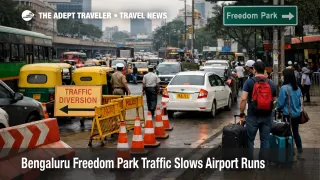
Travelers in Bengaluru, India, now face a three day surface transport problem centered on Freedom Park after police traffic advisories warned of congestion and diversions from March 23, 2026, through March 25, 2026. The pressure point is central Bengaluru road access, especially around Seshadri Road and adjoining junctions, not Kempegowda International Airport (BLR) flight operations themselves. For visitors moving between central hotels, KSR Bengaluru City station, Majestic area bus and rail connections, and the airport corridor, the practical consequence is longer and less predictable road time at the exact stage of a trip where small delays can break check in, boarding, and station handoffs.
Bengaluru Freedom Park Traffic: What Changed
Police advisories say large scale protests are expected around Freedom Park from March 23 through March 25, with participants and vehicles likely to converge through Seshadri Road and surrounding central city approaches. Published diversion guidance names several affected movements, including traffic from Shanthala Junction and Khoday Circle toward Anand Rao Flyover and Freedom Park, traffic from Mysore Bank toward Basaveshwara Circle, and traffic approaching from Kalidasa Road, Kanakadasa Junction, Maurya Junction, and Subbanna Junction. Suggested reroutes run through corridors such as Lulu Mall Road, KFM Road, Rajiv Gandhi Circle, Mantri Mall Road, Swastik Circle, Seshadripuram, Nehru Circle, Race Course Flyover, Race Course Road, KG Road, Tank Bund Road, Raj Bhavan Road, and Infantry Road.
That makes this more than a generic protest warning. Bengaluru police have effectively flagged a managed traffic event with named detours across a large part of the central city grid. First order, road journeys through central Bengaluru can take materially longer than normal even if a driver is still moving. Second order, those lost minutes can spill into missed train boarding, late hotel arrivals, compressed sightseeing windows, and tighter airport departures for travelers who built plans around normal weekday transfer times.
Which Bengaluru Travelers Face the Most Disruption
The travelers most exposed are the ones using central Bengaluru as a transfer platform. That includes visitors staying near the Race Course Road, Seshadripuram, Gandhi Nagar, Majestic, and KSR Bengaluru City station side of town, plus anyone crossing the center on the way to BLR. The airport remains far north of the protest zone, so the core risk is not airport access at the terminal, but the uncertainty of getting out of the central city cleanly and on time.
Rail travelers should take this seriously even if trains are operating normally. The advisory touches roads that matter for getting into and out of Bengaluru's main intercity transport core, and station trips are often less forgiving than airport trips because train boarding windows are tighter and missed departures are harder to recover from on the same day. Tour groups and business travelers with back to back appointments in the city center face a similar problem, since a road delay in one leg can throw off the rest of the day's schedule.
Airport passengers have a narrower margin for error if they are starting in the affected central districts. BLR has previously advised travelers to arrive at least three hours before departure under heightened screening conditions, which means a city side delay now compounds an already earlier airport arrival expectation. Travelers who normally count on a predictable ride from the center should assume that the weakest part of the journey during this window is the first urban leg, not the final airport approach.
What Travelers Should Do Now
For March 23, March 24, and March 25, travelers leaving central Bengaluru for BLR should add substantial road buffer, especially for morning and late afternoon departures when normal traffic is already heavier. A practical approach is to treat airport runs from the city center as a two stage trip, first escaping the diversion zone, then making the longer airport drive. If the trip is important, leaving 45 to 60 minutes earlier than usual is the safer play, and more may be justified when starting near Seshadri Road, Mysore Bank, Majestic, or Race Course Road.
For rail and bus connections, the decision threshold is tighter. If a booking depends on arriving at the station shortly before departure, that is a weak plan during this advisory window. Travelers should either move their hotel base closer to the departure point the night before, or plan to arrive well ahead of time and absorb the extra wait instead of gambling on a normal city run. The cost of an early arrival is small compared with the cost of a missed departure and a same day rebooking scramble.
The best signals to monitor are not broad city headlines, but live route conditions and police updates on the exact corridors named in the advisory. Drivers and hotel desks should be asked specifically about Seshadri Road side access, Race Course Flyover conditions, and whether the KG Road, Tank Bund Road, or Raj Bhavan Road alternatives are still moving. For airport trips, airline status can remain normal while the ground transfer fails, so flight on time status alone is not a useful green light.
Why the Disruption Spreads Beyond Freedom Park
Freedom Park protests regularly create outsized traffic effects because the site sits inside a dense central road network rather than in an isolated event space. Once police start funneling vehicles away from one set of approaches, the displaced traffic does not disappear, it shifts onto alternate central corridors that are already busy. That is why even travelers with no reason to go near the protest itself can still get caught in the ripple effects.
What happens next depends on protest turnout and how long police keep diversions active each day through March 25. The current reporting supports meaningful friction rather than total paralysis. Flights should still operate, and the airport corridor should still function, but the reliability of central Bengaluru transfer timing is weaker than normal until the advisory window ends. Travelers who treat this as a city traffic management story, not an airport operations story, will make better decisions over the next three days.