

Cuba Blackouts Raise Travel Risk Amid U.S. Threats
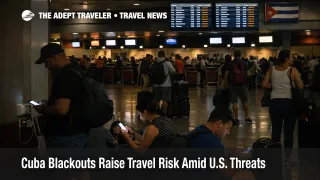
Cuba blackout travel risk is rising again after the island's national grid collapsed for the second time in a week on March 21, 2026, extending a month of repeated power failures and forcing travelers to plan for communications outages, patchy hotel services, and unreliable on-island transport. For now, this is a major ground-operations problem more than a confirmed air shutdown. U.S. officials still list Cuba at Level 2, Exercise Increased Caution, citing crime and unreliable electrical power, and the U.S. Embassy in Havana has separately warned that outages can affect water, lighting, refrigeration, and communications. Travelers with near-term Cuba plans should build extra power, cash, and transfer buffers instead of assuming normal resort and city operations.
Cuba Blackout Travel Risk: What Changed
Cuba's latest nationwide outage began on March 21 after an unexpected shutdown at a generating unit at the Nuevitas thermoelectric plant in Camagüey province, according to Cuban authorities cited by Reuters. By March 22, officials said power had been restored to nearly half of Havana, but that still left large parts of the capital and much of the country dealing with unstable service. Reuters described this as Cuba's second total grid collapse in a week and the third major outage in March, which moves the story beyond routine inconvenience and into recurring itinerary risk for anyone relying on dependable power and city services.
The political language around the crisis is louder than the confirmed operational change. Cuban Deputy Foreign Minister Carlos Fernandez de Cossio said Havana is prepared for the unlikely possibility of a U.S. military engagement after President Donald Trump said on March 16 that he expected to have the "honor" of taking Cuba "in some form." But the most important limiting fact for travelers is that the head of U.S. Southern Command told lawmakers on March 19 that the U.S. military is not rehearsing for an invasion or otherwise preparing to seize the island. That leaves travelers facing a real infrastructure problem and a real political uncertainty premium, but not verified evidence of an imminent attack.
Which Cuba Trips Face the Most Friction
The most exposed travelers are those staying in older city hotels, private rentals, or smaller beach properties with weak backup power, plus anyone depending on mobile data, card payments, refrigerated medicines, or time-sensitive intercity transfers. The embassy's March 16 security alert warned that outages can hit water supply, lighting, refrigeration, and communications, which means the traveler problem is not just darkness. It is the loss of the systems that keep a trip functioning, including charging, ride coordination, restaurant operations, and hotel recovery capacity.
Travelers transiting Havana face a different risk profile. I have not found a current official notice confirming a broad commercial flight shutdown at José Martí International Airport (HAV), so it would be wrong to write this as an airport closure story. The more credible reading is that airport trips become more fragile when city power, communications, and fuel conditions are unstable. First order, travelers can struggle to confirm rides, charge phones, or reach support desks. Second order, missed transfers, hotel overnights, and harder same-day rebooking decisions become more likely if another grid failure hits during a departure or arrival window.
What Travelers Should Do Now
Travelers already in Cuba should shift into outage-mode planning, not crisis-mode panic. Keep phones, battery packs, paper reservation details, offline maps, and enough local cash for at least a day of disrupted payments. Confirm whether your hotel has generator coverage for guest rooms, water pressure, elevators, and front-desk systems, because "backup power" can mean very different things in practice. If you have flights within the next 24 to 72 hours, move your transfer planning earlier and assume extra road and communications friction on the way to the airport.
For new bookings, the tradeoff is simple. Travelers with flexible dates should wait until the grid shows more than a brief recovery cycle. Travelers who must go soon should favor larger hotels with independently confirmed generator capacity, daytime arrivals, and itineraries that avoid tight same-day connections to ferries, tours, or long road transfers. This is not the moment to build a Cuba trip around thin buffers or "figure it out on arrival" assumptions.
The next decision point is whether outages continue as isolated restoration setbacks or become a rolling pattern that degrades diplomatic, hotel, and transport reliability further. One added warning sign is the Associated Press report that Cuba rejected a U.S. Embassy request to import diesel for its generators, a dispute that could complicate embassy operations if fuel scarcity worsens. That does not automatically change public travel rules today, but it does signal how tight the operating environment has become.
Why Cuba's Outages Keep Returning, and What Happens Next
The mechanism is bigger than one failed plant. Reuters and AP both describe an aging generation system already under strain, with fuel shortages compounding the instability and daily outages in some areas lasting many hours even before total grid collapses. In practical travel terms, that means each restoration is fragile because the system is being restarted into the same structural weaknesses that caused the crisis in the first place. A partial recovery in Havana is useful, but it is not the same thing as stable island-wide service.
What happens next depends on whether Cuba can stabilize fuel supply and hold the grid together for more than a short interval. Politically, Washington and Havana remain in talks, while Trump's rhetoric has become more threatening, but the U.S. military's public position remains that it is not preparing an invasion. For travelers, the likely near-term outlook is not sudden war tourism headlines, it is continued uncertainty around power, communications, and service reliability. Until that changes, Cuba should be treated as a destination where the trip can still operate, but only with extra margin, lower service expectations, and a real backup plan.
Sources
- Cuban power grid collapses for second time in a week amid US oil blockade | Reuters
- Cuba begins recovery efforts after second grid collapse in a week | Reuters
- Cuba is ready for any potential attack from US amid oil blockade, envoy says | Reuters
- Trump says he can do 'anything I want' with Cuba | Reuters
- US military not preparing for Cuba invasion, senior US general says | Reuters
- Cuba Travel Advisory | Travel.State.gov
- Security Alert, U.S. Embassy Havana, Cuba, March 16, 2026
- Cuba's power grid collapses leaving it without electricity for the 3rd time this month | AP News