

Middle East Oil Shock Lifts Summer Airfare Risk
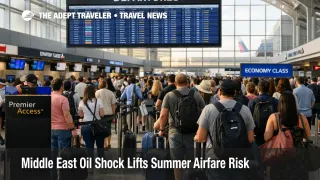
If you are booking flights for summer 2026, the main risk is no longer just whether fares feel high, it is whether higher oil and jet fuel costs keep pushing prices up through the next booking window. Major U.S. airline executives have already warned investors that the Middle East conflict is materially raising fuel expense, and they are signaling that stronger fares, route trimming, or both will be used to protect margins. That does not guarantee every ticket will jump immediately, but it does raise the odds that late bookers, long haul travelers, and premium cabin buyers will see the pressure first.
Summer Airfare Increases: What Changed
The change is straightforward. Since the conflict that began on February 28, 2026, oil and jet fuel costs have surged, and airline executives are now speaking openly about the revenue response. Reuters reported on March 20 that United Airlines expects oil could stay above $100.00 per barrel through 2027, while American Airlines said on March 17 that higher fuel costs had already added about $400 million (USD) to first quarter expense. Reuters also reported that Delta and American each expect roughly a $400 million (USD) first quarter hit from fuel.
The shipping side is also more complex than a simple "closed or open" headline. The Strait of Hormuz, which carries about one fifth of global oil and LNG flows, has been heavily disrupted, but Reuters reported on March 22 and March 23 that traffic has at times remained selectively open, with some ships still moving while many others remain stranded or restricted. That matters for travelers because airlines do not need a full energy shock to raise fares, they just need sustained uncertainty and higher jet fuel input costs.
For now, the operational consequence is not a summer flying collapse. It is a pricing problem. Reuters reported that U.S. carriers are still seeing strong demand and have already pushed through fare increases in parts of the market, especially where demand is less price sensitive. That means the early pain is more likely to show up in business class, long haul itineraries, and closer in bookings than in every domestic economy fare all at once.
Which Travelers Face the Most Fare Pressure
The travelers most exposed are the ones with the least flexibility. That includes people booking long haul summer trips late, travelers who need specific dates during peak school vacation periods, and passengers who normally rely on premium cabins or convenient one stop itineraries. Reuters reported that United is pairing higher fares with cuts to weaker flights, including some off peak flying from Chicago O'Hare International Airport (ORD), which can narrow low fare options even before a traveler sees the price screen.
Leisure travelers chasing the cheapest domestic coach fares may not feel the full force first, especially on competitive U.S. routes where airlines still need to fill a lot of seats. But that should not be confused with safety from higher pricing. Reuters reported that U.S. airlines believe strong spring and early summer demand gives them room to lift fares as fuel climbs, and analysts cited premium and corporate demand as especially resilient. When that happens, the first order effect is a higher ticket. The second order effect is that travelers priced out of one fare bucket spill into the next cheapest options, which can raise the floor under economy pricing too.
International travelers are also more exposed than purely domestic flyers because they sit closer to the fuel intensive part of the network. Some foreign carriers have already added fuel surcharges or cut flying, while U.S. carriers are using a mix of fare increases and selective capacity discipline instead. Either way, the result for passengers is similar, fewer cheap seats, less schedule choice, or both.
What Travelers Should Do Now
The immediate move is to stop assuming summer fares will drift down on their own. If you already know your travel dates and the price is acceptable for your budget, waiting for a broad market reset is a weaker bet than it was a month ago. The U.S. Energy Information Administration said in its March 2026 outlook that Brent crude is expected to remain above $95.00 per barrel over the next two months, which covers a meaningful stretch of the summer booking window.
The next decision point is trip structure. Travelers trying to control costs should compare nearby airports, accept less ideal departure times, and price the whole trip rather than a single headline fare. When airlines trim marginal flying to protect profitability, the cheapest itinerary can disappear even if the nonstop you wanted is still operating. That is especially relevant in large hub markets where off peak options often anchor the low end of the fare ladder.
The main threshold for waiting is clear evidence that the energy shock is easing. Travelers should watch three signals over the next few weeks: whether traffic through Hormuz normalizes, whether crude retreats meaningfully from current elevated levels, and whether U.S. carriers stop talking about fare action as a necessary offset. If those signals do not improve, the safer assumption is that summer airfare increases will keep filtering through, first in long haul and premium markets, then more unevenly across the rest of the network.
Why Higher Fuel Costs Spread Through Airfares
Fuel is one of the largest airline costs, and sudden fuel moves are harder for carriers to absorb than steady, predictable ones. IATA said on March 13 that jet fuel is one of the industry's highest costs and that sudden changes are more challenging than merely high prices. That distinction matters here because the current pressure is being driven by conflict, shipping disruption, airspace stress, and uncertainty about how long those conditions will last.
Airlines have a limited playbook when fuel spikes. They can raise fares, add surcharges, cut weaker routes, or lean harder on premium demand and loyalty revenue. Reuters reported that United is already cutting some unprofitable flights while counting on stronger pricing, and American told investors it was prepared to take revenue steps if higher fuel proves more durable. That is how an oil shock becomes a traveler pricing story instead of just an airline earnings story.
What happens next depends less on one executive warning than on the duration of the energy disruption. If the conflict cools and shipping conditions improve, airlines may keep some of the fare gains but lose the need for broader increases. If oil stays elevated into late spring, travelers should expect a firmer summer fare floor, more expensive premium cabins, and fewer cheap close in options on long haul routes. The serious risk is not that every seat becomes unaffordable, it is that flexibility gets more expensive just as the busiest travel months begin.
Sources
- Reuters, United Airlines to Cut More Flights as It Eyes Oil Above $100 Through 2027
- Reuters, U.S. Airlines Lean on Demand, Fares as Iran War Rattles Overseas Peers
- Reuters, Strong Travel Demand Lifts U.S. Airlines Despite Fuel Price Surge
- American Airlines Group, JP Morgan Industrials Conference Transcript, March 17, 2026
- U.S. Energy Information Administration, Short-Term Energy Outlook
- IATA, Jet Fuel Price Monitor
- IATA, Chart of the Week, March 13, 2026
- Reuters, Trump Postpones Military Strikes on Iranian Power Plants
- Reuters, Gas Tankers Sail Through Hormuz to India, Most Ships Still Stuck
- Reuters, Iran Says Hormuz Open to All but Enemy-Linked Ships