

State Department Worldwide Alert Raises Travel Caution
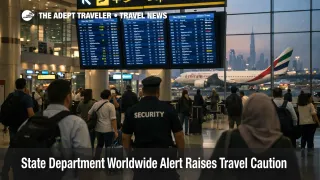
The State Department worldwide alert issued on March 22, 2026 adds a new layer of caution for Americans abroad, especially in the Middle East, after Washington warned that groups supportive of Iran may target U.S. interests worldwide. For travelers, this is not a blanket order to cancel every trip or a global shutdown notice. It does raise the risk of sudden embassy guidance changes, periodic airspace disruptions, and tighter decision making for anyone traveling through the Middle East or relying on nearby hubs. Americans abroad should review the latest destination specific advisory, monitor their nearest U.S. embassy or consulate, and enroll in STEP before the next movement point in their trip.
State Department Worldwide Alert: What Changed
The immediate change is official U.S. government posture. On March 22, 2026, the Department of State issued a worldwide caution advising Americans everywhere, and especially in the Middle East, to exercise increased caution. The alert explicitly warns that periodic airspace closures may disrupt travel, that U.S. diplomatic facilities, including outside the Middle East, have been targeted, and that Iran aligned groups may target U.S. interests or places associated with Americans worldwide.
That matters operationally because a worldwide caution sits above the usual country by country planning process. Travelers still need to read the destination level advisory for the place they are visiting, but now they also have to account for the possibility that the security picture or the route picture can change faster than usual, particularly if their itinerary depends on Middle East airspace, a regional hub connection, or ground movement near U.S. facilities. The State Department's March 23 Middle East page also directs Americans in the region to follow the latest guidance from the nearest embassy or consulate and contact the Department's 24 hour task force for travel options to return safely.
Which Travelers Face the Most Exposure
The highest exposure is not spread evenly. Americans already in the Middle East, passengers transiting hubs tied to regional airspace, business travelers with fixed schedules, cruise and tour passengers with hard embarkation dates, and anyone moving on short notice are the most vulnerable to the alert's practical effects. A flexible leisure trip to a lower risk destination is not in the same category as a time sensitive itinerary that depends on one narrow corridor or one same day connection.
The first order effect is movement friction. An airspace closure, an embassy security alert, or a fast moving local incident can force reroutes, missed connections, longer ground transfers, or last minute hotel changes. The second order effect is weaker recovery once something slips. Rebooking options can narrow quickly, especially if multiple travelers are pushed into the same fallback hubs or if local transport patterns tighten around a security event. This is why the alert matters even outside active conflict zones. The problem is not only where the threat is highest, but where the travel system becomes less forgiving.
What Travelers Should Do Now
Travelers with departures in the next 24 to 72 hours should treat this as a decision point. Check the destination advisory, look for any fresh embassy or consulate alerts, and confirm whether your airline is still operating the route you plan to use. If your itinerary touches the Middle East, a nearby air corridor, or a city where U.S. facilities may draw extra security posture, build more time between segments and avoid assuming a tight same day connection will hold.
This is also the point to enroll in the Smart Traveler Enrollment Program, or STEP, if you have not already. STEP is the State Department's free enrollment service that sends travelers email updates and alerts from U.S. embassies and consulates abroad. Travelers should also keep hotel, airline, and onward transport bookings easy to change where possible, because the cost saving from a rigid plan can disappear quickly if one closure or local security alert breaks the trip.
Waiting can still make sense for some travelers, but only if the trip is discretionary and the booking is flexible. Rebooking earlier is the stronger choice when the trip has a fixed purpose, a one shot departure, or multiple connected elements that would be expensive to rebuild.
Why This Alert Changes Planning, and What Happens Next
A worldwide caution is not the same as a Level 4 Do Not Travel advisory. The State Department's advisory system still works on a destination basis, with separate levels and risk indicators for each country. What changed here is that the U.S. government added a global overlay tied to current threats, meaning travelers have to read both the country advisory and the live embassy level updates, rather than relying on the country page alone.
The next development to watch is not a single headline, but a pattern. Travelers should monitor whether embassy alerts begin appearing in more places, whether airlines start adjusting schedules around regional airspace, and whether the State Department changes advisory levels for specific countries. Until then, the State Department worldwide alert should be read as a warning that the operating environment for Americans abroad is less stable than normal, especially in and around the Middle East, and that the best protection is faster monitoring, more buffer, and a trip plan that can bend without breaking.