

Dublin Airport Cap Threatens U.S. Summer Access
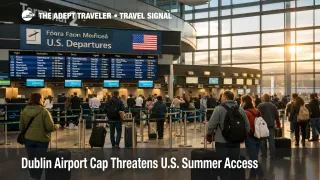
The Dublin Airport cap dispute has turned from an Irish planning fight into a live transatlantic booking risk. On March 25, Aer Lingus told an Irish parliamentary committee there is a serious risk the United States could retaliate if Ireland does not move quickly to remove Dublin Airport's 32 million passenger cap, after Airlines for America asked the U.S. Department of Transportation in January to curb Irish carrier access if the cap remains in place. For travelers, that means summer 2026 uncertainty is no longer just about airport growth in Ireland. It now reaches U.S. flights, fares, and how long Dublin remains the easiest Ireland gateway for nonstop transatlantic trips.
Dublin Airport Cap Dispute, What Changed
What changed on March 25 was the level of threat, not the existence of the cap itself. The cap has been in place since the 2007 to 2008 planning approvals tied to Terminal 2 and related works, and Irish officials have already been working on legislation to revoke or amend it. But Aer Lingus chief executive Lynne Embleton's warning, alongside comments from Airlines for America chief executive Chris Sununu that Washington is watching closely, pushes the story into a different category. This is now a dispute with possible bilateral consequences under the EU U.S. air transport framework, not just a domestic airport planning headache.
The immediate operational problem is that Dublin Airport exceeded the 32 million annual cap by about 4 million passengers last year, while the Irish government is still trying to get legislation through. Reuters reported the government has pledged a new law by early summer, and Irish transport officials told lawmakers earlier this month that the bill is meant to give the minister power to revoke or amend the cap and prevent future passenger caps being imposed through planning conditions. That matters because airlines are scheduling the summer season now, not after a leisurely legal cleanup in late 2026.
Which Travelers and Routes Are Most Exposed
The most exposed travelers are summer passengers relying on Dublin, Ireland as a nonstop gateway between the United States and Ireland, especially those booking peak season trips with little flexibility. Aer Lingus is the clearest airline at risk because it is the main Irish carrier with a large U.S. network from Dublin, and it had already planned its biggest ever transatlantic summer schedule for 2026, including added New York JFK and Boston frequency, higher Nashville and Indianapolis service, more Orlando flying, and a new Raleigh Durham route from April 2026.
That does not mean those routes are being cut now. It means the dispute now sits over a network that was built for growth. Travelers most likely to feel pressure first are those chasing nonstop Dublin flights on peak weeks, those building trips around precise arrival days, and those depending on Dublin's U.S. Preclearance facility in Terminal 2 to simplify onward U.S. arrival. If the dispute drags, the first order effect is tighter seat supply and less schedule elasticity. The second order effect is spillover, higher fares into Dublin, more pressure on Shannon, and more itineraries routed through Britain or mainland Europe instead of a clean nonstop.
What Travelers Should Do Before Summer Fares Harden
Travelers with fixed Ireland dates should not treat this as a reason to panic book any fare they see. But they also should not assume the Dublin market will stay loose into late spring. The practical move now is to price Dublin and Shannon side by side, then compare those with one stop options through London, Amsterdam, or other major European hubs. The tradeoff is simple, Dublin nonstop convenience versus a backup plan that may be less elegant but more resilient if capacity tightens.
There is also a timing threshold. If you need a specific week in June, July, or August, or you are traveling for a cruise, tour, wedding, or fixed event, waiting for the legal picture to become perfectly clear is the wrong strategy. Book when you can still choose among routings, not when the market has already shifted to a smaller number of workable seats. If your trip is flexible and fare sensitive, waiting can still make sense, but only if you are also willing to use Shannon, split ticket connections, or an overnight gateway stop if Dublin prices jump.
The signals to watch are concrete. Travelers should monitor whether Ireland actually passes the bill on the early summer timeline, whether U.S. officials escalate beyond docket pressure, and whether airlines start trimming frequency, reducing availability, or steering more passengers to alternate gateways. A sudden drop in low fare Dublin inventory for peak weeks would be a more meaningful warning sign than political rhetoric on its own.
Why This Fight Matters Beyond Dublin
The mechanism behind the dispute is straightforward. The original cap was tied to surface access and planning constraints around Dublin Airport, not a modern airline market design. But once a local cap starts constraining access at a major transatlantic gateway, airline groups can argue that the restriction conflicts with broader market access commitments under open skies arrangements. That is why this moved from an airport planning problem to a U.S. Department of Transportation complaint.
What happens next depends on which clock runs faster, the Irish legislative clock or the retaliation clock. Irish officials have already advanced the Dublin Airport Passenger Cap Bill 2026 and say the goal is to lift the restriction while staying inside EU legal requirements, including environmental assessments where required. Airlines, meanwhile, are pressing for faster action because they fear a final EU court outcome or a slower legislative process could hit summer scheduling and access before the bill fully lands. For now, the Dublin Airport cap dispute is still a threatened capacity shock, not an enacted one. But it is close enough to summer that travelers booking Ireland and U.S. trips should treat it as a real planning variable, not background noise.
Sources
- Aer Lingus sees serious risk of US retaliation over Dublin airport cap, Reuters
- Dublin Airport (Passenger Cap) Bill 2026, Oireachtas Joint Committee on Transport submission
- Complaint filed in DOT docket DOT-OST-2026-0067, Regulations.gov
- Order 2026-1-8 in DOT docket DOT-OST-2026-0067, Regulations.gov
- Aer Lingus launches biggest ever transatlantic schedule for 2026, Aer Lingus Media Centre
- Travelling To The USA, Dublin Airport
- United States, European Commission Mobility and Transport