

Manila Transport Strike Threatens March 26 Airport Runs
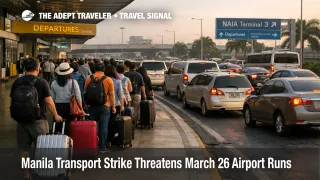
Travelers moving through Manila, Philippines, on Thursday, March 26, 2026, and Friday, March 27, 2026, now face a real ground access problem, not just a commuter inconvenience. The U.S. Embassy in the Philippines warned of a two day nationwide transportation strike, including Metro Manila and areas near the embassy, while Philippine reporting says participating groups expect action across several modes, including public utility jeepneys, buses, UV Express, transportation network vehicle services, and motorcycle taxis. That widens the risk from routine city delays to airport access, hotel transfers, and same day domestic connection timing, especially for travelers relying on road transport into Ninoy Aquino International Airport (MNL).
Manila Transport Strike: What Changed
What changed is the scope. This is not being framed only as a jeepney stoppage. GMA News reported that organizers said public utility jeepneys, public utility buses, UV Express vehicles, transportation network vehicle services, and motorcycle taxis were among the modes expected to participate, with some drivers possibly stopping work as early as Wednesday, March 25, 2026. Reuters has separately reported that Philippine transport protests have been driven by surging diesel costs tied to the wider oil shock hitting the country.
For travelers, the immediate problem is that Manila airport trips are road dependent even when flights operate normally. NAIA's operator says the airport is reached through major expressways and public roadways, which means any strike that removes road based public transport or pushes more travelers into private vehicles can slow the same access corridors everyone else needs. The strike also matters beyond the embassy district. Organizers and local reporting are treating it as nationwide, with protest activity in Metro Manila and a planned march from Welcome Rotonda in Quezon City to Mendiola in Manila on March 27.
Which Travelers Face the Most Disruption
The highest exposure is for travelers departing Ninoy Aquino International Airport (MNL) from hotels in Manila, Makati, Bonifacio Global City, Pasay, or Parañaque who planned to use taxis, ride hail, motorcycle taxis, jeepneys, buses, or mixed mode transfers. Domestic flyers are exposed because shorter check in assumptions break first when the road trip becomes unreliable. International travelers are exposed because Manila airport runs already depend on congested urban roads, and terminal access delays can eat into airline check in cutoffs even if the flight itself remains on time.
Provincial trips are also at risk. A strike that touches buses and UV Express services can disrupt not only Metro Manila circulation but also onward movements to nearby provinces and intercity terminals. The second order effect is that displaced demand shifts onto the transport that remains available. That can mean surge pricing on ride hail, longer waits for private cars, tighter hotel departure windows, and more missed domestic connections for travelers trying to transit Manila in one day. MMDA has said it is prepared to offer free shuttle services, which may soften some commuter pain, but that does not restore normal door to door airport access for visitors carrying luggage or aiming for a timed flight departure.
What Travelers Should Do Now
For Thursday and Friday departures, travelers should treat the Manila transport strike as a ground access disruption first and a flight disruption second. The safest move is to lock in airport transport the night before, use a hotel car or a trusted prebooked private driver where possible, and avoid assuming you can call a ride on demand at the usual price or wait time. Travelers with very early or late flights should think in terms of preserving the airport arrival, not optimizing sleep or checkout convenience.
A practical buffer is to add at least 60 to 90 minutes beyond your normal Manila airport departure plan on both March 26 and March 27. For domestic flights, that means many travelers should aim to be at the airport roughly three hours before departure. For international flights, four hours is the more defensible target if you are crossing the city or relying on any public or app based road transport. The tradeoff is obvious, you may wait longer in the terminal, but that is less costly than missing check in because the road network tightened unexpectedly.
Rebook or reroute only if your itinerary is already fragile. Travelers with short domestic connections in Manila, intercity bus links after arrival, or cruise, ferry, or tour departures tied to the same day should consider moving to an earlier flight, traveling on March 25 if possible, or shifting to an airport hotel on Wednesday night. Travelers already staying close to the airport have a simpler decision, leave earlier than usual and monitor local traffic rather than changing flights immediately.
How the Disruption Spreads Through Travel
The mechanism is straightforward. When a strike removes part of the public transport supply and may also affect ride based services, more passengers compete for fewer vehicles on the same roads leading to the airport. Manila airport access then slows in two ways at once, road congestion gets worse, and the backup options get thinner. That is why a labor action that begins as a commuter issue can become an air travel timing problem even without cancellations at the airport itself.
The next question is whether the strike remains uneven and localized, or whether participation is broad enough to hit both Metro Manila circulation and provincial feeder links. MMDA's shuttle plan suggests authorities expect meaningful commuter disruption, but the exact degree of airport spillover will depend on how many vehicles actually stay off the road, whether ride based drivers join at scale, and how much protest activity slows traffic near key corridors on Friday's march day. Travelers should monitor airline messages, hotel transport desks, and local road conditions late on March 25 and early on both strike days. A stable picture would mean private transfers still move with only moderate delays. A worsening picture would mean widespread ride shortages, heavy surge pricing, longer hotel pickup waits, and repeated warnings to leave much earlier than normal.
Sources
- Demonstration Alert: Nationwide Transportation Strike, March 26 to 27, 2026, U.S. Embassy in the Philippines
- Transport Groups Set Strike on March 26 to 27 Amid Rising Fuel Prices, GMA News
- Various Groups to Join 2 Day Nationwide Transport Strike Over Fuel Price Surge, ABS-CBN News
- MMDA Says Ready to Offer Free Shuttle Services for March 26 to 27 Transport Strike, ABS-CBN News
- Transport, New NAIA Infrastructure Corporation
- Philippine Jeepney Drivers Protest as Rising Fuel Prices Cut Their Pay, Reuters, March 19, 2026