

Backroads Expands 2026 U.S. National Park Trips
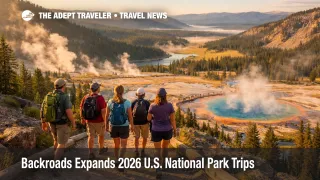
Backroads national park trips are getting bigger for 2026, with the active travel company saying it has increased departures by 12 percent over 2025 and added new park itineraries as demand continues to hold up across the U.S. system. That matters most for travelers planning summer and shoulder season trips to marquee parks such as Yellowstone National Park, Yosemite National Park, Glacier National Park, and Acadia National Park, where availability, lodging, and timed-entry style access rules can tighten well before departure. The change is not a systemwide disruption, but it is a clear demand signal in a travel segment where crowding, logistics, and booking windows already shape the trip as much as the scenery. Travelers who want guided active trips in 2026 should expect earlier competition for popular dates and start planning park access, lodging, and transport now.
Backroads National Park Trips: What Changed
Backroads said on March 25, 2026, that it is seeing more than 10 percent growth in active travel to U.S. national parks and has raised its 2026 national park departures by 12 percent over 2025. The company also said it added new itineraries including glamping trips in Maine and Yellowstone, plus a Moab Multi-Adventure Tour. Backroads tied that push to sustained interest in bucket-list U.S. parks ahead of the country's July 4, 2026, 250th anniversary milestone.
The company's release points to especially strong summer 2026 growth in Crater Lake National Park, Great Smoky Mountains National Park, Joshua Tree National Park, Acadia, Yellowstone, and Yosemite. Backroads also reiterated that its park portfolio now spans more than 20 U.S. national parks and multiple trip formats, including biking, hiking and walking, and multi-adventure products.
Who Benefits Most From the 2026 Expansion
The clearest fit is for travelers who want a structured national parks trip rather than a do-it-yourself road trip. That includes families, multigenerational groups, and travelers who want guides, logistics, and activity planning bundled into one booking. Backroads explicitly said it is seeing repeat family demand for multigenerational park trips built around biking, hiking, kayaking, and cultural activities.
The bigger benefit is not just more departures. It is more chances to secure a workable itinerary in parks where trip planning can get squeezed by limited lodging, vehicle reservations, timed-entry systems, and long in-park drive times. Travelers who do not want to manage those moving parts themselves may find guided active trips more attractive as peak-season planning gets tighter. That is particularly true in headline parks where demand stays high even when total national system visitation fluctuates from year to year.
What Travelers Should Do Before Booking
Book early if the goal is a summer 2026 departure in Yellowstone, Yosemite, Glacier, Acadia, or other high-demand parks. More departures help, but they do not remove the underlying pressure on rooms, activity slots, and transport into gateway towns.
Compare guided availability against the self-planned alternative before assuming an independent trip will be cheaper or easier. The tradeoff is straightforward. Independent travel can look cheaper at first, but it pushes the traveler into the hardest parts of national park logistics, especially when lodging is fragmented or park access rules shift by season.
Watch the trip window, not just the destination. Travelers who can move to late spring or early fall usually get a better balance of weather, availability, and crowd pressure. Families tied to school calendars have less flexibility, which is one reason expanded departures matter more for them. If a preferred guided departure is already thin, that is usually a sign to decide now rather than wait for a last-minute bargain that may never appear.
Why Demand Is Holding Up, and What Happens Next
Backroads' expansion lines up with broader demand signals from the National Park Service. The agency said the park system recorded more than 323 million recreation visits in 2025, and 26 parks set new visitation records, even though total visits were down 2.7 percent from the all-time 2024 peak. That points to a market where interest remains strong, but pressure is not evenly spread. Some flagship destinations are still carrying very heavy demand, which is what travelers feel on the ground through scarce lodging, traffic, and tighter planning windows.
One detail in the original Backroads copy needs context. The release frames the growth around the country's 250th anniversary, which will be commemorated on July 4, 2026. But National Park Week in 2026 is scheduled for August 22 to August 30, not in April. That matters because travelers using anniversary messaging as a timing cue should not confuse the July 4 national milestone with the National Park Service's late-August park promotion window.
What happens next is less about one operator and more about booking behavior. If guided operators keep adding capacity while park demand stays concentrated in the same marquee destinations, travelers should expect more choice on paper, but not necessarily looser peak-season conditions on the ground. The practical takeaway is simple. More 2026 departures improve odds of finding a trip, but they do not eliminate the need to choose dates early and build around park-specific constraints.
Sources
- Backroads Reports More Than 10% Growth in Active Travel to US National Parks Ahead of the Country's 250th Anniversary
- Public Interest in National Parks Remains Strong as Visits Exceed 323 Million in 2025
- Visitor Use Statistics Dashboard, 2025 Visitation At-A-Glance
- America250
- National Park Week 2026 Celebrates America's Story
- National Park Week, U.S. National Park Service