

UK ETA Boarding Rule Now Blocks Unprepared Travelers
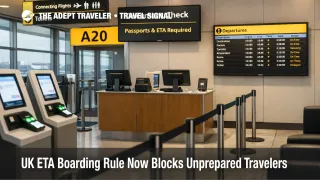
The UK ETA boarding requirement became a hard pre departure checkpoint on February 25, 2026, and that changes where trips fail. The main pressure point is no longer the UK border alone, it is airline check in and boarding. Eligible visa free visitors who show up without an Electronic Travel Authorisation now risk being stopped before departure, missing the flight they already paid for, and absorbing same day rebooking and hotel costs that are harder to recover later. For travelers heading to the United Kingdom in the next few weeks, the smart move is to treat ETA approval as part of ticketing, not as a last minute admin step.
UK ETA Boarding Requirement: What Changed
The UK government said that from February 25, 2026, non visa nationals covered by the scheme would be barred from entering the country without an ETA, and that airlines would prevent passengers from boarding if they do not have an ETA, an eVisa, or other valid documentation. That is the hardening your scanner note is getting at. Before that date, many travelers and even some advisors still treated the ETA as a policy rolling into place. After that date, it became an enforceable travel permission tied to the boarding process.
The ETA currently costs £16 and is linked digitally to the passport used in the application. It allows multiple journeys to the UK for visits of up to six months at a time, and it remains valid for two years or until the passport expires, whichever comes first. The UK government also says the fee will rise to £20 from April 8, 2026, which creates another practical reason not to delay if a traveler already knows a UK trip is coming.
Operationally, this is a meaningful friction story rather than a niche paperwork change. The first order effect is boarding denial for otherwise ticketed passengers. The second order effect is itinerary damage, missed onward rail tickets, same day hotel changes, and tighter recovery options when the denial happens at the airport instead of days earlier. That is especially true for short breaks, cruise joins, wedding trips, and multi stop Europe itineraries where one missed air segment can break the rest of the booking chain.
Who Needs an ETA Before Travel
The ETA applies to most visitors who do not need a visa for short UK stays, including many travelers from Europe, the United States, Canada, and Australia. GOV.UK says most visitors to the UK now need either an ETA or a visa, depending on nationality and purpose of travel. British and Irish citizens do not need an ETA, and people who already have permission to live, work, or study in the UK also fall outside the normal ETA requirement.
Each traveler needs their own ETA, including children and babies. That matters for families, because one missing approval can stop the whole booking from working smoothly. Travelers also need to use the same passport for travel that they used when applying, since the ETA is linked to that document. A renewed passport or a mistaken assumption about dual nationality can create last minute disruption even when the traveler believes they are already cleared.
There are a few edge cases travelers should not gloss over. Eligible passengers making a connection through the UK and passing through passport control need an ETA. By contrast, the Home Office says passengers transiting through Heathrow or Manchester without passing through UK passport control do not currently need one. The Common Travel Area also complicates things at the margins, because some legal residents of Ireland from visa free nationalities may not need an ETA for travel within that area if they can show proof of legal residency. Those are exceptions, not the default. Most short stay leisure and business visitors should assume they need to verify eligibility before booking or at least before online check in opens.
What Travelers Should Do Before Departure
Travelers should apply through the official GOV.UK pathway or the UK ETA app as soon as travel plans are firm. The Home Office says most applicants currently get an automatic decision in minutes, but it still recommends applying at least three working days before travel because some cases need further review. That official advice is the minimum buffer, not the ideal one. For real world trip protection, applying one to two weeks before departure is the safer booking rhythm, especially for families, group trips, expensive nonrefundable stays, or any itinerary with a same day connection.
The main decision threshold is simple. Do not rely on same day approval if the trip has any meaningful downstream commitments. Waiting may work for a low stakes city break with flexible inventory, but it is the wrong gamble for cruises, tours, event travel, or itineraries where the first missed flight turns into a cascade of penalties. Travelers who have already booked should verify the ETA status against the exact passport they plan to use, and dual British citizens should travel on a valid British passport or the right status documentation rather than assuming another passport will be enough.
The next point to monitor is not just approval speed, but fee and enforcement drift. The fee increase to £20 on April 8, 2026 is already published, and carrier checks are now part of the travel system. That means travelers should expect stricter document screening at check in, not looser treatment as the policy matures. In practice, the cheapest mistake is applying early. The expensive mistake is discovering the rule at the airport.
Why the UK Is Enforcing ETA at Boarding
The UK has been rolling ETA out in stages since 2023, but February 25, 2026 was the point where the government said the requirement was now being enforced universally for eligible non visa national visitors. Parliament's written statement makes the mechanism clear, carriers are required to check that passengers hold the right permission before travel, and they may face penalties if they carry someone who does not. That is why this is no longer a soft border rule. Airlines have their own operational reason to stop passengers before wheels up.
For travelers, that enforcement model shifts risk forward in the journey. Problems now surface at online check in, airport counters, and boarding gates rather than being left entirely to UK border officers on arrival. That is more efficient for the UK system, but it is harsher on unprepared passengers because the failure happens before the trip starts, when rebooking options are often expensive and same day alternatives are limited. It also means travel sellers and advisors who lag on the rule can directly expose clients to avoidable loss.
What happens next is less about whether the UK will soften and more about whether traveler awareness catches up. The policy is in force, the boarding check is live, and the published fee is rising again in April. Travelers who still think ETA is something they can sort out on arrival are now operating on the wrong assumption. The safer pattern is to treat UK travel permission the same way travelers already treat ESTA style approvals elsewhere, as a pre departure requirement that should be cleared well before the airport day.