

Venice Daytripper Fee Widens for Spring 2026
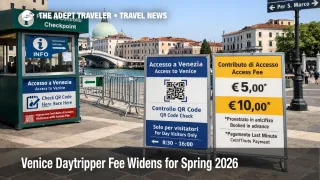
Venice is bringing back its day visitor access system for a wider stretch of spring and early summer in 2026, and the real traveler consequence is timing, not just price. The city will require daytrippers to register and, unless exempt, pay on 60 dates between April 3 and July 26, 2026, mostly from Friday to Sunday, with checks tied to a QR code and peak-hour enforcement from 830 a.m. to 400 p.m. That is an expansion from 54 charge days in 2025, even though Venice's own experiment has so far trimmed peak-day pressure only modestly rather than transforming it. For travelers, the practical takeaway is simple: same-day Venice visits now need to be treated like a timed-access destination on many peak weekends, while overnight guests still need exemption paperwork even when they do not owe the fee.
Venice Daytripper Fee: What Changed
The 2026 calendar runs across selected dates in April, May, June, and July, beginning Friday, April 3, and ending Sunday, July 26. The city's official access-fee platform says the charge applies only during the 830 a.m. to 400 p.m. window on those dates, and the booking system keeps the two-tier price used in the latest model: €5.00 (EUR), about $5.40 (USD), when registered by the fourth day before arrival, and €10.00 (EUR), about $10.80 (USD), when booked within the final three days. Venice is not just keeping the fee, it is widening the number of operating days after 2025 results showed more than 723,000 paid entries and more than €5.4 million in revenue.
That makes this less of a novelty rule and more of a recurring access-control season. Travelers arriving by train for a quick day in the historic center, cruise passengers trying to maximize a port call, and mainland visitors planning a spontaneous Saturday are the most exposed. The system does not target overnight guests in the municipality, but it still requires them to hold an exemption QR code linked to their lodging status. Venice's official FAQ says hotel and other accommodation guests do not pay the access fee because they already pay the tourist tax, yet they still need the exemption process completed for the days covered by the rule.
Who Needs To Act Before Travel
The most important distinction is not tourist versus non-tourist. It is daytripper versus overnight guest inside the Municipality of Venice. If a traveler is entering the historic center for the day without sleeping in Venice municipality accommodation, the fee generally applies on active dates unless another exemption covers them. If a traveler is staying overnight in a hotel, B&B, guesthouse, or short-term rental within the municipality, the payment is waived, but the exemption documentation is still required.
The exemption universe is broad, but that does not mean travelers should assume they are covered. Official materials list residents of Venice, people born in the municipality, Veneto residents, children under 14, certain students and workers, and several other categories among those excluded or exempt, with some groups able to rely on ID alone and others required to request a formal exemption voucher. That distinction matters at the checkpoint stage, because enforcement is document-based, not assumption-based.
Venice says spot checks take place at main entry points, and the system is built around showing a valid payment voucher or exemption QR code when asked. The official FAQ currently says failure to present proof of payment or proof of exemption can trigger an administrative fine ranging from €25.00 to €150.00 (EUR), while city communications tied to enforcement have also described a broader penalty range of €50.00 to €300.00 (EUR) plus the owed access charge. The safest reading for travelers is that skipping registration is a bad bet, because the city is actively enforcing the system rather than treating it as symbolic.
What Travelers Should Do Before Departure
Day visitors should decide early whether Venice is a fixed-date stop or a flexible one. If the trip is locked in, book the access fee or secure the exemption QR code well before the four-day threshold to avoid paying the higher late-booking rate. If the itinerary is flexible, shifting a visit outside the fee window, either to a non-charge day or to hours after 4:00 p.m., can reduce friction and lower the chance of arriving into Venice at one of its most crowded operating periods.
Overnight guests should not treat the hotel booking itself as enough. Venice's official guidance says accommodation guests need the exemption voucher process tied to their stay, and travelers should confirm that with the property before arrival rather than assuming the front desk will sort it out after check-in. That matters most for rail arrivals at Venezia Santa Lucia and other high-flow entry points where checks can happen before a traveler has settled in.
The next decision point is crowd strategy, not fee strategy. If Venice continues expanding paid-access dates while peak-day volumes remain high, the fee will function more as a crowd-management and data-gathering filter than as a hard brake on overtourism. Travelers who care most about ease of movement should prioritize shoulder-day visits, early evening arrivals, or overnight stays that spread time in the city beyond the 830 a.m. to 400 p.m. pressure window. That is the practical lesson from the Venice daytripper fee so far: pay attention to access timing, not just the €5 versus €10 headline.
Why Venice Is Expanding the Rule Anyway
Venice is extending the experiment because the city is trying to manage concentrated day-visitor surges in a place with very limited physical slack. Narrow pedestrian corridors, waterbus crowding, station choke points, and high-volume weekend arrivals all create stress long before a headline number captures it. City officials present the fee as a tool to spread demand and protect livability, while critics argue the numbers still show only limited change in the highest-pressure patterns. Both can be true at once: the system can improve registration, visibility, and enforcement without yet solving overtourism on its own.
That is what makes 2026 operationally significant. Venice is not backing away after one or two pilot seasons. It is normalizing a broader seasonal control regime for day visitors. In an earlier Adept Traveler article, Venice daytripper fee returns for 2026 outlined the initial 2026 framework. The new traveler read is sharper now that the portal is live and the dates are in force: if a spring or early summer Venice stop is built around a same-day visit, the Venice daytripper fee has become a planning variable, not a footnote. Travelers weighing broader crowd pressure across southern Europe may also find useful context in Overtourism 2025: Europe's Hotspots Impose New Rules.