

Austin Festival Traffic Hits Airport, Downtown Trips
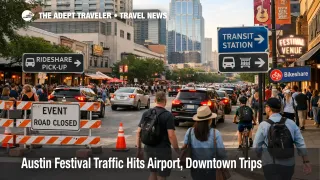
Austin festival traffic is back in a higher risk pattern for travelers because city officials are warning that 2026 spring event crowds will be larger and more dispersed across downtown Austin, not concentrated in one core zone. The City of Austin is pushing visitors to its official mobility guide for street closures, rideshare loading areas, transit stations, and bike routes, while SXSW's own 2026 planning points to a downtown footprint spread into multiple neighborhood style hubs during the Austin Convention Center redevelopment. That changes the problem for travelers staying downtown, landing at Austin Bergstrom International Airport (AUS), or moving between hotels, meetings, and event venues on the same day. Travelers should build more transfer buffer, avoid car dependent venue hopping when possible, and default to walking or transit for short downtown moves.
Austin Festival Traffic Is Spreading Across Downtown
The immediate change is not simply that Austin is busy. It is that city officials are explicitly expecting "larger, more dispersed crowds" throughout downtown and are telling visitors to use an interactive mobility guide that maps street closures, rideshare staging areas, loading zones, public transit routes, and bicycle routes. The spring festival season began with SXSW on March 12, 2026, and the city says the broader season runs through early May, which extends the period when downtown access can stay less predictable than normal.
The spread matters because downtown Austin works differently when festival traffic is pushed across more blocks and more venue clusters. SXSW has already said its 2026 format is spilling into "mini, badge specific neighborhoods" as the convention center undergoes redevelopment. In practice, that means travelers are more likely to face rolling slowdowns across the central business district instead of one obvious choke point to avoid.
The most exposed areas are the downtown entertainment and venue districts named by Austin Travis County EMS, including Sixth Street, the Warehouse District, Rainey Street, and East Austin. Those are exactly the kinds of zones that can turn a simple hotel to venue trip into a curb access problem, especially when road closures, permit parking enforcement, and heavy pedestrian movement stack together in the same few hours.
Which Travelers Face The Most Austin Festival Traffic Risk
The biggest exposure is for three groups. First, airport to downtown arrivals with tight schedules are vulnerable because festival demand can hit both the road trip from AUS and the final curbside approach to hotels or venues. Second, convention, corporate, and group travelers moving between multiple downtown appointments face a higher chance of late arrivals because the city expects people to be walking, biking, and using other mobility devices in places drivers may not expect this year. Third, travelers staying outside downtown but attending events inside the core face the highest parking and pickup friction, since both the city and SXSW warn of heavy traffic, limited parking in some areas, and widespread closures.
For airport connected trips, the safest default is often transit rather than rideshare during peak festival windows. CapMetro says Route 20 and Route 483 serve the airport, with Route 20 running every 15 to 30 minutes, a $1.25 single fare, and about a 35 minute ride to downtown, while also avoiding the long walk to rideshare pickup and any surge pricing. Route 20 also directly serves downtown destinations such as Republic Square and City Hall, which gives travelers a cleaner backup option when curbside demand spikes.
Walking can beat driving once travelers are already in the core. That is especially true when events are spread across nearby hotels, clubhouses, and entertainment districts rather than concentrated in a single convention building. The tradeoff is that travelers need to treat downtown as a pedestrian heavy environment, not assume door to door car access will remain efficient all day.
What Travelers Should Do Now
Travelers flying into AUS for downtown stays should avoid planning a zero buffer airport arrival. AUS itself recommends arriving 2.5 hours before domestic flights and 3 hours before international flights during this period, and the city says parking and traffic controls will be active across downtown. For inbound trips, that means building extra time between landing and any first fixed appointment. For outbound trips, it means leaving downtown earlier than usual if your route depends on rideshare pickup, checked baggage, or multiple handoffs.
For airport to downtown transfers, use Route 20 when cost control and predictability matter more than direct door to door service. Use rideshare when luggage, accessibility, or off corridor lodging makes transit impractical, but expect pickup friction and higher pricing during the busiest windows. Once downtown, walking, bikeshare, and transit are usually the better play for short movements between venues. SXSW also warns that cabs are in high demand and that drivers should expect weekday peak delays from 700 a.m. to 900 a.m. and 430 p.m. to 700 p.m.
Travelers should abandon same hour handoffs when a trip depends on airport arrival, hotel check in, and a timed downtown appearance in one chain. The better threshold is simple, if one late pickup or one closure would break the day, switch to transit, move the meeting, or arrive the night before. Monitor the city mobility guide, CapMetro trip tools, and venue specific updates through the next 24 to 72 hours before any fixed downtown commitment.
Why Austin's 2026 Festival Pattern Is Different
The mechanism behind this year's mobility strain is structural, not just seasonal. Austin officials say the convention center redevelopment is helping push SXSW activity into a more dispersed downtown pattern, and SXSW itself has described the 2026 event as spreading into mini neighborhoods across the city core. That shifts congestion away from one central venue and into a wider street grid, which increases the odds that hotel access, rideshare routing, and short cross downtown hops all become slower at the same time.
The next operational question is whether travelers adapt early enough to keep downtown trips functional. Austin is already steering visitors toward walking, public transit, and CapMetro Bikeshare, and CapMetro has promoted airport and downtown transit links for festival travel. If that mode shift holds, the city can absorb more demand. If not, the likely result is more curbside congestion, more expensive airport pickups, and more missed timings for meetings, check ins, and event entry across the downtown core.