

EU Entry Exit System Goes Fully Live on April 10
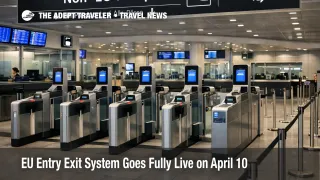
Europe's EU Entry Exit System reaches its hard operational deadline on April 10, 2026, when the European Commission says the rollout becomes fully operational across all participating external border crossing points. For short stay non EU travelers, that means the old pattern of manual passport stamping gives way to digital entry and exit records tied to biometric checks, including a facial image and fingerprints. The shift is bigger than a paperwork tweak. It changes the border processing model at airports, seaports, and land crossings, and travelers with tight layovers, same day transfers, or coach and ferry connections should build more buffer into April trips.
EU Entry Exit System: What Changes on April 10
The official EU position is now clear. The Entry Exit System, or EES, began a six month progressive rollout on October 12, 2025, and becomes fully operational on April 10, 2026. From that point, the system is meant to be in use at all external border crossing points in the 29 participating European countries, replacing manual passport stamping for eligible short stay non EU travelers.
For travelers, the practical change is that border records become digital by default. The system stores passport data, the date and place of each entry and exit, biometric data such as a facial image and fingerprints, and any refusal of entry. The EU says first time travelers after implementation will provide personal data, fingerprints, and a face image, while travelers already recorded in the system will usually go through verification rather than a full fresh enrollment, though data may sometimes need to be collected again.
This is also the point where many travelers may confuse EES with ETIAS. They are not the same system. EES is the border registration system going fully live on April 10, 2026. ETIAS, the separate pre travel authorization for many visa exempt travelers, is still scheduled to start later, in the last quarter of 2026, and the EU says no action is required for ETIAS yet.
Which Travelers and Border Crossings Face the Most Friction
The system applies to non EU nationals making short stays of up to 90 days within any 180 day period when they cross the external borders of the participating countries. EU explanations say that includes the Schengen area states using the system, with Ireland and Cyprus outside it, plus Iceland, Liechtenstein, Norway, and Switzerland. In practice, the biggest traveler pressure points are likely to be first entry into the area, not every movement inside it. A U.S. traveler flying nonstop from the United States into Germany, France, Spain, or Italy will face the new process at that first external border. A traveler connecting into the Schengen area through another participating country faces it at the first point of entry there instead.
The first order effect is more consistent biometric processing. The second order effect is queue volatility, especially where immigration, airline document checks, and ground transport timing all stack together. Airports with large long haul arrivals, ferry ports handling non EU arrivals, and land borders used by coach tours or self drive itineraries are the places where early friction can hurt the rest of the day's itinerary fastest. Even if the system is designed to reduce waiting times over time, the EU's own phased rollout language makes clear that April 10 marks the end of a transition period, not the end of adaptation pressure for border authorities, carriers, and travelers.
The travelers least exposed are those who remain in the international transit area without entering the participating countries, because they are not registered in EES in that scenario. Travelers with generous arrival buffers, overnight airport hotels, or flexible onward transport are also better positioned than those trying to clear border control and make a short rail, coach, cruise, or regional flight connection on the same day.
What Travelers Should Do Before April Travel
Travelers arriving from outside the participating area in April should plan for slower first touch border processing, even where the airport itself is running normally. The smart adjustment is not panic, it is time. Leave more room between scheduled arrival and the next locked commitment, especially on the first day of the trip. That means more conservative layovers on separate tickets, extra time before cruise embarkation or escorted coach departures, and less confidence in tight airport to rail handoffs.
The main decision threshold is whether your itinerary depends on a narrow post arrival sequence. If you need to clear immigration, collect bags, recheck luggage, and catch a separate onward flight or train, the safer move is to widen that connection or shift the onward leg to later the same day. If you are arriving into a major gateway and heading straight to a hotel, the system change is more likely to be an inconvenience than a trip breaker.
What to monitor next is not just whether EES is live, because that part is settled, but how individual crossing points handle the first full operational days. Travelers should watch carrier check in guidance, airport notices, and border authority messaging at their actual point of arrival. The likely pattern is uneven friction rather than a uniform continent wide slowdown. Some airports and ports will absorb the change cleanly. Others will run slower when several long haul arrivals bunch together.
Why the Deadline Matters, and What Happens Next
What makes April 10 important is that Europe has moved from a staggered introduction to a fixed system wide operating point. During the rollout, not all crossings and not all travelers were necessarily processed through EES, and passport stamping continued alongside the new system. After full implementation, the digital system becomes the standard border record for eligible travelers.
The EU argues that EES improves border security, helps identify overstayers, and makes identity fraud easier to detect through biometric matching. The Commission says the system has already logged more than 45 million border crossings since rollout began, recorded more than 24,000 refusals of entry, and helped identify people presenting security risks or using different identities. Those are policy benefits for governments. For travelers, the operational reality is a tradeoff, more data collection and a more structured border process now, in exchange for a system the EU says should become faster and more accurate once border staff and travelers fully adjust.
The next major step after EES is ETIAS later in 2026, but travelers should not merge those deadlines. April travel is about border processing and biometrics at the crossing itself, not about completing a new online authorization before departure. The main practical takeaway is simple, Europe's digital border regime is no longer theoretical. On and after April 10, 2026, travelers entering the participating area from outside it should expect the new process to be the default and should plan their arrival day accordingly.