

Greek Ferry Cancellations Hit Island Hops Again
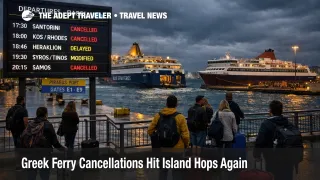
Greek ferry cancellations are back in the decision mix for spring Greece trips, and the timing is awkward for travelers building same day island transfers through Athens and Piraeus. Ferryhopper's disruptions board flagged Olympian Ferries as having suspended itineraries and listed Blue Star Chios trip cancellations for March 30 and March 31, while Blue Star Ferries' March 31 weather bulletin showed wider bad weather schedule changes across multiple Aegean services. For travelers, this is more than a nuisance. In shoulder season, one missed ferry can break an entire island circuit, force an unplanned mainland overnight, or wipe out the buffer between an airport arrival and a port departure.
Greek Ferry Cancellations: What Changed
The immediate change is that ferry reliability weakened again at the sea transport layer just as spring island demand is building. Ferryhopper's live alerts page listed Olympian Ferries as operating under suspended itineraries and separately flagged Blue Star Chios trip cancellations on March 30 and March 31. Blue Star Ferries then updated its official bad weather bulletin at 5:00 p.m. local posting time on March 31, showing continued weather related itinerary changes through April 2 on several routes.
For Blue Star, the operational problem is broader than a single ship headline. The carrier's March 31 bulletin canceled Blue Star Paros's March 31 Piraeus to Patmos, Lipsi, Leros, Kalymnos, Kos, Symi, and Rhodes sailing, and it published a modified Blue Star Chios rotation across March 29 to March 31 covering Piraeus, Santorini, Anafi, Heraklion, Sitia, Kasos, Pigadia, Diafani, Chalki, and Rhodes. Blue Star's standard disruption language says ticket changes are required when a sailing is canceled and directs passengers to the agency that issued the booking, or to the operator directly for web, app, or call center reservations.
The Olympian Ferries signal is less transparent. Ferryhopper is showing suspended itineraries, but a current route by route English language notice was not readily visible on the operator's public site at publication time. That matters because uncertainty at a smaller ferry operator can be as disruptive as a formal cancellation when travelers are trying to decide whether to leave an airport hotel, head for the port, or rebook a hotel on an island that may no longer be reachable that day.
Which Island Itineraries Are Most Exposed
The most exposed travelers are not just people already on a ferry booking. They are passengers trying to stitch together flights, ferries, hotels, and timed check ins into a same day chain. That includes international arrivals landing in Athens, Greece, and moving straight to Port of Piraeus, travelers changing islands on a one night stop, and anyone relying on one of the longer Aegean routes that touches several islands before reaching the final destination.
Blue Star Chios is a good example of why the risk spreads. The vessel serves a long multi stop route and carries up to 1,782 passengers, so a cancellation or major modification does not stay contained to one pier or one island. It can delay hotel arrivals, compress onward availability on a later sailing, and reduce slack for passengers who thought they had enough time between an inbound flight and a ferry departure.
Spring makes that fragility worse. Summer frequency can sometimes hide a bad day by offering another departure later on the same route or the next morning. Shoulder season often does not. When one sailing drops out, travelers can be pushed into a mainland overnight, a port switch, or a route redesign through a different island entirely. The main pressure point shifts from ferry time itself to the handoff between airport, port, and hotel. That is where missed connections become expensive.
What Travelers Should Do Before the Port Transfer
Travelers with a March 31 to April 2 movement window should stop treating airport to ferry transfers as routine. If your ferry is the same day as an international arrival, the safer play is to check the operator's latest notice before leaving the airport, not just the original ticket confirmation. A booking that still exists in your inbox may already be under a modified sailing pattern or require a ticket change to travel.
Rebook early if your plan depends on a single daily ferry, a non refundable island hotel, or a late day arrival where a missed sailing would strand you on the mainland. Waiting can still work for travelers with flexible lodging, open ended stays in Athens, or an island with multiple carriers and frequencies. The wrong place to wait is in transit between the airport and the port, because that is when your alternatives get narrower and more expensive.
Refund and rebooking mechanics also matter here. Blue Star's disruption notices repeatedly state that canceled sailings require ticket changes and direct passengers back to the booking channel that issued the ticket. That means travelers who booked through an intermediary should confirm who controls the change first, instead of assuming the port counter can fix everything on departure day. Once Greek ferry cancellations start cascading through the schedule, the practical threshold is simple, abandon same day transfer plans when a single missed sailing would force you to lose both the island overnight and the next morning's onward movement.
Why the Ferry Layer Is Fragile in Spring
The mechanism is weather, then network design. The Hellenic National Meteorological Service marine bulletin carried gale warnings on March 31 and warned of locally gale force winds across parts of the Aegean in the next 12 hours, with gusts potentially much stronger than the baseline forecast. That kind of marine setup does not just slow ferries down. It can force cancellations, route modifications, and selective port omissions, especially on multi stop services where one change at sea ripples across the entire timetable.
That is why sea disruption in Greece spreads so quickly through the rest of a trip. First order, the sailing is canceled or modified. Second order, airport arrivals miss the port window, hotels hold rooms for late arrivals who never show, and island hopping plans lose the sequence that made them work in the first place. What happens next depends on whether the weather window improves and whether operators restore normal rotations quickly on April 1 and April 2. Until that becomes clearer, Greek ferry cancellations should be treated as an itinerary design problem, not just a transport delay.