

Qantas Learmonth Waiver Extends to April 13
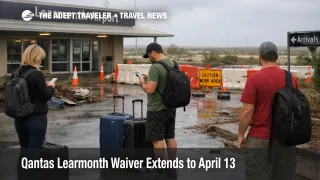
The Qantas Learmonth waiver now runs deeper into April, which gives Exmouth and Ningaloo travelers a wider commercial escape hatch while the destination is still recovering from Cyclone Narelle. On March 31, 2026, Qantas updated its travel policy for Learmonth-bound passengers to cover travel through April 13, 2026, for tickets issued on or before March 30, 2026. That does not mean the destination is fully back. It means travelers with flights, hotels, tours, and self-drive plans now have a clearer point at which to rebook, cancel, or hold, before more non-air costs start locking in.
Qantas Learmonth Waiver: What Changed
Qantas now says customers traveling to or from Learmonth on eligible tickets can choose a fee-free refund, a fee-free Flight Credit, or a fee-free date change within seven days of the original travel date, subject to availability and any fare difference. The updated Learmonth policy applies to flights booked on or before March 30, 2026, for travel between March 19 and April 13, 2026. Customers who booked directly with Qantas can make fee-free changes in Manage Booking or the Qantas app, while travelers wanting a refund, or wanting to discuss switching to a flight departing from or arriving into Karratha, are told to contact Qantas directly. Travelers who booked through an agent need to work through that agent.
That is the new commercial detail. In an earlier Adept Traveler article, Learmonth Airport Closure Extends Exmouth Disruption, the main issue was that Learmonth Airport was expected to stay closed to commercial traffic for at least a week after cyclone damage. The update now is not a new closure notice. It is that Qantas has widened the window in which affected customers can act without waiting for the airport, road network, town services, and tourism operations to recover on the same timetable.
Which Exmouth and Ningaloo Trips Are Most Exposed
The most exposed travelers are the ones with stacked bookings and fixed-use dates. That means people flying into Learmonth Airport (LEA) for whale shark season, reef tours, dive trips, resort stays, holiday rentals, or road trips where the first night, rental pickup, and tours were built around a same-day arrival. A wider airfare waiver matters most when the flight is only one part of a larger prepaid itinerary.
First order, the Qantas Learmonth waiver gives those travelers more flexibility on the flight itself. Second order, it changes the timing for other decisions. A traveler who can now delay a flight farther into April may also be able to move a hotel stay, push back a whale shark or reef booking, or scrap the fly-in plan entirely and rebuild around another gateway. That is more useful than waiting for a final all-clear if lodging cancellation deadlines or excursion deposits hit first.
It also matters that Exmouth and the surrounding region are still recovering beyond the airport itself. ABC reported widespread damage in Exmouth after the cyclone, with significant airport damage, more than 2,000 homes still without power across affected areas, and continuing limits on water use in Exmouth and Onslow while infrastructure repairs continue. Water Corporation separately said reduced pressure and repair work were still affecting Exmouth and that Onslow residents were being told to avoid non-essential travel because of water infrastructure damage.
What Travelers Should Do Before Bundled Bookings Lock In
Travelers with eligible Qantas flights should separate the problem into three bookings, the flight, the lodging, and the activities. The flight now has a clearer waiver window through April 13. The hotel and tour layers may not. That means the next smart move is to check every cancellation deadline tied to your Exmouth or Ningaloo stay before relying on the airfare waiver alone.
Rebook early if your trip depends on fixed-date marine tours, nonrefundable accommodation, or a tightly stacked arrival day. The waiver gives you room to pivot, but it does not guarantee that the tourism product you planned to use will be operating normally by the time your new flight date arrives. For some travelers, moving the trip now will protect more money than waiting for airport normality.
Wait only if your accommodation is flexible, your activities can move, and you can tolerate ongoing uncertainty around local services. Qantas is also explicitly allowing customers to discuss changing to Karratha, which remains the clearest published airline-backed alternate gateway for rebuilding a northern Western Australia itinerary. That option is operationally useful for travelers who still need to reach the region, but it also adds long ground transfer logic, rental car risk, and timetable complexity that should be priced in before you commit.
Why the April 13 Window Changes the Next Decision Point
The bigger point is that airline waivers are not just passenger-service gestures. They are also signals about how long a carrier believes disruption risk may remain commercially relevant. Qantas extending the Learmonth window through April 13 suggests the recovery problem is still serious enough that travelers should not assume a quick reset in the next few days, even if local conditions improve unevenly.
That does not prove Learmonth will stay shut until April 13. It does show that Qantas sees enough ongoing uncertainty to keep broader flexibility in place. For travelers, that shifts the next decision point away from "Is the airport still closed today?" and toward "At what point do my hotel, tour, rental car, and time-off costs become harder to recover than the airfare?" In disruption events like this, the airport is only the first bottleneck. Then come roads, water, staffing, local tourism readiness, and the ability of a remote destination to absorb visitors again at normal pace.
The practical takeaway is simple. Use the wider waiver as a chance to make a whole-trip decision, not just a flight decision. Exmouth and Ningaloo travelers now have a longer airline flexibility window, but the value of that window is highest before the rest of the itinerary starts becoming nonrefundable.